Best Ecommerce Accounting Software for 2026
A direct guide to choosing the best ecommerce accounting software, covering platforms, integration requirements, and what a complete accounting stack looks like for online sellers.
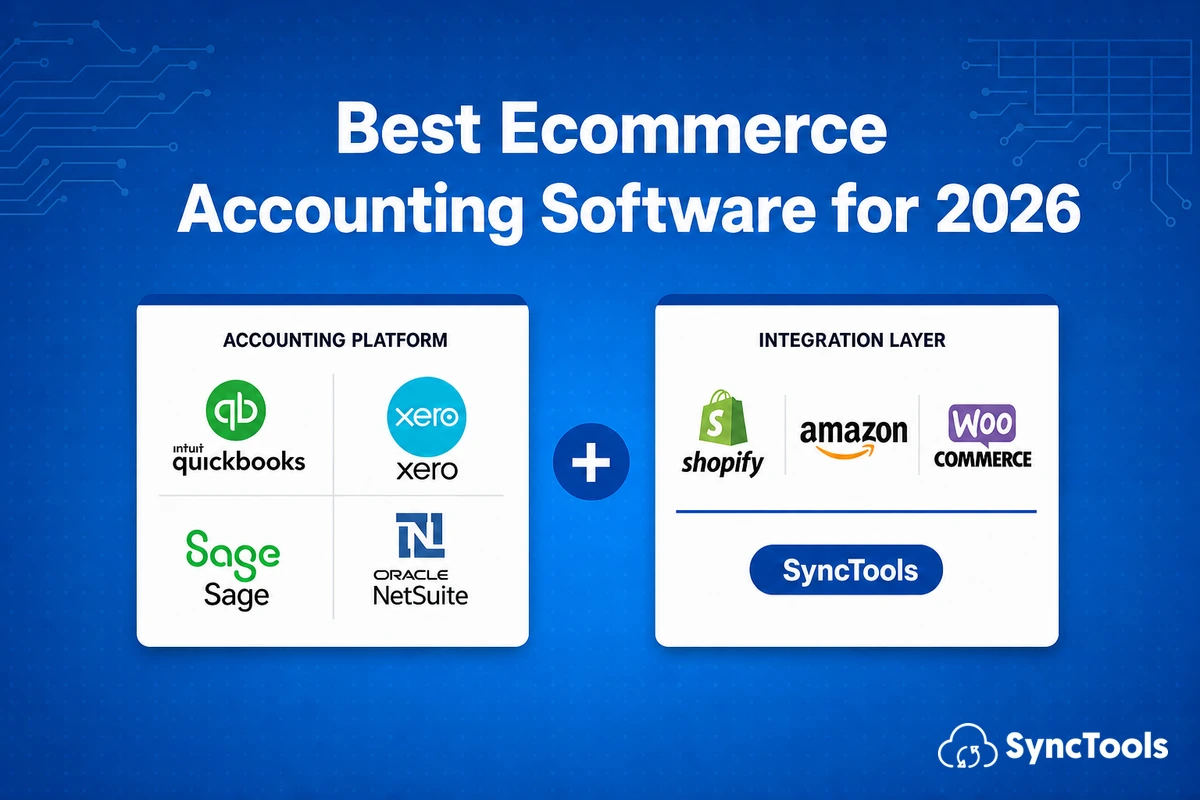
Quick answer: No single product is the "best ecommerce accounting software" in isolation. The right setup combines an accounting platform (QuickBooks Online, Xero, Sage, or NetSuite) with a dedicated ecommerce integration that translates sales channel data into accurate bookkeeping entries. The two work in tandem: accounting platforms manage the ledger; integrations make ecommerce data ledger-ready. This guide covers both layers.
Why Ecommerce Accounting Requires More Than Standard Accounting Software
Off-the-shelf accounting software is built for businesses that issue invoices and receive payments. A reliable accounting system for ecommerce has requirements that those systems don't address natively.
Settlement accounting. Shopify and Amazon don't pay per order; they issue periodic payouts that net revenue, marketplace fees, shipping costs, refunds, and adjustments into a single deposit. Reconciling a payout against the underlying orders requires a calculation step that standard accounting software skips entirely.
Sales tax across jurisdictions. An online retailer selling into multiple US states or countries faces economic nexus obligations in each. The accounting system needs to capture tax data at the point of sale, categorized by jurisdiction, not inferred from bank deposits.
Inventory and COGS. Ecommerce merchants tracking cost of goods sold need consistent inventory valuation. At high order volumes, manual COGS entries aren't feasible; the accounting system or its integration layer must handle them automatically.
Multi-channel complexity. A business selling on Shopify, Amazon, and WooCommerce runs three separate revenue streams with three different fee structures and payout schedules. Each channel needs to reconcile cleanly in the books.
The accounting platforms below handle the ledger. An ecommerce accounting integration handles the translation layer between your sales channels and the ledger. You need both.
The Accounting Platforms
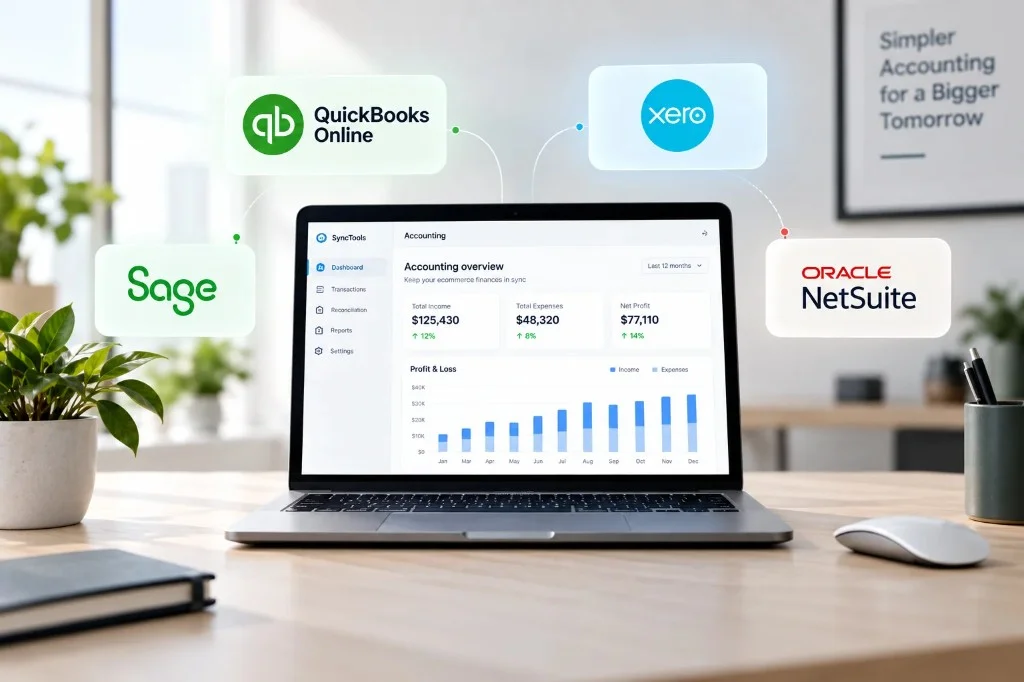
QuickBooks Online
QuickBooks Online is the dominant cloud accounting software for small and mid-market businesses in the United States. Its capabilities include double-entry accounting, accounts receivable and payable, bank reconciliation, payroll, sales tax tracking, and a 750+ app marketplace through the QuickBooks App Store.
Ecommerce assessment. QBO has no native Shopify, Amazon, or WooCommerce connector. It accepts manual journal entries or CSV imports, but neither approach scales past a few hundred orders per month. For ecommerce merchants, QBO functions well as the accounting backend when paired with a dedicated integration that pulls channel data, categorizes it correctly, and posts reconciled entries to QBO rather than raw transaction noise.
QuickBooks Desktop. QuickBooks Desktop (Pro, Premier, Enterprise) remains common in established businesses that haven't migrated to the cloud. Most ecommerce-to-QB integrations target QBO only. If your business or accounting team runs QuickBooks Desktop, verify integration compatibility before committing to any tool.
Best for: US-based merchants seeking software for ecommerce accounting that integrates with Shopify, Amazon, or WooCommerce, backed by a widely understood platform with strong US accountant and bookkeeper support.
Xero
Xero is a cloud accounting platform founded in New Zealand, widely adopted by accounting firms in Australia, the UK, and Canada, with growing adoption in the United States. Its strengths include a clean bank reconciliation workflow, multi-currency support, a large accountant partner network (Xero Gold and Platinum tiers), and 1,000+ integrations through the Xero App Store.
Ecommerce assessment. Like QBO, Xero has no native ecommerce channel connectors. Xero's bank feed imports raw transactions, sufficient for a brick-and-mortar business but insufficient for an ecommerce merchant processing thousands of transactions across multiple platforms. As accounting software with ecommerce integration, Xero performs best when paired with a connector that batches and reconciles channel data before it reaches the Xero ledger.
Best for: Ecommerce merchants with an accounting firm that works in the Xero ecosystem, UK/AU/EU sellers with VAT requirements, or businesses where multi-currency support is a primary requirement.
Sage Business Cloud Accounting
Sage is an established accounting software provider with products spanning small business to enterprise. Sage Business Cloud Accounting (formerly Sage One) is its cloud offering for smaller businesses; Sage 50cloud and Sage Intacct serve the mid-market and enterprise.
Ecommerce assessment. Sage's accounting software ecommerce integration ecosystem is smaller than QBO's or Xero's. Its app marketplace is growing, but fewer native connectors exist for Shopify, Amazon, or WooCommerce. Merchants choosing Sage should verify that an integration supporting their specific channel mix is available before committing to the platform.
Best for: UK and European businesses where Sage has strong accountant adoption, or businesses already in the Sage ecosystem that need it as accounting software for online retail business.
Oracle NetSuite
NetSuite is a cloud ERP platform that combines accounting, inventory management, CRM, and order management in one system. It is positioned for businesses that have outgrown what QBO or Xero can handle.
Ecommerce assessment. NetSuite's SuiteCommerce module provides native ecommerce order management and inventory tracking. For businesses using third-party channels (Shopify, Amazon), NetSuite still requires integration, but the integration ecosystem is mature. The tradeoff: NetSuite's implementation and licensing costs are substantially higher than QBO or Xero. Implementation typically requires a specialist partner and takes months, not days.
Best for: Mid-market to enterprise ecommerce businesses with complex inventory requirements, multi-subsidiary structures, or a need to consolidate ERP and accounting functions.
Platform Comparison
| Factor | QuickBooks Online | Xero | Sage Business Cloud | NetSuite |
|---|---|---|---|---|
| US market / sales tax | Strong | Adequate | Limited | Strong |
| UK / AU / VAT support | Adequate | Strong | Strong | Strong |
| Accountant ecosystem | Largest (US) | Large (AU/UK/CA) | Established (UK) | Enterprise |
| Native ecommerce connectors | None | None | None | Partial |
| QuickBooks Desktop migration path | Direct | No | No | No |
| Scale ceiling | ~$10M revenue | ~$10M revenue | ~$10M revenue | No ceiling |
What Ecommerce Accounting Integration Does
The accounting platforms above manage the ledger. What they don't do is convert raw ecommerce data (Shopify payout reports, Amazon settlement files, WooCommerce order exports) into proper double-entry accounting entries. That is the function of accounting software for e-commerce integration, also called ecommerce accounting integration software.
A capable ecommerce accounting integration:
- Connects to your sales channels (Shopify, Amazon Seller Central, WooCommerce, Linnworks, and others) and pulls transaction data automatically on a defined schedule.
- Categorizes revenue, fees, refunds, and adjustments into the correct chart-of-accounts categories without manual intervention.
- Handles settlement timing: mapping each payout deposit in your bank feed to the orders, fees, and adjustments it comprises.
- Manages tax data: passing sales tax amounts at the correct jurisdiction level to your accounting platform, not as a single undifferentiated tax line.
- Reconciles: your books balance to the penny against actual payments received.
Without this layer, ecommerce merchants reconciling manually at high order volume are typically running one to two months behind. Beyond a few hundred orders per month, manual reconciliation introduces errors that compound at month-end close.
SyncTools
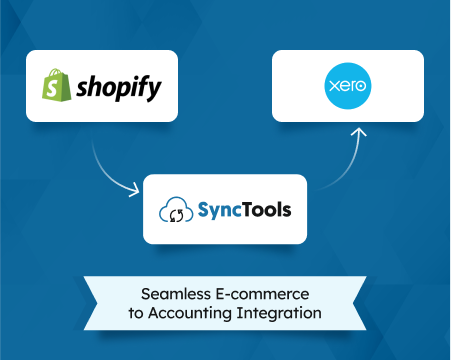
SyncTools is an ecommerce accounting integration that connects Shopify, Amazon, WooCommerce, and Linnworks to QuickBooks Online, QuickBooks Desktop, Xero, Sage, and NetSuite.
Ecommerce assessment. SyncTools handles settlement-level reconciliation, mapping each payout to its constituent orders, fees, and adjustments rather than posting a gross revenue figure. It supports QuickBooks Desktop in addition to QBO, which most competing integrations do not. Transaction categorization uses automated matching with exception handling for transactions that don't reconcile automatically. SyncTools holds certified status with QuickBooks and Xero and has a Catalyst Partnership with Linnworks.
SyncTools is listed on the Shopify App Store, QuickBooks App Store, Xero App Store, and Linnworks App Store.
Best for: Merchants needing QuickBooks Desktop support, Linnworks users, or businesses managing multi-channel sales across Shopify, Amazon, and WooCommerce.
How to Choose the Best Accounting Software for Ecommerce
Choosing the right platform involves two decisions: accounting software and integration. The right combination depends on your channel mix, your accountant's existing platform, and your order volume.
Choose your accounting platform based on:
- Where your accountant or bookkeeper works (QBO for US-based; Xero for AU/UK/CA)
- Tax requirements (VAT: Xero or Sage; US sales tax: QBO or NetSuite)
- Whether you're on QuickBooks Desktop (if so, confirm your integration supports it)
- Revenue scale (QBO/Xero handle most businesses under $10M revenue; NetSuite for enterprise)
Choose your integration based on:
- Channel coverage: confirm support for all your selling channels, not just the primary one
- Accounting platform support: most integrations support QBO and Xero; fewer support Sage, NetSuite, or QuickBooks Desktop
- Reconciliation depth: does it reconcile at the order level or post summary journal entries? Summary entries are faster to configure but harder to audit and reconcile against bank statements
- Tax handling: does it pass per-jurisdiction tax amounts or aggregate them?
- Exception handling: what happens to transactions that don't match automatically? The quality of exception management determines how much manual review time the integration saves
FAQ
What is the best accounting software for an ecommerce business?
For most small to mid-market ecommerce businesses, the right choice is QuickBooks Online or Xero paired with a dedicated ecommerce accounting integration. QBO is the default for US-based merchants; Xero is preferred by accounting firms in Australia, the UK, and Canada. Use the platform your accountant works in, combined with an integration that supports your channels. Neither platform connects natively to Shopify, Amazon, or WooCommerce, so an integration is required to translate channel data into accounting entries the platform can use.
Do I need separate ecommerce accounting software and a general accounting platform?
For most ecommerce merchants, yes. General accounting platforms (QBO, Xero, Sage) manage the ledger but lack native connectors to Shopify, Amazon, or WooCommerce. Ecommerce accounting integration software bridges that gap by pulling channel data and converting it into properly categorized ledger entries. Running both is standard practice for any merchant processing more than a few hundred orders per month.
What is the difference between ecommerce accounting software and an ERP?
Accounting software manages the financial ledger: revenue, expenses, bank reconciliation, and reporting. An ERP (such as NetSuite) adds inventory management, order management, and operational functions in one system. Most small and mid-market ecommerce businesses start with an accounting platform plus integrations; ERPs make financial sense when the overhead of maintaining multiple disconnected systems exceeds the cost of a consolidated platform.
Can QuickBooks Online handle ecommerce accounting?
QuickBooks Online handles ecommerce accounting when paired with an integration that connects your sales channels to QBO. QBO alone (relying on manual entry or CSV imports) doesn't scale past a few hundred orders per month. With a proper integration handling settlement reconciliation and transaction categorization, QBO works well for high-volume ecommerce merchants.
Can Xero handle ecommerce accounting?
Xero works well as the accounting backend for ecommerce when paired with an integration. Its bank feed imports raw transactions, but ecommerce merchants need categorized, reconciled entries, not raw bank data. Xero's multi-currency support and accountant network make it the most practical choice for UK, Australian, and international sellers.
What accounting software do Shopify sellers use?
Shopify merchants most commonly use QuickBooks Online or Xero for bookkeeping. UK-based Shopify merchants frequently choose Xero for its VAT handling; US-based merchants tend toward QBO for its larger accountant community and US sales tax tools. Both require a dedicated integration to sync Shopify sales data into the accounting platform accurately.
How does ecommerce accounting software handle Amazon FBA?
Amazon FBA accounting is complex because Amazon pays via bi-monthly settlement reports that net sales, marketplace fees, FBA fulfillment costs, refunds, storage charges, and other adjustments into a single deposit. Proper ecommerce accounting integration breaks each settlement into its components: recognizing revenue separately from fees, mapping each line to the correct chart-of-accounts category, and reconciling the net deposit against the constituent transactions. Posting the gross payout as revenue overstates income and creates reconciliation problems that compound over time.
What is the best bookkeeping software for ecommerce?
QuickBooks Online Simple Start or Xero Starter combined with a low-cost ecommerce integration is the standard starting point. Both platforms handle the ledger accurately at scale when the integration is correctly configured. The integration layer matters more than the platform tier as order volume grows; prioritize one that handles your channel mix accurately. QBO Simple Start is the standard US starting point for small businesses.
Do I need an accountant if I use ecommerce accounting software?
Ecommerce accounting software and integrations automate transaction categorization and reconciliation, but they don't replace the judgment an accountant provides on tax elections, inventory valuation methods, depreciation, entity structure, and financial planning. Most ecommerce merchants benefit from a bookkeeper managing day-to-day entries and an accountant reviewing month-end and handling tax filing.
What should ecommerce accounting software handle automatically?
At minimum: channel transaction import, settlement reconciliation (mapping each deposit to the underlying orders and fees it represents), sales tax capture by jurisdiction, refund accounting, and standard financial report generation. More capable integrations also handle COGS recognition, multi-currency conversion at correct exchange rates, and exception flagging for transactions that don't reconcile automatically.
What is the best online accounting software for ecommerce?
QuickBooks Online is the standard choice for US-based merchants; Xero for UK, Australian, and Canadian sellers. Both are cloud platforms with mature integration ecosystems. Either performs accurately only when paired with a dedicated integration handling settlement reconciliation, fee categorization, and multi-channel data.
How do I choose between ecommerce accounting integrations?
Start with channel coverage: the integration must support all the platforms you sell on, not just your primary one. Then evaluate: reconciliation depth (order-level vs. summary journal entries), accounting platform support (especially relevant if you're on QuickBooks Desktop or Sage), per-jurisdiction tax handling, pricing relative to your order volume, and the quality of exception handling for transactions that don't match automatically. The last point, exception handling, is the primary driver of ongoing manual review time.
SyncTools connects Shopify, Amazon, WooCommerce, and Linnworks with QuickBooks, Xero, Sage, and NetSuite. Listed on the Shopify App Store, QuickBooks App Store, Xero App Store, and Linnworks App Store.
Ready to automate your accounting?
Connect Shopify, WooCommerce, or Linnworks to QuickBooks, Xero & more. Setup in minutes.