Fashion Ecommerce Inventory Accounting: Size, Color & SKU Complexity Explained
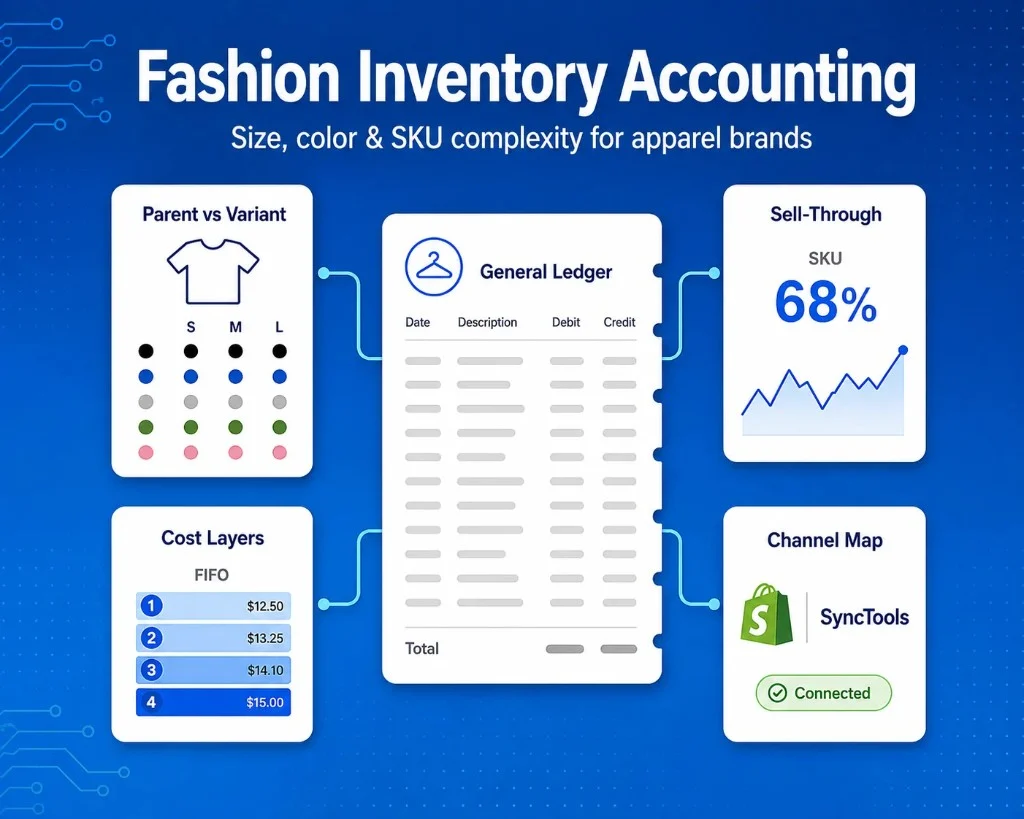
The accounting problem in fashion ecommerce isn't that your financial statements don't show every size and color separately. It's that your underlying inventory data needs to know those variants exist.
A single fashion style in five colors and six sizes creates 30 sellable variants. Each variant can have its own inventory position, sales velocity, return pattern, and, in some cases, different underlying costs.
A brand can still report financial results at the style, category, or channel level. But without reliable variant-level data underneath those reports, important problems can disappear inside an aggregate number.
You may not see that:
- One size is consistently overstocked
- One color has almost no sell-through
- An extended-size variant has a different cost
- A particular SKU generates unusually high returns
- One channel is selling a variant at a significantly different margin
- A slow-moving variant needs a different markdown strategy from the rest of the style
This is the real inventory accounting challenge for fashion ecommerce.
This guide explains how parent products, variant SKUs, inventory costing, sell-through, returns, markdowns, and multi-channel SKU mapping fit together and what a fashion brand needs to track to maintain reliable inventory and profitability data at scale.
Why Size and Color Variants Break Standard Inventory Accounting
Parent product vs. variant SKU
Fashion products typically have two identities in an ecommerce system: the parent product or style and the variant SKU.
The parent represents the overall product, for example, a “Classic Hoodie.”
The variant represents the specific sellable combination, such as:
Classic Hoodie → Black → XL → HD-BLK-XL
A product page may display the hoodie as one product, but inventory and transaction systems need to distinguish the individual variants customers can actually purchase.
Why the distinction matters
A fashion brand can report financial results at the style level while maintaining inventory data at the variant level.
That underlying detail allows the business to answer questions such as:
- Which sizes are selling fastest?
- Which colors are accumulating inventory?
- Which variants have the highest return rates?
- Which SKUs have different costs?
- Which variants need markdowns?
- Which channel is generating the best margin?
The important distinction is therefore:
Financial reporting level ≠ inventory tracking level
You don't necessarily need a separate financial statement for every SKU. You do need reliable underlying inventory and transaction data if you want accurate SKU-level analysis.
Cost allocation across variants
Landed cost represents the applicable costs associated with bringing inventory to its present location and condition. Depending on the business and its accounting policy, this can include product cost, inbound freight, duties, and other directly attributable costs.
Those costs may initially be recorded at the purchase-order, shipment, style, or product level and then allocated across the applicable inventory.
The important question for fashion brands is whether that allocation reflects genuine differences between variants.
For example:
- Extended sizes may require more material
- Certain colorways may require different dyes or trims
- Packaging may vary by product
- Different suppliers may produce the same style at different costs
- Freight or import costs may need to be allocated across a shipment
A brand shouldn't assume that every variant necessarily has a completely different accounting cost. If the underlying cost is genuinely the same, a consistent cost basis may be appropriate.
The goal is to ensure that the inventory records support the costing method the business has adopted and that genuine cost differences are not hidden inside an arbitrary average.
What to track
For each variant, your inventory data should be capable of connecting:
Parent style → Variant SKU → Purchase/order → Applicable cost → Inventory quantity → Sales → Returns → COGS
That structure makes it possible to analyze variant profitability without confusing operational SKU tracking with the accounting method used to value inventory.
FIFO vs. weighted-average inventory costing
Inventory costing determines how product costs flow into COGS when inventory is sold.
Two common inventory costing approaches are:
FIFO
FIFO (First In, First Out) generally assumes that the earliest inventory costs are recognized in COGS first.
This becomes relevant when the same SKU is purchased at different costs over time.
For example, a black hoodie could cost $30 per unit in January and $34 per unit in July because manufacturing or material costs increased.
Under FIFO, the cost layers are considered in their acquisition sequence when determining COGS.
Weighted average
Weighted-average costing calculates an average cost across applicable inventory.
This can simplify inventory accounting when a business purchases the same products repeatedly at different costs and individual units are not separately identified for financial reporting.
Why fashion brands need to understand the difference
Fashion brands often purchase inventory in seasonal batches, replenish successful styles, and experience changes in manufacturing, freight, duty, and currency costs.
That means the same SKU can have different acquisition costs over time.
Before relying on a SKU-level margin report, confirm:
- Which inventory costing method your business uses
- Where inventory cost is calculated
- How new purchase costs enter the inventory records
- How returns affect inventory and COGS
- How inventory costs are transferred to the accounting system
Your ecommerce platform, inventory management system, and accounting software may each handle product cost differently.
The objective isn't simply to attach a cost number to every SKU. It's to ensure that the cost flowing into COGS is consistent with the inventory accounting method your business has adopted.
The SKU explosion problem
The math is simple:
Styles × Colors × Sizes = Potential Variants
One design in five colors and six sizes can create:
1 × 5 × 6 = 30 variants
A brand carrying 300 active styles could therefore have thousands of sellable SKUs.
The challenge isn't simply storing those SKUs. It's maintaining the relationships between them and the transactions that affect inventory and profitability.
Reconciliation effort grows with complexity
Every additional variant creates more inventory, sales, return, and cost relationships to validate.
A brand with 5,000 active variants may need to reconcile:
- Inventory quantities
- Product costs
- Sales
- Returns
- Discounts
- Channel mappings
- Inventory adjustments
- Purchase orders
- Warehouse movements
The operational burden can grow rapidly even when the number of parent products appears manageable.
Errors can hide inside aggregated data
Suppose one style contains 30 variants and one cost is mapped incorrectly.
At the style level, the error may be diluted into the overall product margin.
At the variant level, the problem is immediately visible.
This is why SKU-level data is valuable even when financial reporting remains aggregated.
When manual processes become a problem
There is no universal SKU count at which spreadsheets stop working.
Complexity depends on:
- Number of variants
- Number of sales channels
- Number of warehouses
- Transaction volume
- Frequency of cost changes
- Return volume
- Inventory turnover
- Number of people maintaining the data
The warning sign isn't a particular number of SKUs. It's when reconciliation becomes dependent on repeated manual updates and errors become difficult to detect before they affect financial reporting or business decisions.
How fashion inventory data should be structured
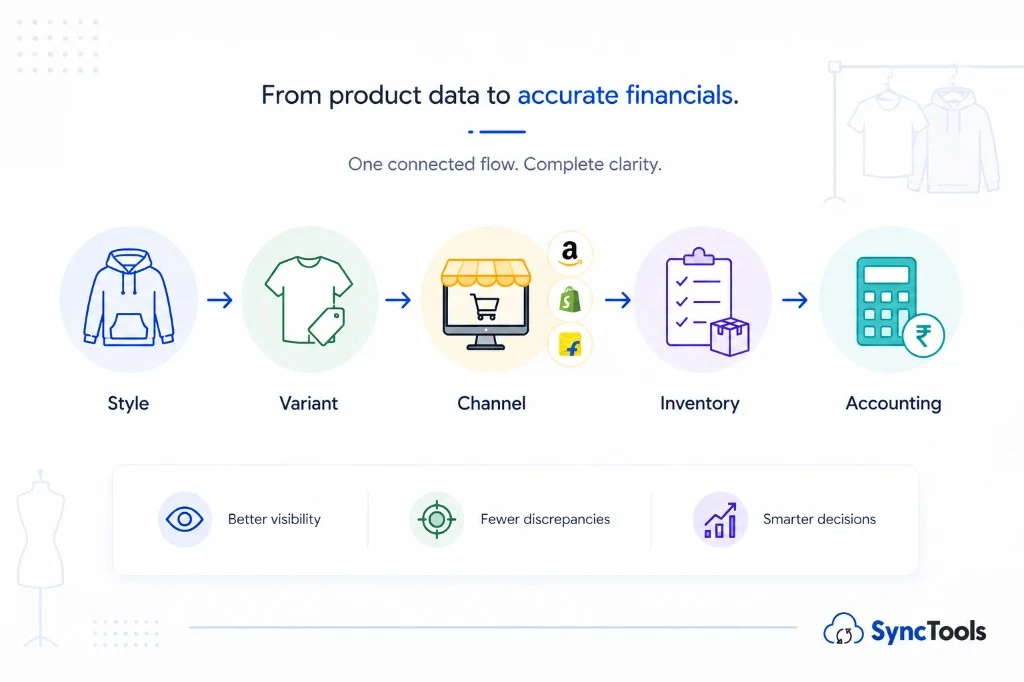
A reliable fashion inventory system needs to preserve the relationship between the product a customer sees and the specific inventory unit behind it.
| Level | Example | What it represents |
|---|---|---|
| Product / Style | Classic Hoodie | Overall product design |
| Color | Black | Product attribute |
| Size | XL | Product attribute |
| Variant SKU | HD-BLK-XL | Specific sellable inventory unit |
| Channel SKU | Amazon / Shopify SKU | Channel-specific identifier |
| Cost | $32.50 | Applicable inventory cost |
| Inventory | 47 units | Current inventory position |
| Sales | 18 units | Units sold |
| Returns | 4 units | Units returned |
| Sell-through | 38% | Inventory velocity |
The data relationship should look like:
Style → Variant → Channel mapping → Transaction → Inventory → Accounting
This structure allows a brand to maintain financial reporting at an appropriate aggregate level while still having the underlying data needed for SKU-level analysis.
It also makes it easier to identify where discrepancies originate.
For example, if Shopify reports 50 units sold but the accounting system records sales against the wrong SKU, the problem can be traced back through the channel-SKU mapping rather than being discovered only as a month-end inventory discrepancy.
For fashion brands operating across Shopify, marketplaces, wholesale, and multiple fulfillment locations, maintaining this relationship becomes increasingly important as the number of variants grows.
Sell-through and markdown analysis by variant
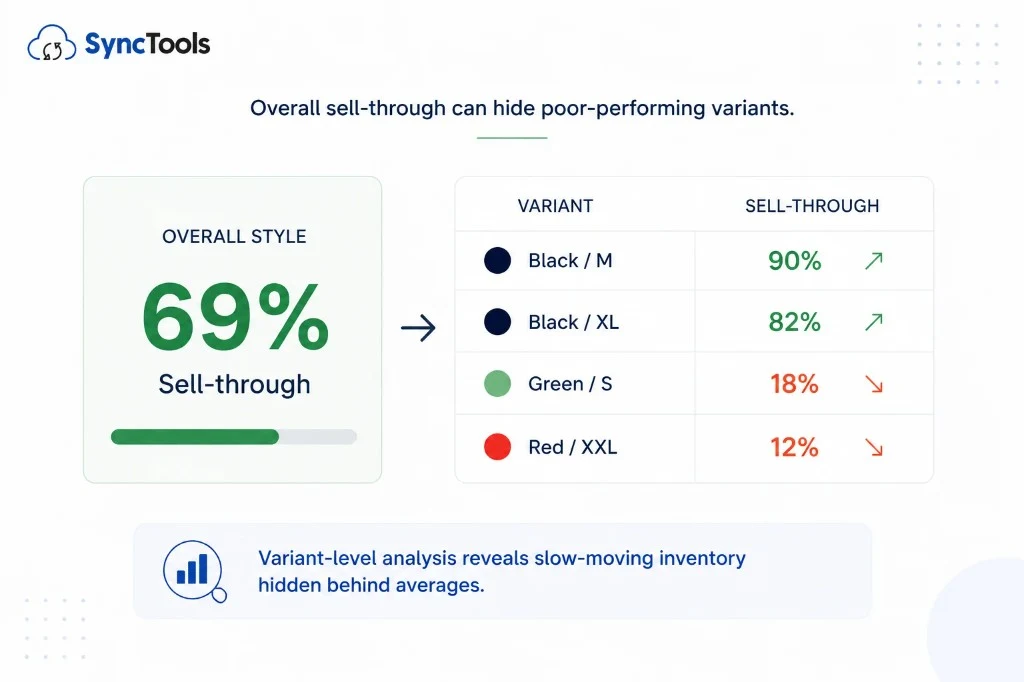
Aggregate style-level sales data can hide the information merchandising and finance teams need to make inventory decisions.
Consider a hoodie with 30 variants.
The overall style may show a healthy 69% sell-through.
But that average could hide:
- Black/M at 90%
- Black/XL at 82%
- Green/S at 18%
- Red/XXL at 12%
The style looks healthy.
Several individual variants are not.
Size-curve performance
A style can have strong overall demand while particular sizes consistently underperform.
Tracking sales and inventory by variant helps identify whether the issue is:
- Incorrect size allocation
- Poor demand forecasting
- Product fit
- Regional demand
- An unusual size curve
Color performance
The same principle applies to colorways.
One popular color can make an entire style look successful while slower colors accumulate inventory.
Variant-level reporting allows merchandising teams to treat those colorways differently rather than applying the same strategy to every SKU.
Markdown decisions
SKU-level sell-through can make commercial markdown decisions more precise.
However, SKU-level tracking does not automatically determine whether an accounting write-down is required.
These are two separate decisions:
Commercial decision: Should we reduce the selling price to improve sell-through?
Accounting decision: Does the inventory carrying amount remain recoverable under the applicable accounting requirements?
Inventory age, expected selling price, sell-through, seasonality, and estimated costs to sell can all be relevant to the accounting assessment.
Identifying slow-moving inventory
There is no universal rule such as “six weeks without a sale means dead stock.”
A meaningful threshold depends on the product category and lifecycle.
A six-week sales gap may be serious for fast fashion but completely normal for seasonal, luxury, or occasionwear.
Brands should therefore define inventory-aging thresholds based on:
- Product lifecycle
- Seasonality
- Historical sell-through
- Expected demand
- Current inventory position
- Planned markdowns
- Expected selling price
The objective is to identify slow-moving variants early enough for merchandising and finance teams to act.
Returns at SKU granularity
Apparel returns can be materially higher than ecommerce returns overall, particularly because customers cannot physically assess fit, sizing, or fabric before purchasing.
Just as importantly, returns don't necessarily distribute evenly across variants.
Fit-driven return patterns
Certain sizes or styles may consistently generate higher returns because of fit or sizing issues.
If returns are tracked only at the style level, the pattern can disappear.
SKU-level reporting can reveal:
Style → Size → Return rate → Return reason
That information can become useful not only to finance, but also to product and merchandising teams.
Returned inventory needs condition tracking
A returned product doesn't necessarily go straight back into normal sellable inventory.
It may be:
- Restocked as sellable inventory
- Sent for inspection
- Refurbished
- Sold at a discount
- Written off because it cannot be resold
The inventory workflow should distinguish between these outcomes.
Otherwise, a business can end up reporting the same quantity as available inventory even though some returned units are damaged or otherwise not immediately saleable.
Accounting treatment of returns
A customer return can affect both revenue and inventory accounting.
Depending on the applicable accounting framework and the company's established policy, the accounting workflow may need to address:
- Refund or revenue adjustment
- Recovery of returned inventory
- COGS adjustment
- Condition of returned inventory
- Any required inventory valuation adjustment
A returned item should therefore not be treated as simply “+1 inventory unit.”
The financial and inventory treatment should reflect what actually happened to the product.
Automating return workflows can help connect the original transaction, refund, inventory movement, and accounting records without requiring every adjustment to be entered manually.
Multi-Channel SKU Mapping
Fashion brands rarely sell through a single channel. Shopify, Amazon, wholesale, and marketplaces each generate their own SKU or listing IDs, and those IDs frequently don't match your internal variant SKU structure.
When that mapping breaks down, so does your reconciliation: sales get recorded against the wrong SKU, inventory counts drift between what a channel reports and what you actually hold, and cost-of-goods calculations end up applied to the wrong variant.
This is one of the least-discussed pain points in fashion ecommerce accounting. Most guidance focuses on single-channel DTC brands, but for any brand selling across more than one platform, it's often the single biggest source of reconciliation errors.
AI-powered reconciliation tools are increasingly how brands close this gap without manually cross-checking SKU IDs channel by channel.
What SKU-level profitability analysis actually requires
A fashion business doesn't necessarily need to produce its statutory financial statements at SKU level.
But if management wants to understand which variants are profitable, the underlying data needs to connect inventory, cost, sales, returns, discounts, and channel activity to the appropriate SKU.
At minimum, the data structure should capture:
- Parent product and variant SKU: linked but independently identifiable
- Applicable inventory cost: based on the company's costing method
- Sales by channel: Shopify, marketplace, wholesale, or other channels
- Units sold: by SKU and period
- Discounts and promotions: where relevant to profitability analysis
- Returns and refunds: linked to the original transaction and SKU
- Inventory position: units available, committed, returned, or otherwise unavailable
- Inventory aging: to identify slow-moving variants
- Relevant fulfillment or channel costs: where the business wants contribution-level profitability
This creates the foundation for SKU-level profitability analysis without confusing management reporting with statutory financial reporting.
For example:
Net sales
− applicable COGS
− discounts
− returns
− channel/payment costs
− relevant fulfillment costs
= SKU contribution
The exact profitability calculation should reflect the metrics the business chooses to manage.
The key is that the underlying transaction and inventory data needs to be reliable enough to support that analysis.
Manual spreadsheets can technically hold this information. The challenge is maintaining the relationships accurately when SKU counts, sales channels, returns, and inventory movements grow.
How to fix fashion ecommerce inventory complexity
The solution isn't to force every financial report down to the SKU level.
It's to make sure the data underneath your accounting system preserves the detail required to manage the inventory correctly.
The key capabilities are:
Variant-level inventory tracking
Maintain inventory quantities and identifiers at the sellable SKU level while preserving the relationship to the parent style.
Consistent inventory costing
Apply the inventory costing method adopted by the business consistently and ensure product costs flow correctly into COGS.
Variant-level sell-through analysis
Measure inventory velocity by size and color instead of relying only on the blended performance of the parent style.
Condition-aware returns
Connect refunds and returned inventory to the original SKU and distinguish resalable, discounted, refurbished, and non-resalable units.
Channel-level SKU mapping
Maintain a reliable mapping between internal SKUs and the identifiers used by Shopify, marketplaces, wholesale systems, and other sales channels.
Inventory reconciliation
Regularly compare ecommerce, warehouse, inventory-management, and accounting records so discrepancies can be identified before they distort financial reporting.
SKU-level profitability analysis
Connect sales, costs, returns, discounts, and relevant channel costs to the appropriate variant so management can understand where margin is actually being generated.
This is the difference between an accounting system that can technically store ecommerce transactions and an accounting workflow that can keep pace with the operational complexity of fashion.
Bottom line
Fashion inventory accounting doesn't fail because financial statements need to show every size and color separately.
It fails when the underlying data loses the relationship between:
Style → Variant → Cost → Inventory → Sale → Return → Channel → Accounting
When those relationships are maintained, a brand can report financial results at the level appropriate for the business while still having the detail needed to understand SKU-level performance.
That detail matters because aggregate numbers can hide:
- Slow-moving sizes
- Underperforming colorways
- Variant-level cost differences
- High-return SKUs
- Channel-specific margin problems
- Inventory aging
- Markdown opportunities
The answer isn't simply more spreadsheet discipline.
It's a data structure and accounting workflow designed to preserve the detail of how fashion products are actually sold, returned, and replenished without requiring someone to manually maintain thousands of SKU-level relationships every month.
Your accounting system shouldn't have to understand fashion. Your data layer should.
As SKU counts grow, the difficult part isn't creating another product record.
It's keeping SKU, cost, inventory, sales, returns, channels, and accounting records connected as transactions multiply.
SyncTools helps fashion and apparel brands automate the movement and reconciliation of ecommerce data into their accounting workflows, reducing the manual work involved in managing complex product and transaction data.
Shopify & marketplaces → Orders & payouts → SKU mapping → Returns → Inventory → Accounting → Reconciliation
If your fashion business is dealing with growing SKU complexity, multiple sales channels, or increasingly manual reconciliation, see how SyncTools supports accounting automation for apparel and fashion brands.
Explore SyncTools for Apparel & Fashion
Frequently Asked Questions
How many SKUs does one style actually generate?
Multiply the active colors by the active sizes. A style available in five colors and six sizes can create 30 sellable variants.
The actual number may be lower if certain size/color combinations aren't offered.
Should I track cost at the SKU level or the style level?
Track inventory operationally at the SKU or variant level, while applying the inventory costing method appropriate to your accounting framework and business circumstances.
A style may have the same underlying cost across several variants, while genuine differences in material, construction, or other applicable costs may require different treatment.
The important distinction is between SKU-level inventory visibility and the method used to calculate inventory cost and COGS.
What's the difference between a parent SKU and a variant SKU?
A parent product represents the overall style, while a variant SKU represents a specific sellable combination such as size and color.
For example: Parent: Classic Hoodie. Variant: HD-BLK-XL.
The e-commerce storefront may display one product page for the hoodie, but inventory and transaction systems need to identify the specific variant purchased.
How do I check whether my system is using FIFO or weighted-average?
Check the inventory accounting settings in the system responsible for calculating your financial inventory and COGS. Confirm how the system handles a SKU purchased at different costs over time.
Don't assume that the product-cost field in Shopify or another e-commerce platform represents your financial inventory-costing method.
Your accountant should confirm the costing method used for financial reporting and whether the ecommerce, inventory, and accounting systems are aligned.
At what SKU count do spreadsheets stop being viable?
There is no universal SKU threshold.
A business with 1,000 relatively simple SKUs and one sales channel may be easier to manage than a business with 500 SKUs spread across Shopify, Amazon, wholesale, and multiple warehouses.
The better indicators are reconciliation effort, number of manual updates, error frequency, number of inventory locations, number of sales channels, return volume, and frequency of cost changes.
When maintaining the data becomes more time-consuming than analyzing it, automation becomes increasingly valuable.
Does SKU-level tracking actually change when I mark down inventory?
SKU-level tracking can make commercial markdown decisions more precise because sell-through, inventory age, and demand can be evaluated by variant.
However, SKU-level tracking does not by itself determine whether an accounting write-down is required.
A commercial markdown answers: “What price should we sell this product at?”
An accounting valuation assessment answers: “Is the inventory still appropriately valued under the applicable accounting requirements?”
Those decisions are related but should not be treated as the same thing.
Can Shopify track fashion inventory by size and color?
Shopify can represent products with multiple variants such as size and color, but the broader accounting question is how that variant information, inventory cost, returns, and sales data flow into the accounting system.
For brands with complex inventory and multiple sales channels, maintaining consistent SKU mapping between ecommerce, inventory, and accounting systems becomes increasingly important.
Why is SKU-level inventory important for fashion brands?
Because fashion demand is rarely uniform across every variant.
The same style can have strong demand in one color and weak demand in another, while certain sizes can have very different sell-through or return rates.
SKU-level inventory data makes those differences visible before they become end-of-season inventory problems.
Should every SKU have a separate P&L?
No. A business does not necessarily need a separate formal P&L for every SKU.
Instead, the underlying data should be detailed enough to support SKU-level profitability analysis when management needs it.
Financial reporting can remain at the appropriate aggregate level while management reporting uses SKU-level data to identify product and inventory decisions.
Ready to automate your accounting?
Connect Shopify, WooCommerce, or Linnworks to QuickBooks, Xero & more. Setup in minutes.