Fashion Ecommerce Accounting: The Complete Guide for Shopify & DTC Clothing Brands
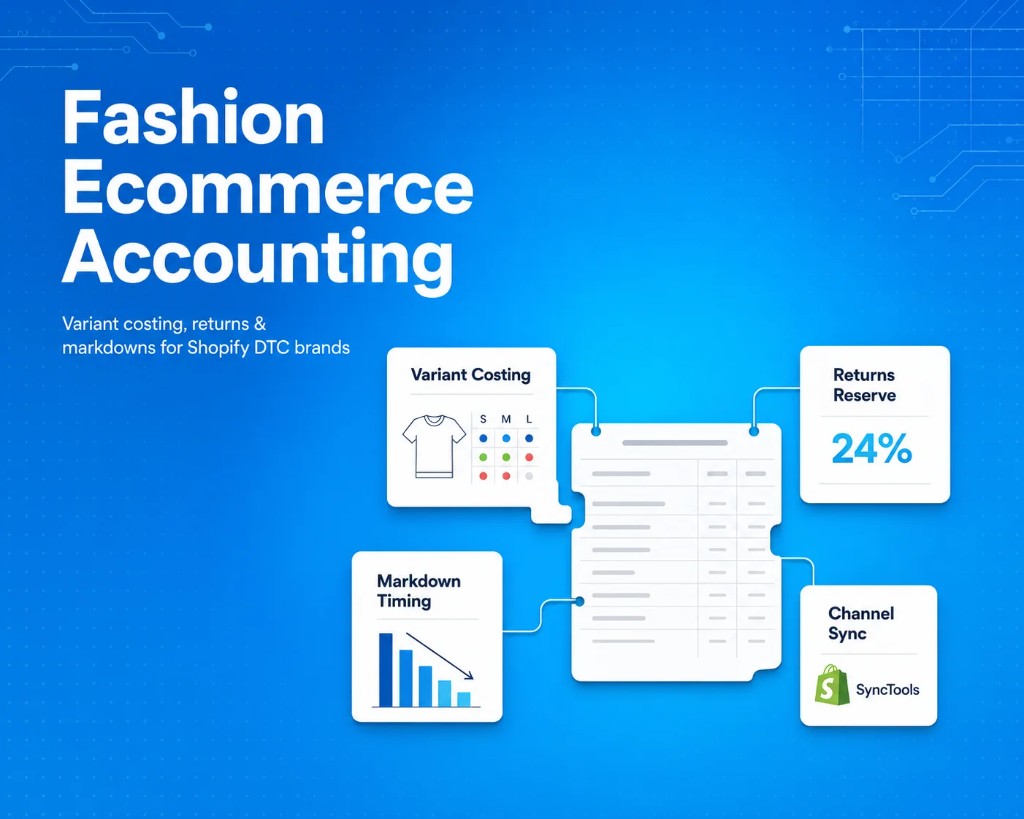
Fashion ecommerce accounting differs from standard ecommerce accounting because apparel businesses have to manage variant-level inventory, high return rates, seasonal markdowns, landed costs, and revenue across multiple sales channels.
A single fashion style can become dozens of SKUs once you account for size and color. The cost of producing and delivering those products can include manufacturing, freight, duties, and other landed costs. Returns can materially change reported revenue and inventory, while unsold seasonal products may require closer review as their expected selling price falls.
That makes accurate accounting more than simply recording Shopify sales and matching deposits to the bank.
This guide explains the accounting and financial management issues that matter most for Shopify and DTC fashion brands, including:
- Variant-level inventory and COGS
- Landed cost and inventory costing
- Returns, refunds, and exchanges
- Seasonal inventory and markdowns
- Shopify, wholesale, and marketplace reconciliation
- Sales tax and economic nexus
- Monthly close procedures
- Fashion ecommerce accounting KPIs
- Choosing between accounting software, automation, and professional accounting support
Whether you're a fashion brand owner, bookkeeper, accountant, or finance lead, the goal is the same: make your financial records reflect what is actually happening in the business.
Fashion Ecommerce Accounting at a Glance
| Accounting area | Why it matters for fashion brands | What to track |
|---|---|---|
| Variant costing | The same style can have multiple sizes and colors with different economics | Style, SKU, size, color, unit cost |
| Landed cost | Factory cost alone may not represent the inventory's total cost | Product cost, freight, duties, customs |
| Returns | Refunds can materially reduce the revenue originally recorded | Return rate, refunds, recoverable inventory |
| Exchanges | Size and color exchanges create additional inventory and transaction movements | Original SKU, replacement SKU, price difference |
| Seasonal inventory | Unsold apparel can lose expected selling value as a season ends | Inventory age, sell-through, expected selling price |
| Markdowns | Discounts affect realized revenue and gross margin | Original price, markdown price, units sold |
| Multi-channel sales | Shopify, marketplaces, and wholesale have different payout and fee structures | Sales, fees, refunds, payouts, AR |
| Inventory reconciliation | Accounting inventory may differ from physical or platform inventory | Units, value, shrinkage, adjustments |
| Sales tax | Selling across jurisdictions can create tax collection obligations | Sales by jurisdiction, nexus status, tax collected |
| Month-end close | Multiple moving parts make manual reconciliation error-prone | Revenue, COGS, inventory, returns, fees, AR |
The four areas that deserve the closest attention are inventory costing, returns, seasonal inventory, and multi-channel reconciliation. Getting these right gives you a much more reliable view of gross margin and operating performance.
Why fashion accounting breaks the standard ecommerce playbook
Most ecommerce accounting content is written for a business selling a handful of simple products at a fixed cost. Fashion brands rarely work that way.
A single style can generate dozens of SKUs once you factor in size and color. Returns run far higher than most retail categories, often 20 to 40 percent depending on the product type. Inventory doesn't hold its value the way a phone case does. A jacket that doesn't sell by the end of a season gets marked down, sometimes repeatedly, before it's gone.
Each of these realities changes how you calculate cost of goods sold, when you recognize revenue, and how accurate your profit and loss statement actually is. Get them wrong and your margins look better on paper than they are in the bank account.
Chart of accounts for a fashion DTC brand
A generic ecommerce chart of accounts misses line items that matter specifically to apparel businesses. Set yours up to separate:
- Sample and prototype costs: these are development expenses, not COGS, and mixing them in distorts your true unit cost
- Influencer seeding and gifting: decide upfront whether this sits in COGS or marketing, and apply it consistently
- Wholesale versus DTC revenue: different channels carry different margins and payment terms, and blending them hides which side of the business is actually profitable
- Marketplace and payment fees by channel: Shopify, Amazon, and buy-now-pay-later providers like Klarna or Afterpay each take a different cut in a different way
- Freight in versus freight out: inbound shipping is part of landed cost, outbound is an operating expense, and conflating them skews your margin picture
Building this structure once, at the start, saves you from re-categorizing a year of transactions later.
Cost of goods sold for multi-variant inventory
Inventory and COGS are where fashion ecommerce accounting becomes more complicated than a typical online store.
A fashion brand may sell one style in six sizes and four colors, creating 24 SKUs. The underlying production cost may be identical across those variants, or it may differ because of material usage, construction, packaging, or other factors.
The accounting system should therefore distinguish between how inventory is tracked operationally and which inventory costing method the business uses for financial reporting.
Track inventory at the SKU and variant level
Operationally, fashion brands should be able to identify inventory by style, SKU, size, and color.
If all variants have substantially the same underlying cost, the business may use a consistent cost basis across those variants under its chosen inventory accounting method. If a particular variant has a genuinely different cost, for example, a larger size requires materially more material, that difference should be reflected in the inventory costing process where appropriate.
The important point is consistency: don't use a single generic product cost simply because several variants belong to the same style.
Understand landed cost
The amount paid to a manufacturer is not always the full cost of getting inventory ready for sale.
Depending on the business and its accounting policy, inventory cost can include applicable costs such as:
- Product or manufacturing cost
- Inbound freight
- Customs and duties
- Import-related costs
- Other costs directly attributable to bringing inventory to its present location and condition
For example, if a garment costs $35 from the manufacturer and the applicable inbound freight and duties add another $5, the inventory cost may be $40 rather than $35.
That difference matters when calculating gross margin.
Choose and apply an inventory costing method consistently
Fashion businesses should use an inventory costing method appropriate to their accounting framework and circumstances. Common approaches include:
- FIFO (First In, First Out): assumes the earliest inventory costs are recognized in COGS first
- Weighted average cost: calculates an average cost across applicable inventory
- Specific identification: tracks the actual cost of specifically identifiable inventory where appropriate
The right method depends on the business, accounting framework, inventory characteristics, and professional accounting advice. The key is to apply the selected method consistently.
Match COGS with the related revenue
COGS should reflect the inventory cost associated with products sold during the relevant reporting period.
The timing matters.
A factory payment is not automatically the same thing as an accounting expense. Inventory generally moves through stages such as:
Purchase / production → inventory → sale → COGS
This distinction is particularly important for fashion brands that place large seasonal purchase orders months before products are sold.
Purpose-built ecommerce accounting tools can reduce the manual work involved in mapping orders, inventory costs, returns, and payouts into the accounting system while maintaining SKU-level visibility.
Accounting for returns and refunds in fashion ecommerce
Returns are one of the biggest differences between fashion ecommerce and many other product categories.
Fit, sizing, color expectations, and product preference can all influence whether a customer keeps an apparel purchase. For brands with significant return activity, simply recording gross Shopify sales and treating refunds as a later adjustment can make monthly performance difficult to interpret.
Separate sales, refunds, and expected returns
When a customer returns a product, the accounting impact can involve more than reversing the original sale.
Under applicable revenue recognition guidance, a business may need to account for expected returns through a refund liability and recognize an asset representing its right to recover products expected to be returned, subject to the relevant accounting requirements.
The exact treatment depends on the company's accounting framework and circumstances, so brands should establish their return accounting policy with their accountant.
Track return rates by SKU
Don't look only at the overall return rate.
Track returns by:
- Style
- SKU
- Size
- Color
- Sales channel
- Reason for return
- Return condition
For example, if a particular dress has a significantly higher return rate in one size, that may indicate a sizing or fit issue. If a color has an unusually high return rate, the issue may be product expectation rather than accounting.
The accounting data can therefore become an operational feedback loop for merchandising and product teams.
Account for the condition of returned inventory
Not every returned item goes straight back into sellable inventory.
A returned garment may be:
- Restocked as sellable inventory
- Sent for inspection or refurbishment
- Discounted because packaging or condition has changed
- Written off if it cannot be resold
Your accounting and inventory processes should distinguish between these outcomes.
Exchanges need their own workflow
Fashion brands also need to account for exchanges, particularly size and color exchanges.
An exchange can involve:
- Removal of the original SKU
- Addition of the replacement SKU
- A price difference
- Additional payment or refund
- Inventory movement
- Potential changes in shipping or fulfillment costs
A same-product exchange, such as replacing one size or color with another, can have different revenue implications from a completely new sale and return. Your accounting treatment should follow the applicable accounting guidance and your established policy.
Automating return and exchange workflows can reduce the manual entries required during month-end reconciliation while keeping inventory and financial records aligned.
Markdown and seasonal inventory write-downs
Fashion inventory has a characteristic that many other ecommerce products don't: time can reduce its expected selling value.
A winter collection that remains unsold when the season ends may still have the same manufacturing cost on paper, but its expected selling price can be materially lower. The same can happen when a trend changes, a collection is discontinued, or a product has consistently poor sell-through.
Separate markdowns from accounting write-downs
A markdown is a commercial pricing decision.
A write-down is an accounting adjustment that may be required when inventory's carrying value is no longer recoverable under the applicable accounting requirements.
They are related, but they are not the same thing.
For example:
- Original selling price: $120
- Markdown price: $80
- Unit inventory cost: $50
The $40 reduction in selling price is a commercial markdown. Whether an accounting write-down is required depends on factors such as the inventory's carrying amount, expected selling price, costs to complete or sell, and the applicable accounting framework.
Monitor inventory aging
Fashion brands should maintain inventory aging data such as:
- 0–90 days
- 91–180 days
- 181–365 days
- 365+ days
The exact thresholds should reflect the brand's product lifecycle rather than being treated as universal accounting rules.
Use aging together with:
- Sell-through rate
- Current selling price
- Planned markdowns
- Historical sales velocity
- Expected future demand
- Seasonality
- Estimated costs to sell
This creates a better basis for identifying inventory that may require a valuation review.
Why this matters
If aging inventory continues to be carried at an amount that is no longer recoverable, the balance sheet can overstate inventory and profitability can appear stronger than it really is.
A consistent inventory review process helps finance and merchandising teams identify these issues earlier, and gives management a clearer view of the cash tied up in slow-moving stock.
Inventory costing methods for fashion ecommerce
The inventory costing method you choose affects how product costs flow into COGS and, ultimately, how gross profit is reported.
The appropriate method depends on your accounting framework, inventory characteristics, and business circumstances. A fashion brand should establish its method with its accountant and apply it consistently.
FIFO
FIFO, or First In, First Out, assumes that the earliest inventory costs are recognized in COGS first.
This can be particularly relevant for businesses where inventory costs change over time because of:
- Material price increases
- Manufacturing cost changes
- Freight fluctuations
- Currency movements
- Supplier price changes
Weighted average cost
Weighted average costing uses the average cost of applicable inventory.
This can simplify accounting when a brand purchases the same product repeatedly at different costs and individual units are not practically tracked by purchase lot.
Specific identification
Specific identification assigns actual costs to specifically identifiable inventory.
It can be appropriate in circumstances where individual items or lots can be reliably identified and the accounting framework permits or requires that approach.
Don't confuse operational SKU tracking with financial costing
Your ecommerce system may need to know exactly how many units of a product exist by:
Style → SKU → Size → Color → Location
That doesn't necessarily mean your financial statements must use a different costing method for every individual variant.
The important requirement is that the inventory records support the costing method being used and that the method is applied consistently.
For fashion brands, this distinction becomes particularly important as SKU counts grow and inventory moves between warehouses, fulfillment partners, Shopify, marketplaces, and physical locations.
Accounting for exchanges in fashion ecommerce
Returns aren't the only inventory movement fashion brands need to account for. Exchanges are especially common when customers want a different size or color.
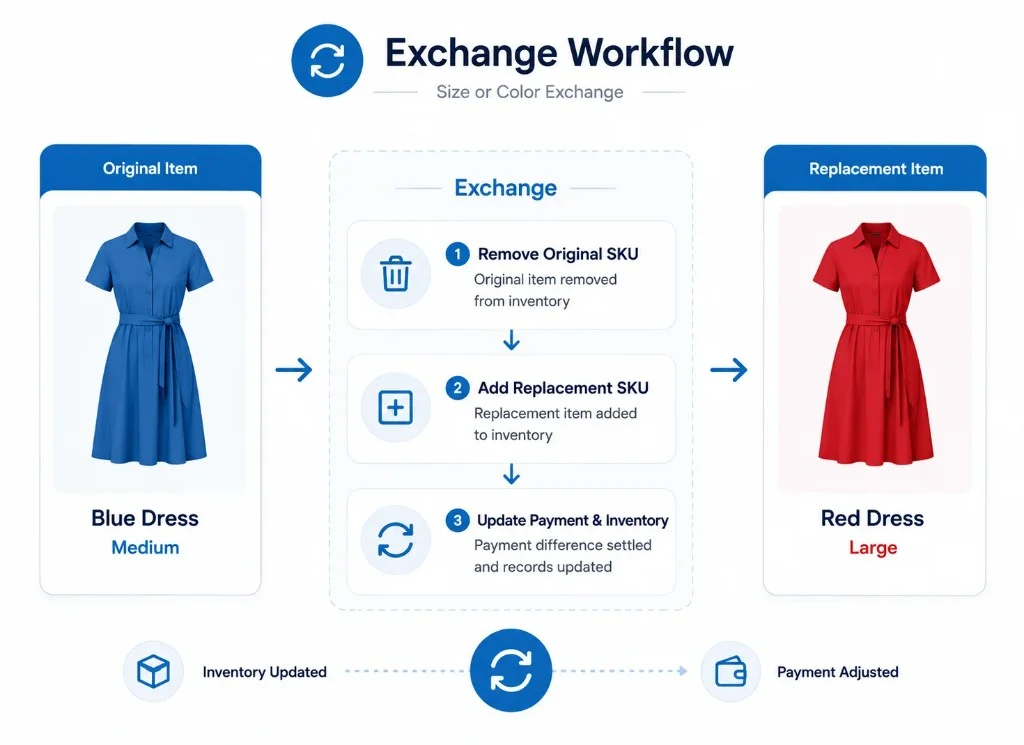
Consider a customer who purchases a $100 dress in Medium and exchanges it for the same dress in Large.
Operationally, the business has moved:
1 Medium returned → 1 Large shipped
But the accounting and inventory systems still need to correctly record the movement.
Track the original and replacement SKU
At minimum, an exchange workflow should capture:
- Original order
- Original SKU
- Returned quantity
- Replacement SKU
- Replacement quantity
- Price difference
- Refund or additional payment
- Return shipping
- Inventory disposition
Same-product exchanges
A size or color change within the same product can have different accounting implications from a customer returning one product and purchasing a completely different product.
The business should establish a consistent policy for these transactions based on the applicable revenue recognition and inventory accounting requirements.
Why exchanges matter for fashion brands
Ignoring exchanges can create discrepancies between:
- Shopify order data
- Inventory records
- COGS
- Refunds
- Customer balances
- Accounting records
Automating the exchange workflow reduces the number of manual adjustments required during month-end close and gives finance teams a more accurate view of product-level returns and inventory.
Fashion ecommerce accounting: a simple worked example
Consider a fashion brand selling a jacket through Shopify.
Step 1: Calculate the inventory cost
The jacket costs:
- Manufacturer cost: $35
- Inbound freight: $3
- Applicable duties and customs: $2
- Illustrative landed inventory cost: $40 per jacket
The exact costs included in inventory should follow the company's accounting policy and applicable accounting requirements.
Step 2: Sell the product
The brand sells 100 jackets at $100 each.
- Gross sales: $10,000
Assume 20 jackets are subsequently returned.
The financial impact of those returns should not be treated simply as 20 additional inventory units. The business needs to account for the applicable refund liability/revenue adjustment and the right to recover returned products, along with the condition of the returned inventory.
Step 3: Assess returned inventory
Suppose:
- 15 returned jackets are in resalable condition
- 3 require refurbishment before resale
- 2 cannot be resold
The inventory records should distinguish between these outcomes rather than assuming all 20 units immediately return to normal sellable inventory.
Step 4: Review margin
The brand should then evaluate:
- Gross revenue
- Refunds
- Net revenue
- COGS
- Payment fees
- Fulfillment costs
- Return-related costs
- Markdown impact
This produces a much more useful view of the economics than simply comparing Shopify sales against bank deposits.
The lesson
For fashion brands, profitability is influenced by what happens after the original order.
The sale, return, exchange, inventory recovery, markdown, and eventual resale can all affect the economics of the original transaction.
That is why accounting automation needs to connect ecommerce transactions with inventory and accounting records rather than treating every Shopify payout as a simple revenue entry.
Accounting references
Fashion ecommerce businesses should establish their accounting policies with a qualified accounting professional and apply the requirements relevant to their accounting framework and jurisdiction.
The following resources provide useful reference material:
- FASB ASC 606 Revenue from Contracts with Customers: guidance relevant to revenue recognition, including consideration of variable amounts and customer returns
- FASB ASC 330 Inventory: guidance relevant to inventory measurement and accounting
- IRS Publication 538, Accounting Periods and Methods: US tax guidance covering inventory and accounting methods
- State tax authorities: sales-tax registration, collection, filing, and economic-nexus requirements vary by jurisdiction
This article is intended for educational purposes and should not be treated as accounting, tax, or legal advice.
Multi-channel revenue reconciliation: Shopify, wholesale, and marketplaces
Selling through Shopify, wholesale accounts, and marketplaces means reconciling revenue that arrives on different schedules, with different fees deducted, in different currencies if you sell cross-border.
At minimum, monthly reconciliation should confirm that what your accounting software shows as revenue matches the payout reports from each channel, with fees, discounts, and shipping broken out rather than netted into one lump figure. Wholesale invoices paid on terms need to be tracked separately from immediate DTC transactions so you're not missing revenue that's been earned but not yet collected.
This is also where manual entry becomes the most time-consuming and the most error-prone part of the monthly close. Tools built specifically for apparel and fashion accounting automation sync ecommerce platform data directly into your accounting software, removing the manual step of pulling and re-entering payout data from each channel, and reducing the reconciliation errors that come from doing it by hand across multiple platforms.
Sales tax and nexus for hybrid wholesale and DTC brands
Selling across states, and across both wholesale and direct channels, creates nexus obligations that are easy to miss until a state notices first. Marketplace facilitator rules mean platforms like Amazon may collect and remit tax on your behalf on marketplace sales, but that doesn't cover your Shopify store or wholesale invoices, and it's still your responsibility to confirm you're compliant everywhere you have nexus.
Aggregate sales data across every channel monthly, not just at filing time, so you can see when you're approaching an economic nexus threshold in a new state before it becomes a compliance problem.
Monthly close checklist for fashion brands
A repeatable monthly close for a fashion brand should cover, at minimum:
- Reconcile revenue and fees from every sales channel against bank deposits
- Record COGS matched to the same period as the revenue it relates to
- Review returns by channel and by SKU
- Update inventory counts and adjust for shrinkage or loss
- Apply any markdown or write-down adjustments for aging stock
- Reconcile wholesale invoices and outstanding AR
- Calculate and set aside sales tax obligations by jurisdiction
- Finalize the P&L and balance sheet
Running this consistently, on the same schedule every month, is what turns your books from a compliance task into something you can actually use to make decisions.
Tools, accountants, or both
Spreadsheets work early on, but the manual effort scales badly once you're managing variant-level COGS, multi-channel reconciliation, and return reserves at the same time. At that point, most fashion brands land on one of three setups: accounting software alone, software plus a syncing tool to automate channel reconciliation, or software and sync paired with an accountant who understands apparel-specific issues like the ones covered above.
If you're evaluating that third option, working with an accountant who's actually verified for fashion and ecommerce work matters more than it sounds. SyncTools pairs its platform sync with a network of CA-verified accountants, so the reconciliation and the review of what it produces both come from a source you can trust, rather than syncing clean data into books nobody's checking.
Get fashion ecommerce accounting under control
Fashion accounting becomes difficult when sales, inventory, returns, exchanges, fees, and payouts live in different systems.
SyncTools helps fashion and apparel brands connect their ecommerce data with their accounting workflow, reducing the manual work involved in moving and reconciling transaction data.
With the right setup, your accounting workflow can connect:
Shopify & marketplaces → Orders & payouts → Returns & refunds → Inventory & COGS → Accounting software → Reconciliation
For brands that need additional accounting expertise, SyncTools also connects ecommerce businesses with CA-verified accountants who understand the requirements of ecommerce and fashion businesses.
Explore SyncTools for apparel and fashion
Frequently asked questions
What's different about accounting for a fashion brand versus a regular ecommerce business?
Fashion brands typically have more inventory complexity because one style can exist across multiple sizes and colors, while returns, exchanges, seasonal markdowns, and inventory aging can materially affect profitability. Brands selling through Shopify, marketplaces, and wholesale also need to reconcile different sales, fee, refund, and payout structures.
How should I calculate COGS when I sell the same style in multiple sizes and colors?
Track inventory at the SKU and variant level operationally, but apply the inventory costing method appropriate to your accounting framework and business circumstances. If all sizes and colors have substantially the same underlying cost, a consistent cost basis may be appropriate. If a variant has a materially different cost, that difference should be reflected where required by the applicable costing method.
Do I need to account for returns differently in a fashion brand?
Returns require particular attention because apparel can have significant return activity. Under applicable revenue recognition guidance, expected returns can affect recognized revenue and may require a refund liability and an asset representing the right to recover returned products. Returned inventory should also be evaluated based on whether it is immediately resalable, requires refurbishment, or cannot be resold.
When should I write down apparel inventory?
There is no universal rule that apparel must be written down after a specific number of months or seasons. Instead, brands should regularly evaluate whether inventory's carrying amount remains recoverable under the applicable accounting requirements. Inventory aging, sell-through, expected selling price, planned markdowns, seasonality, and estimated costs to sell can all be relevant indicators.
Do I need to worry about sales tax if I sell wholesale and DTC?
Potentially, yes. Selling through Shopify, marketplaces, and wholesale channels can create different sales-tax collection and reporting considerations. Marketplace facilitator rules may shift collection responsibilities for certain marketplace transactions, but they do not automatically resolve a brand's obligations for its Shopify store or wholesale sales. Brands should monitor sales by jurisdiction and review their nexus and registration obligations with a qualified tax professional.
Should I hire an accountant or use software to manage this myself?
The answer depends on transaction volume, inventory complexity, sales channels, and your team's accounting expertise. Accounting software can handle the core books, while ecommerce synchronization tools can automate data movement and reconciliation. As complexity increases, many fashion brands benefit from combining accounting software and automation with an accountant who understands ecommerce inventory, returns, and multi-channel sales.
What is the biggest accounting mistake fashion ecommerce brands make?
Treating Shopify sales and bank deposits as if they were the complete picture of revenue and profitability. A fashion brand also needs to account for inventory costs, returns, refunds, payment and marketplace fees, inventory adjustments, markdowns, and other channel-specific transactions.
How often should a fashion ecommerce brand reconcile inventory?
At minimum, inventory and financial records should be reviewed as part of the monthly close. Higher-volume brands or businesses with frequent inventory movements may benefit from more frequent reconciliation. The right frequency depends on transaction volume, inventory value, warehouse processes, and the level of discrepancy the business can tolerate.
What KPIs should fashion ecommerce brands monitor?
Useful financial and inventory KPIs include gross margin, contribution margin, COGS percentage, return rate, sell-through rate, inventory turnover, inventory aging, markdown percentage, and SKU-level profitability. Monitoring these together helps identify whether poor performance is being driven by pricing, product cost, returns, slow-moving inventory, or channel economics.
Ready to automate your accounting?
Connect Shopify, WooCommerce, or Linnworks to QuickBooks, Xero & more. Setup in minutes.