Apparel Ecommerce Returns & Refund Accounting: Complete Guide
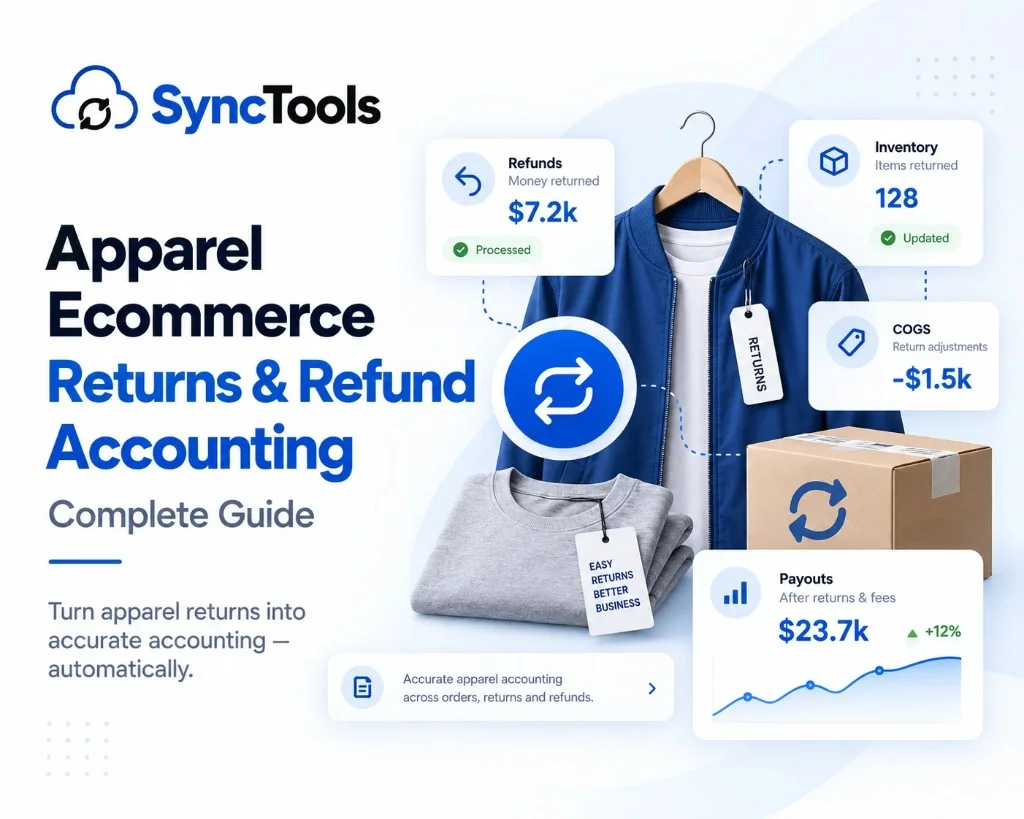
Returns are part of apparel ecommerce, but accounting for them is more complicated than simply reversing a sale.
A single return can affect revenue, inventory, cost of goods sold (COGS), taxes, payment fees, shipping costs, store credit, Shopify payouts, and bank reconciliation. These effects may also happen on different dates.
For apparel brands managing multiple sizes, colors, SKUs, exchanges, and high return volumes, apparel ecommerce returns accounting needs to connect what happened financially with what happened to the physical product.
This guide explains how to account for returns and refunds properly, where accounting errors commonly appear, and how ecommerce accounting automation can help finance teams maintain better visibility as transaction volumes increase.
Why Apparel Returns Are More Complicated Than Regular Refunds
A customer buying a jacket creates a relatively straightforward accounting flow.
The business records:
- Revenue
- Sales tax or VAT where applicable
- Payment fees
- Inventory reduction
- COGS
- Customer payment
- Shopify payout
A return can reverse some of those entries, but not necessarily all of them.
For example, the customer may receive a full refund, but the business could still lose money from:
- Payment processing fees
- Original shipping
- Return shipping
- Warehouse inspection
- Repacking
- Product markdowns
- Damaged inventory
This is where apparel and fashion accounting becomes more important. Returns need to be connected with the right SKU, inventory value, COGS, fees, and payout activity, rather than treated as a simple negative sale.
The National Retail Federation estimated that 19.3% of online sales would be returned in 2025.
For apparel businesses, where sizing, fit, color expectations, and style preferences influence buying decisions, return accounting deserves much more attention than simply recording a negative sale.
Return vs. Refund: Understand the Difference First
One of the most important principles in ecommerce returns accounting is understanding that a return and a refund are not the same event.
What is a return?
A return represents the physical product being sent back or expected back from the customer.
It is primarily an inventory and operational event.
What is a refund?
A refund represents money being returned to the customer.
It is primarily a financial event.
The two can happen on completely different dates.
Example
Consider this timeline:
| Event | Date |
|---|---|
| Customer buys a blazer | August 25 |
| Return requested | August 30 |
| Warehouse receives product | September 3 |
| Product inspected | September 4 |
| Refund issued | September 5 |
| Refund included in Shopify payout | September 8 |
For the customer, it is simply one return. For the finance team, that same return can create several accounting entries across different dates or even different months. If everything is recorded as a single event, it can lead to mismatches in month-end reporting, inventory, and payout reconciliation.
What Happens in the Books When an Apparel Product Is Returned?

A complete apparel return can involve several accounting events.
1. The Original Sale Is Recorded
When the customer places an order, the accounting workflow may capture:
- Product sales
- Discounts
- Shipping income
- Sales tax or VAT
- Payment method
- Payment processing fees
- Inventory
- COGS
The original transaction should remain identifiable if the customer later returns part or all of the order.
2. The Customer Requests a Return
A return request does not automatically mean you've already refunded the money.
The customer may still need to:
- Ship the product back.
- Wait for warehouse inspection.
- Select an exchange
- Accept store credit
- Complete another return condition.
From an accounting perspective, this stage should not automatically be treated as a completed cash refund.
3. The Warehouse Receives the Product
Once the product comes back, the inventory question begins.
Was the returned garment:
- Unopened and immediately resalable?
- Tried on but still sellable?
- Missing packaging?
- Damaged?
- Worn?
- Defective?
- Seasonal and likely to require markdown?
- The wrong SKU?
The answer determines what should happen to inventory.
Should Every Returned Product Go Back Into Inventory?
No.
A customer refund does not automatically mean the returned unit should be restored to normal sellable inventory.
The physical condition of the returned product matters.
| Returned Product Condition | Possible Inventory Treatment |
|---|---|
| New and resalable | Return to sellable inventory |
| Packaging damaged | Inspect or repackage before restocking |
| Minor defect | Refurbish or downgrade |
| Seasonal item | Consider markdown or valuation impact |
| Heavily damaged | Write down or write off |
| Wrong item received | Investigate before adjustment |
| Product missing | Do not automatically restore stock |
For apparel brands, this distinction is critical.
A returned dress may technically be back in the warehouse but still have lower economic value than before it was originally sold.
For growing brands, apparel and fashion accounting needs to connect these return decisions with inventory value, COGS, and SKU-level records. Otherwise, the refund may be recorded correctly while the inventory side tells a different story.
How Returns Affect COGS
When a product is sold, its inventory cost generally moves into the cost of goods sold.
If that product later comes back in sellable condition, the inventory cost may need to be restored, and the related COGS reversed, depending on the accounting method used.
Xero's tracked inventory guidance, for example, explains that when returned inventory is correctly processed, quantity on hand increases and the original COGS can be reversed.
Simple Example
Assume:
- Dress selling price: $100
- Product cost: $35
When the dress is sold:
- Revenue increases by $100
- Inventory decreases by $35
- COGS increases by $35
If the customer returns the dress and it is resalable:
- The refund reduces the amount of revenue retained.
- Inventory may increase by $35
- The related COGS may be reversed.
If the dress is damaged and cannot be resold, restoring the full $35 to normal inventory may not be appropriate.
That is why refund accounting and inventory accounting must remain connected.
Apparel Variants Make Return Accounting More Difficult
Fashion businesses rarely sell just one SKU product.
A single shirt may have:
- XS / Black
- S / Black
- M / Black
- L / Black
- XL / Black
- XS / White
- S / White
- M / White
- L / White
- XL / White
Suppose the customer returns:
Medium / Black
but the accounting or inventory workflow restores:
Medium / White
The total unit count may still appear correct.
But the actual inventory is wrong.
That can affect:
- Reordering
- Purchasing
- Stock availability
- Variant profitability
- Sell-through analysis
- COGS
- Merchandising decisions
For apparel businesses, return accounting should therefore preserve SKU, size, and color information wherever practical.
How Refunds Affect Ecommerce Revenue
When a refund is completed, the business no longer keeps some or all of the original customer payment.
Many companies use a dedicated Sales Returns and Allowances or similar contra-revenue account.
This provides better visibility than simply reducing the sales account.
For example:
| Line item | Amount |
|---|---|
| Gross Sales | $500,000 |
| Less: Returns and Refunds | $45,000 |
| Net Sales | $455,000 |
Keeping refunds visible separately makes it easier to understand:
- How much revenue is being reversed
- Which products generate the most refund value
- Whether returns are growing faster than sales
- Which channels produce the highest refund rate
- How returns affect net revenue
Payment Processing Fees Do Not Always Disappear With the Refund
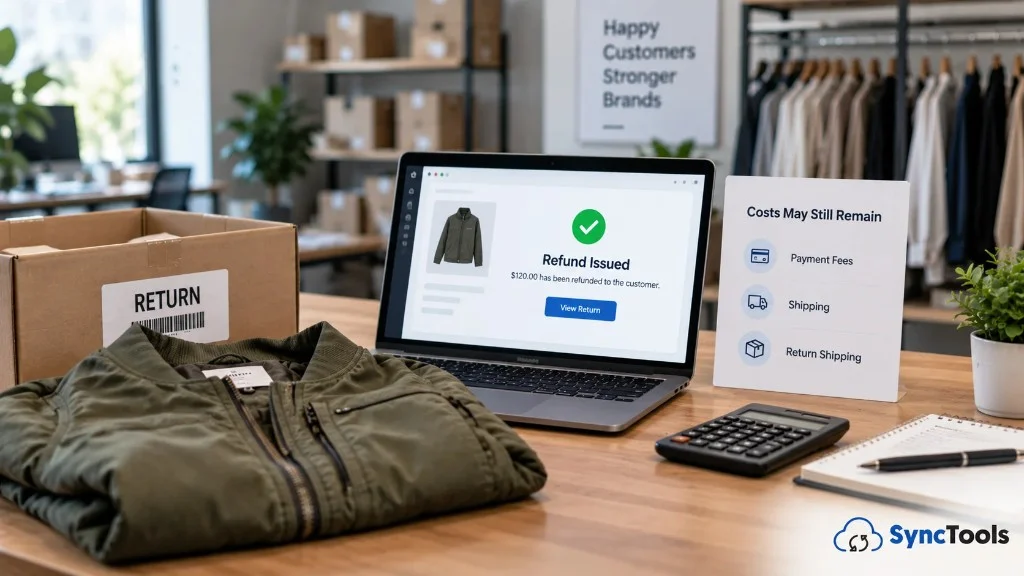
A common mistake is assuming that reversing revenue also reverses every cost connected with the original sale.
That is not always true.
Shopify currently states that with Shopify Payments, the original credit card transaction fee is not returned when a merchant issues a customer refund.
Example
Assume:
| Item | Amount |
|---|---|
| Jacket selling price | $120 |
| Product cost | $42 |
| Payment processing fee | $4 |
| Outbound shipping cost | $8 |
| Return label | $7 |
The customer receives the full $120 refund.
The jacket returns in good condition, and the $42 product cost goes back into inventory.
However, the company may still have incurred:
- $4 payment processing fee
- $8 outbound shipping
- $7 return shipping
Total remaining direct cost: $19
This excludes warehouse labor, inspection, customer support, packaging, or potential markdowns.
A full customer refund does not mean the company fully recovers its costs.
Partial Refund Accounting Needs More Detail
Not every apparel customer returns the complete order.
A customer might purchase:
- 2 shirts
- 1 jacket
- 1 pair of trousers
and return only one shirt.
The accounting workflow should identify the part of the transaction connected with:
- Refunded merchandise
- Discounts
- Tax
- Shipping
- Returned quantity
- COGS
- Fees
Shopify lets merchants issue partial refunds for selected items, shipping, and eligible duties.
So, treating the full order as one negative entry can hide what was actually refunded.
How Should Apparel Exchanges Be Accounted For?
Exchanges matter for fashion businesses because customers often switch sizes or colors.
Example
Original purchase
Blue Dress / Medium: $100
Exchange
Blue Dress / Large: $100
There may be no cash refund.
But inventory still changes.
Medium: +1 returned
Large: -1 shipped
If the returned Medium dress is damaged, you may need another inventory adjustment.
From a payment perspective, almost nothing happened.
From an inventory perspective, two different SKUs moved.
When the replacement costs more
Suppose the customer exchanges a $100 dress for a $120 jacket.
Now the accounting workflow may also need to capture:
- Original product return
- Replacement SKU
- Additional $20 payment
- Tax difference
- Inventory movement
- COGS for the replacement item
When the replacement costs less
If the replacement item costs $80, the transaction may instead create a:
- $20 refund
- Store credit
- Other balance adjustment
Exchanges therefore deserve their own workflow rather than being treated as ordinary refunds.
How Should Store Credit Be Treated?
Store credit is different from returning cash to the customer's original payment method.
When you issue store credit, the business still owes the customer value they can use toward a future purchase.
Finance teams should therefore distinguish between:
- Cash refunds
- Store credit issued
- Store credit redeemed
- Exchanges
- Outstanding store-credit balances
Shopify supports refunds to store credit where the merchant's setup and permissions allow it.
The exact accounting treatment should follow the company's accounting framework and established policy.
Do Not Forget Return Shipping and Restocking Fees
Returns sometimes create additional charges.
Depending on the merchant's policy, a customer may pay:
- Return shipping
- Restocking fees
- Exchange shipping
These amounts should not disappear inside the overall refund value.
A business may want separate financial categories for:
- Product sales
- Returns
- Shipping revenue
- Return shipping fees
- Restocking fees
- Payment processing fees
- Reverse logistics costs
This provides much better visibility into what returns are actually costing the company.
How Returns Affect Shopify Payout Reconciliation
One of the biggest accounting challenges appears when refunds are deducted from Shopify payouts.
The amount deposited into the bank is not necessarily equal to gross Shopify sales.
A payout can include:
Example
Shopify sales for a period
$50,000
Bank deposit
$42,800
The $7,200 difference is not automatically missing revenue.
It might contain:
- Customer refunds
- Processing fees
- Timing differences
- Disputes
- Other payout adjustments
Recording the $42,800 bank deposit directly as sales would hide these details.
Instead, reconcile the payout against the individual components that produced the final bank deposit.
The Cross-Month Refund Problem
Apparel returns regularly cross reporting periods.
Consider this situation:
August 28: Customer places order
August 30: Order ships
September 2: Return requested
September 5: Warehouse receives product
September 6: Product inspected
September 7: Refund processed
September 9: Refund affects Shopify payout
Without connected accounting data:
- August sales may appear stronger.
- September refunds may look disconnected.
- Product profitability becomes harder to analyze
- Payout reconciliation becomes more difficult.
For accounting frameworks that require expected return estimation, finance teams may also need to consider returns that are expected but have not yet been processed at the reporting date.
Expected Returns and Revenue Recognition

Larger ecommerce businesses should also understand the difference between:
- Recording a return after it occurs
- Estimating expected future returns
Under IFRS 15, a business selling products with a right of return may need to recognize:
- Revenue for the amount it expects to retain
- A refund liability for amounts expected to be returned
- An asset representing the right to recover products expected to be returned
Simplified Example
Suppose an apparel company ships $500,000 of merchandise shortly before year-end.
Historical data and company policy indicate that part of those sales is expected to be returned after year-end.
The accounting question may therefore be broader than:
How many refunds have already been processed?
Finance may also need to assess:
How much of this revenue do we reasonably expect to retain?
The company's accountant or auditor should confirm the exact accounting approach based on the applicable reporting framework and jurisdiction.
International Refunds Can Create Currency Differences
International apparel brands face another issue.
The exchange rate applied when a refund is processed may differ from the exchange rate used when the original order was placed.
Suppose:
- Original order was $100
- Reporting currency value at sale was £78
- Currency moved before the refund.
The refund may no longer translate back to exactly £78.
This can create foreign exchange differences in accounting records.
Finance teams should avoid forcing foreign-currency refunds to exactly equal the reporting-currency amount of the original sale without reviewing the actual settlement data.
What Should You Track for Every Apparel Return?
A strong return accounting dataset should allow finance teams to identify the complete transaction.
| Data Point | Why It Matters |
|---|---|
| Order ID | Links refund to original sale |
| Original order date | Reporting period |
| Return date | Return timing |
| Refund date | Financial timing |
| SKU | Inventory tracking |
| Size | Variant analysis |
| Color | Variant analysis |
| Quantity returned | Inventory adjustment |
| Refund value | Net sales |
| Tax adjustment | Tax reporting |
| Shipping refund | Revenue adjustment |
| Return fee | Return economics |
| Payment processing fee | Margin analysis |
| Product cost | COGS |
| Product condition | Inventory valuation |
| Restock status | Inventory availability |
| Replacement SKU | Exchange accounting |
| Shopify payout ID | Bank reconciliation |
| Sales channel | Channel reporting |
This creates value beyond bookkeeping.
The same information can help merchandising and operations teams identify products that repeatedly generate expensive returns.
Important Apparel Return Metrics Finance Teams Should Monitor
Return rate alone does not tell the whole story.
Unit Return Rate
Returned Units ÷ Units Sold × 100
Shows how frequently physical products come back.
Refund Rate
Refund Value ÷ Gross Sales × 100
Shows how much gross revenue is being reversed.
Exchange Rate
Exchange Transactions ÷ Total Return Transactions × 100
Shows how much return demand is retained through exchanges.
Sellable Recovery Rate
Returned Units Restored to Sellable Inventory ÷ Returned Units Received × 100
Shows how much returned stock can actually be sold again.
Average Refund Lag
One useful approach is:
Refund Date − Original Order Date
Finance teams can also measure:
Refund Date − Return Receipt Date
The first highlights the complete customer transaction cycle.
The second highlights how quickly the team processes returned merchandise financially after it arrives back.
Return Cost per Order
Return cost can include:
- Unrecovered payment fees
- Return shipping
- Inspection
- Repacking
- Refurbishment
- Markdown losses
- Inventory write-offs
This provides a more realistic view of the financial impact of returns.
Track Returns at SKU Level, Not Only Product Level
Consider this example:
| Variant | Units Sold | Units Returned | Unit Return Rate |
|---|---|---|---|
| Small | 300 | 30 | 10.0% |
| Medium | 400 | 48 | 12.0% |
| Large | 310 | 90 | 29.0% |
| XL | 180 | 27 | 15.0% |
At the overall product level, the dress may appear to perform reasonably well.
At the variant level, Large immediately stands out.
This could indicate:
- Fit inconsistency
- Sizing-chart problems
- Manufacturing variation
- Product description mismatch
- Customer expectation issues
Return accounting can therefore support better decisions across:
- Finance
- Merchandising
- Inventory planning
- Procurement
- Product development
- Ecommerce operations
Month-End Apparel Returns Accounting Checklist
Before closing the month, finance teams should review the following areas.
Revenue and Refunds
- Are all refunds recorded?
- Are partial refunds tracked correctly?
- Is store credit kept separate?
- Are exchanges tracked separately?
- Are refunds shown apart from sales?
Inventory
- Is sellable stock added back correctly?
- Are damaged returns kept out of available stock?
- Is each return matched to the right SKU?
- Have stock changes been checked?
COGS
- Was COGS reversed for restocked items?
- Are damaged goods recorded separately?
- Do inventory records match actual stock?
Payment and Return Costs
- Are payment processing fees captured?
- Are unrecovered fees still recorded after refunds?
- Are return shipping costs recorded consistently?
- Are restocking or return fees categorized correctly?
Shopify Payouts
- Do Shopify payouts reconcile with bank deposits?
- Can refunds be traced to payout activity?
- Are timing differences documented?
Management Reporting
- Can management see gross sales and refunds separately?
- Can SKU analyze returns?
- Can size and color analyze returns?
- Can finance identify return-adjusted product performance?
Why Manual Returns Accounting Becomes Difficult as Apparel Brands Grow
A small store may be able to manage ten or twenty monthly refunds manually.
The process changes when the company is dealing with:
- Hundreds of monthly returns
- Thousands of product variants
- Multiple Shopify stores
- Multiple currencies
- Multiple payment methods
- Partial returns
- Exchanges
- Store credits
- High Shopify payout volumes
The main challenge is not typing transactions into accounting software.
It is preserving the relationship between:
Original Sale → Returned Product → Refund → Inventory → COGS → Shopify Payout → Bank Deposit
A spreadsheet can contain all the numbers while still losing the connection between them.
That is when automation becomes increasingly valuable.
How SyncTools Supports Apparel Returns and Refund Accounting
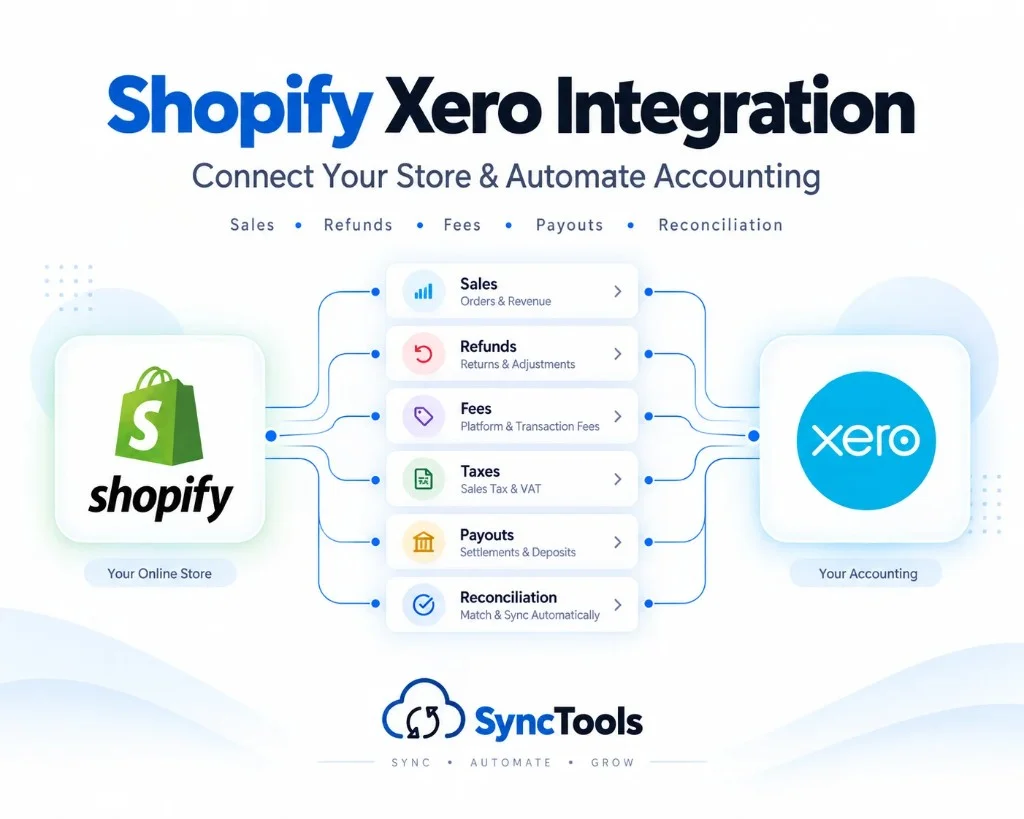
SyncTools helps connect ecommerce transaction data with accounting platforms such as QuickBooks Online and Xero.
Rather than manually rebuilding Shopify activity at month-end, finance teams can create accounting workflows around data including:
- Sales
- Refunds
- Returns
- Taxes
- Shipping adjustments
- Payment information
- Fees
- COGS
- Payouts
For apparel businesses, this is particularly useful because returns often involve multiple financial and inventory events rather than a single refund transaction.
How SyncTools Can Help With Shopify Refund Accounting
Automate Refund Synchronization
Move refund activity from Shopify into the accounting workflow without manually recreating transactions.
Capture COGS Alongside Ecommerce Accounting
SyncTools supports COGS-related accounting workflows, helping businesses keep product cost connected with ecommerce transaction activity.
For apparel brands, this matters most when inventory is returned and the financial effect of the original sale changes.
Improve Shopify Payout Reconciliation
Rather than treating the final Shopify bank deposit as revenue, finance teams can account for the activity that created the payout.
This can include:
- Sales
- Refunds
- Fees
- Taxes
- Other payout adjustments
The result is a clearer connection between ecommerce transactions and the bank deposit.
Apply Accounting Account Mapping
Businesses can configure accounting mappings for categories such as:
- Sales
- Refunds
- Taxes
- Fees
- Shipping
- Clearing accounts
- Other transaction types
This helps maintain a more consistent accounting structure as transaction volume increases.
Use Detailed or Summarized Accounting
Some businesses need transaction-level accounting.
Others prefer summarized accounting entries for high-volume Shopify activity.
SyncTools supports workflows designed around both approaches, depending on the business's accounting requirements.
Support Multi-Store Ecommerce Accounting
Apparel brands often operate:
- Different regional Shopify stores
- Different brands
- Different currencies
- Multiple ecommerce entities
Keeping return and refund activity organized across these environments becomes increasingly important as operations grow.
Automation Still Requires Clear Accounting Rules
Accounting automation works best when the business has already decided how to treat different return scenarios.
Before configuring the workflow, finance teams should define:
- Which account records refunds?
- When should returned inventory be restored?
- How should damaged returns be treated?
- How should store credit be recorded?
- How should return shipping costs be categorized?
- How should exchanges be treated?
- How should foreign currency differences be recorded?
- Which return metrics should management receive?
Once those policies are defined, accounting automation can apply the same structure consistently across a much larger transaction volume.
Final Thoughts
Apparel ecommerce returns accounting should not stop at:
Customer returned item → Issue refund → Reduce sales.
A complete return can affect:
- Revenue
- Inventory
- COGS
- Taxes
- Processing fees
- Shipping costs
- Store credit
- SKU availability
- Shopify payouts
- Bank reconciliation
- Product profitability
These events may happen across several days or accounting periods.
The most useful accounting workflow connects the entire lifecycle:
Original Sale → Return → Inspection → Refund → Inventory Decision → COGS Adjustment → Payout Reconciliation
For growing apparel brands, this provides more than cleaner bookkeeping.
It helps finance teams understand what returns are actually costing, which products are creating problems, how much inventory is being recovered, and whether Shopify settlements genuinely match the books.
If your team is spending every month manually connecting Shopify refunds, returned SKUs, COGS adjustments, fees, and payout differences, SyncTools can help automate the accounting data flow between your ecommerce operations and QuickBooks or Xero.
Build a Scalable Apparel Returns Accounting Workflow
Explore SyncTools for Apparel & Fashion and see how your return accounting workflow can move beyond simply recording refunds.
Frequently Asked Questions
How should an ecommerce business account for customer returns?
Customer returns can affect revenue, inventory, COGS, taxes, payment fees, and payout reconciliation. When a sellable product returns to inventory, the related inventory cost may need to be restored, and COGS reversed, depending on the business's accounting method.
What is the difference between a return and a refund in Shopify?
A return relates to merchandise coming back from the customer. A refund relates to money being returned. Shopify can process the return and refund at different stages, meaning the two events may have different accounting dates.
Should returned apparel always be added back to inventory?
No. Restore returned items to normal inventory only if they are suitable for resale. Damaged, worn, defective, or otherwise unsellable products may require a separate inventory adjustment, write-down, or write-off.
Does Shopify refund payment processing fees when an order is refunded?
For Shopify Payments, Shopify currently states that it does not return the original credit card transaction fee when the merchant issues a customer refund. This means the business can still incur payment-processing costs even when it refunds the entire customer payment.
How should size and color exchanges be accounted for?
The accounting and inventory workflow should track both the returned SKU and replacement SKU. Even when no cash changes hands, inventory movement still occurs between variants. Price differences can also create an additional customer payment, refund, or store-credit balance.
Can SyncTools automate Shopify refunds in QuickBooks or Xero?
SyncTools supports ecommerce accounting workflows that include Shopify refunds, returns, taxes, fees, COGS, payouts, and related transaction data for accounting systems such as QuickBooks Online and Xero. Businesses can configure mappings and accounting workflows according to their requirements.
Ready to automate your accounting?
Connect Shopify, WooCommerce, or Linnworks to QuickBooks, Xero & more. Setup in minutes.