When Ecommerce Growth Outgrows the Accounting Workflow: Inside OMNIASTORES’ Reconciliation Challenge
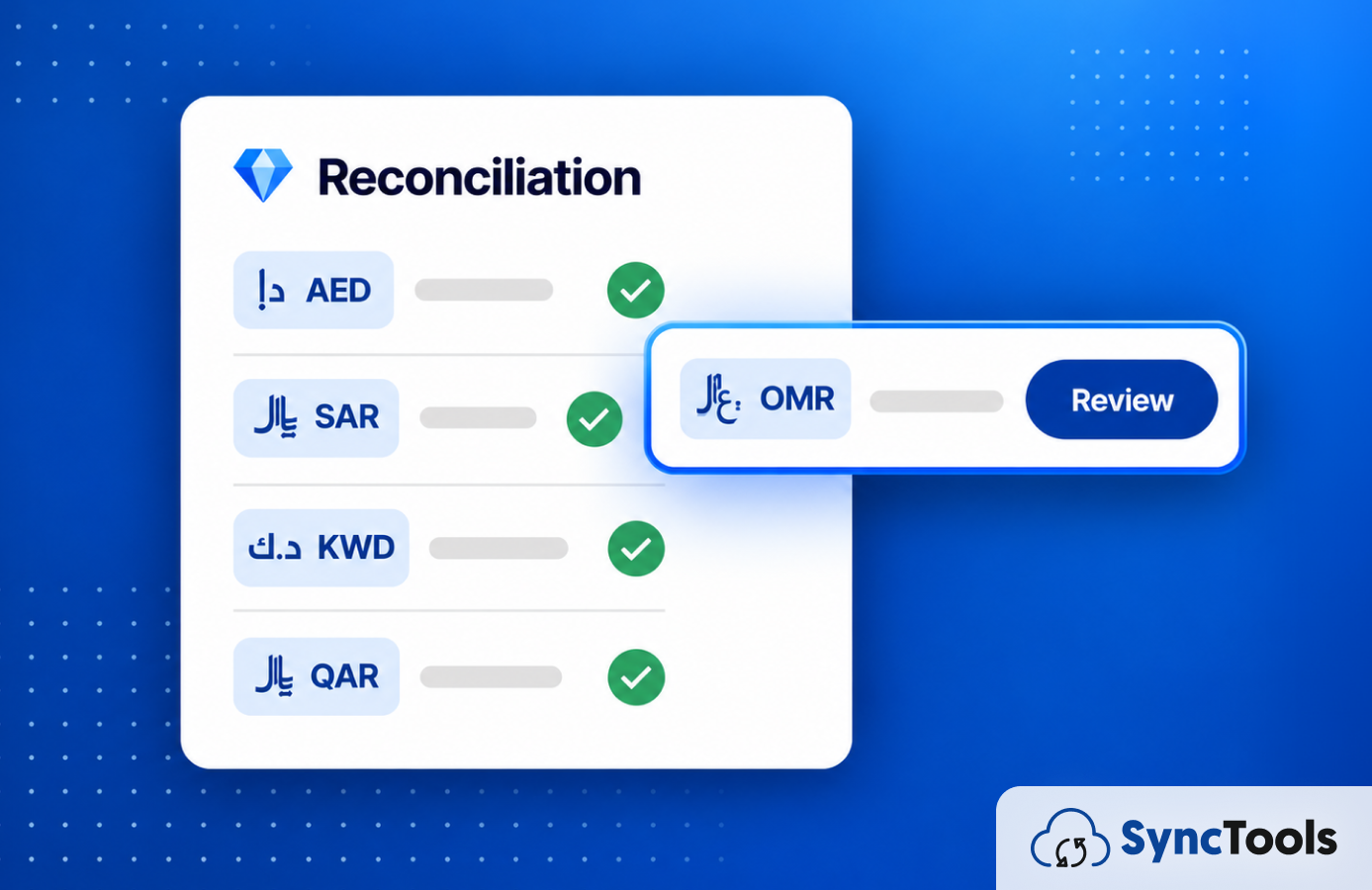
How a Dubai luxury jewelry brand selling across multiple currencies, storefronts, and payment methods reached the point where spreadsheet-based reconciliation could no longer keep pace with its ecommerce operations.
An ecommerce order can take seconds to place.
Accounting for that same order can be considerably more complicated.
As an ecommerce business grows, the complexity rarely comes from sales alone. More orders bring more payments. New markets introduce additional currencies. Different payment providers create different settlement cycles. Refunds, fees, adjustments, and COD collections create additional records between the original sale and the money eventually received.
For OMNIASTORES, a Dubai-based luxury jewelry brand, that complexity had reached the finance team.
The business processes approximately 1,100 orders per month through WooCommerce, sells across six Gulf currencies, operates multiple storefront experiences, and accepts payment methods including Tabby, Tamara, and Cash on Delivery.
Its accounting system is Zoho Books.
The challenge lies in everything between the ecommerce order and the final accounting record.
And that makes OMNIASTORES' requirement relevant to far more than one ecommerce business in Dubai.
Meet OMNIASTORES
OMNIASTORES is a UAE-based luxury jewelry ecommerce business offering collections that include 925 sterling silver jewelry, lab-grown and moissanite pieces, bridal sets, and pearl collections.
Its ecommerce operation has evolved beyond a straightforward single-store setup.
The business operates with:
- WooCommerce as its ecommerce platform
- Approximately 1,100 orders per month
- Six Gulf currencies: AED, SAR, KWD, BHD, QAR and OMR
- A separate Arabic storefront
- Six influencer-led ambassador boutiques
- Tabby and Tamara payment options
- Cash on Delivery (COD)
- Zoho Books for accounting
None of these elements is unusual on its own.
The accounting complexity appears when they all need to work together.
Because while ecommerce platforms are designed to make buying easy, finance teams still need to answer a much more detailed question:
What happened to the money after the customer placed the order?
The Problem Wasn't Selling. It Was What Happened After the Sale.
From the customer's perspective, the transaction is straightforward.
Choose the jewelry.
Select a payment method.
Place the order.
From the accountant's perspective, that order begins another journey.
Consider an order paid through a buy-now-pay-later provider.
WooCommerce records what the customer purchased and the amount charged.
The payment provider maintains its own transaction and settlement records.
Fees, refunds, or other adjustments may affect the final settlement amount.
Zoho Books needs the appropriate accounting records.
The bank ultimately receives the payout.
Finance needs to establish the relationship between them all.
The complete journey looks more like:
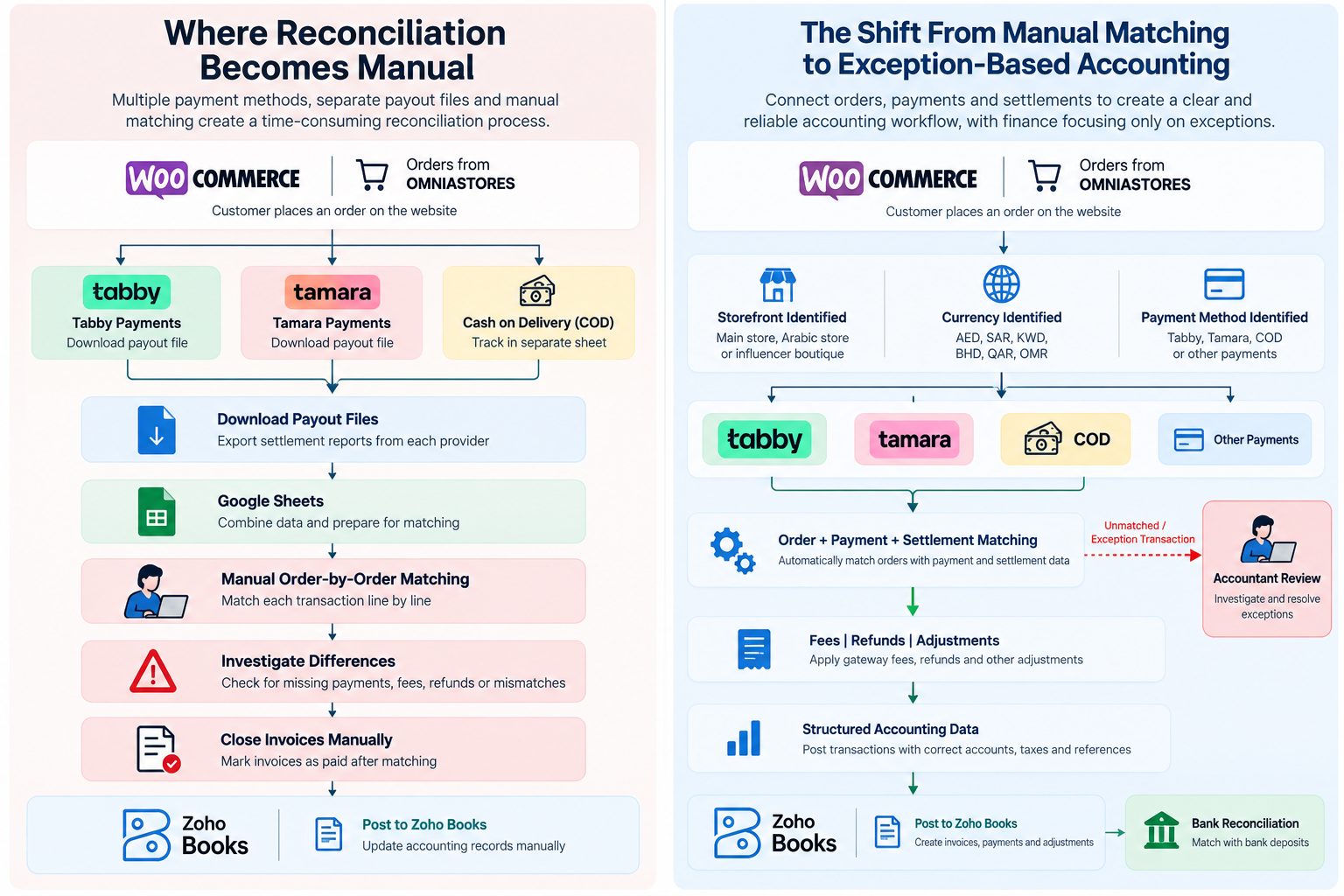
WooCommerce Order → Payment → Settlement → Accounting → Bank Deposit
When these systems don't pass enough connected information, someone has to rebuild that relationship manually.
At OMNIASTORES, that work currently falls heavily on the accountant.
Inside the Manual Reconciliation Workflow
The existing reconciliation process involves downloading payout files from Tabby and Tamara, working with that information in Google Sheets, matching transactions against individual orders, separately tracking COD transactions, and then manually closing the corresponding invoices.
The workflow effectively becomes:
There is nothing inherently wrong with using spreadsheets.
In fact, spreadsheets are often exactly how businesses solve operational problems before those processes become large enough to justify automation.
The issue appears when transaction volume grows, but the underlying finance process remains largely unchanged.
At approximately 1,100 monthly orders, OMNIASTORES isn't dealing with 1,100 isolated sales.
Its finance team is managing transactions that move through different payment methods, currencies, storefronts, and settlement paths.
That is where reconciliation stops being a simple bookkeeping exercise.
It becomes an ecommerce data and accounting workflow problem.
Rebuilding Payouts in Spreadsheets?
Tell us how orders, payment files, and bank deposits move through your ecommerce operation today.
Why WooCommerce to Zoho Books Integration Is Only Part of the Answer
This distinction matters for any ecommerce business evaluating accounting automation.
Connecting WooCommerce with Zoho Books can solve one part of the problem.
Orders can move from the ecommerce platform into the accounting system.
But moving an order and reconciling the money behind that order are not necessarily the same thing.
Finance ultimately needs answers to two questions:
| What did we sell?
And
| Does the money we received correctly correspond to what we sold?
The first question is primarily about transaction synchronization.
The second is about reconciliation.
A scalable ecommerce accounting workflow needs to consider both.
Imagine WooCommerce records an order worth AED 1,000.
Creating the corresponding sales record in Zoho Books establishes the transaction.
But finance may still need to determine:
- Which payment provider processed the transaction?
- Has that transaction been included in a settlement?
- Were fees deducted?
- Was there a refund or adjustment?
- Which bank deposit contains the payment?
- Can you now close the corresponding invoice?
Moving the sales transaction into accounting doesn't automatically establish all of these relationships.
This is why ecommerce accounting architecture should consider the full financial journey of an order, rather than simply moving data between two applications.
Tabby, Tamara and COD Don't Follow the Same Accounting Journey
OMNIASTORES' requirement also demonstrates something that becomes increasingly important as ecommerce businesses expand:
Not every payment method behaves the same way after checkout.
Tabby has its own transaction and settlement process.
Tamara has another.
Cash on Delivery follows an entirely different operational journey.
Card processors and other payment gateways may have their own payout schedules.
The customer may see all of these simply as payment options.
Accounting does not.
Finance needs to understand how the original sale connects with the payment, settlement, fees, adjustments, and eventual bank deposit.
That means a useful reconciliation workflow needs to preserve relationships between data such as:
| Ecommerce Data | Payment/Settlement Data | Accounting Data |
|---|---|---|
| Order ID | Transaction reference | Invoice |
| Order amount | Settlement amount | Payment |
| Currency | Provider fees | Bank/clearing account |
| Refund | Settlement adjustment | Refund/credit entry |
| Payment method | Payout reference | Reconciliation status |
| Store/source | Settlement date | Accounting date |
The objective isn't simply to move these fields from one system to another.
It is to maintain the relationship between them.
That relationship allows finance to move from knowing:
“AED 24,000 reached the bank.”
to knowing:
“These specific orders, refunds, fees and adjustments make up the AED 24,000 deposit.”
That is the difference between recording money and reconciling it.
Multi-Currency Commerce Adds Another Accounting Layer
OMNIASTORES sells across six Gulf currencies:
AED | SAR | KWD | BHD | QAR | OMR
Multi-currency ecommerce can appear relatively straightforward from the customer's perspective.
The storefront displays the appropriate currency and the customer completes the purchase.
Accounting sees the transaction differently.
Finance needs visibility into the original order currency, the payment transaction, the settlement information, and the corresponding accounting record.
Depending on your payment and accounting setup, exchange rates and settlement currencies can add further considerations.
As ecommerce businesses expand internationally, these relationships become increasingly important.
This is why asking:
“Can WooCommerce connect with Zoho Books?”
is only the beginning.
A more useful question is:
Can our accounting workflow preserve the financial journey of each ecommerce transaction from order through payment and settlement to the books?
That question gets much closer to the actual business requirement.
Multiple Storefronts Create Another Reporting Requirement
OMNIASTORES' operating model adds another interesting layer.
Alongside its primary ecommerce operation, the business has a separate Arabic storefront and an ambassador boutique program involving six influencer boutiques.
That means finance may eventually need more than consolidated sales numbers.
Depending on management reporting requirements, transactions may need to remain identifiable by dimensions such as:
- Storefront
- Ambassador boutique
- Currency
- Payment method
- Market
- Product
- Sales source
The specific accounting structure should always follow the company's approved Zoho Books configuration and reporting requirements.
But there is a broader lesson here.
Accounting automation should not remove information that the business needs later for reporting and decision-making.
A good ecommerce accounting workflow doesn't merely ask:
“What should we sync?”
It also asks:
“Which characteristics of the original transaction need to survive after it reaches accounting?”
That is a much more important architectural question.
What the Desired OMNIASTORES Workflow Looks Like
The requirement therefore extends beyond:
WooCommerce → Zoho Books
The desired workflow must account for the financial journey around those orders.
1. Capture the Ecommerce Transaction
WooCommerce provides relevant order information, including products, order values, taxes, discounts, currencies, payment methods, and order status.
2. Preserve Transaction Context
The workflow must retain the information needed to distinguish transactions by storefront, currency, payment method, or other relevant dimensions.
3. Structure the Accounting Data
Transactions should follow the agreed Zoho Books accounting configuration, rather than requiring the accountant to manually reconstruct the records.
4. Connect Payments With Orders
Payment references need to remain connected with the corresponding e-commerce transactions wherever the required data is available.
5. Process Settlement Information
For supported payment providers and workflows, settlement information can help establish which transactions belong to a particular payout.
6. Account for Fees, Refunds and Adjustments
The bank deposit should not become the only record finance relies on.
Relevant fees, refunds and adjustments need to retain their relationship with the original transaction and settlement.
7. Reconcile Against Accounting Records
The desired result is a clearer financial path:
Sale → Payment → Settlement → Accounting → Bank
8. Send Exceptions for Review
Automation should not mean processing every transaction without thinking.
If something doesn't match the expected data or accounting rules, that transaction should remain visible for finance to investigate.
This changes the accountant's role from:
reviewing and matching every transaction
to:
reviewing the transactions that actually require accounting judgment.
That is the shift from manual reconciliation to exception-based accounting.
What Exception-Based Ecommerce Accounting Actually Means
This distinction is worth understanding.
In a manual process, the accountant participates in the normal journey of almost every transaction.
Download → Match → Verify → Update → Close
As transaction volume increases, the workload generally increases with it.
An exception-based workflow changes the operating model.
The expected path becomes:
Capture → Match → Account → Reconcile
And only when something does not match:
Exception → Accountant Review
Finance remains in control.
What changes is where humans spend their attention.
Instead of using accounting expertise to match normal transactions repeatedly, accountants can direct that expertise toward unusual transactions, discrepancies, reporting, and financial review.
That is where automation becomes valuable.
Not because accountants disappear from the process.
Because accountants no longer have to process every predictable transaction manually.
Spend Accounting Time on Exceptions
SyncTools connects ecommerce transaction data with accounting systems so routine activity does not have to be matched by hand.
The Bigger Lesson: Ecommerce Accounting Should Follow the Money, Not Just the Order
OMNIASTORES is based in Dubai.
But the accounting problem it represents is global.
Change the country and the platforms may change.
A Gulf ecommerce business might work with Tabby and Tamara.
A European merchant may accept Klarna.
An Australian business may work with Afterpay.
A global ecommerce operation may use combinations of Stripe, PayPal, marketplace settlements, local payment methods, and multiple bank accounts.
The providers change.
The underlying accounting question doesn't:
Can finance trace the journey from the original ecommerce transaction to the amount eventually received in the bank?
That is where many ecommerce integration projects fall short.
They concentrate on connecting applications.
A stronger approach connects the financial events happening across those applications.
5 Signs Your Ecommerce Accounting Has Reached the Same Point
OMNIASTORES' situation provides several warning signs that other growing ecommerce businesses can recognize.
1. Your Accountant Regularly Downloads Payout Reports
If finance has to download settlement files from payment providers before reconciliation can begin, there may be an opportunity to reduce manual handling.
2. Google Sheets Has Become Part of Your Accounting Architecture
Spreadsheets are useful.
But when they permanently sit between ecommerce, payment providers, and accounting software, they may signal that you're manually rebuilding important relationships between systems.
3. Orders and Payments Are Matched One by One
This can be manageable at low volumes.
At hundreds or thousands of monthly transactions, the process becomes increasingly difficult to scale.
4. Every Payment Method Has Its Own Reconciliation Process
One workflow for BNPL, another for cards, another for marketplaces, and another for COD creates fragmented finance operations.
Every new payment option can potentially create another reconciliation process.
5. Month-End Depends Heavily on One Person's Process Knowledge
If reconciliation works because one accountant knows which exports to download, which spreadsheet to update, and how to match individual transactions, the business carries an operational dependency.
Automation doesn't aim to remove accounting judgment.
It is to stop consuming that judgment on repetitive matching work.
Where SyncTools Fits
This type of ecommerce accounting challenge is exactly why you need to consider integration beyond basic order synchronization.
SyncTools connects ecommerce operations with accounting systems and supports moving structured financial data between them.
For a business like OMNIASTORES, though, the right approach isn't to assume you can turn on every part of the workflow.
The actual requirement needs to be evaluated across:
WooCommerce → Storefronts → Currencies → Payment Methods → Settlements → Zoho Books → Bank Reconciliation
Tabby, Tamara, COD, multi-currency transactions, multiple storefronts, and the required Zoho Books accounting treatment all need to be understood within the actual workflow.
That discovery is important.
Because the objective isn't simply to make WooCommerce and Zoho Books exchange data.
The objective is to create an accounting workflow where sales, payments, settlements, fees, refunds, and relevant transaction references remain connected enough for finance to reconcile them efficiently.
That is a very different integration objective.
And it is the one growing ecommerce businesses should be asking for.
See Where Manual Work Still Sits
Walk through your storefronts, currencies, payment methods, and accounting setup before deciding what should be automated.
From 1,100 Orders to the Next Stage of Growth
OMNIASTORES' current challenge isn't unusual.
It signals an ecommerce business reaching a new level of operational maturity.
The process that worked when transaction volumes were smaller now requires reconsideration.
That's often how accounting automation opportunities emerge.
One spreadsheet becomes several.
One payment provider becomes three.
One currency becomes six.
One storefront becomes multiple selling experiences.
The accountant spends more and more time reconciling what has already happened instead of reviewing what the numbers mean.
Eventually, the systems that generate revenue begin moving faster than the processes that account for it.
OMNIASTORES is approaching that point.
The question is no longer whether its accountant can continue matching transactions manually.
Of course they can.
The more valuable question is:
Should a growing ecommerce business still need its finance team to do it this way?
Still Reconciling Ecommerce Payouts in Spreadsheets?
If your finance team is downloading payment-provider settlement files, matching ecommerce orders manually, maintaining separate COD spreadsheets, investigating payout differences one transaction at a time, or closing hundreds of invoices manually, your accounting software may not be the real problem.
The missing piece may be the workflow connecting your ecommerce, payment, settlement, and accounting data.
Tell the SyncTools team how your ecommerce operation works today.
Share your:
Ecommerce platform → Payment providers → Monthly transaction volume → Accounting software → Current reconciliation process
We'll help you identify where manual work exists, which financial data needs to remain connected, and where accounting automation may fit.
Let's Discuss Your Ecommerce Reconciliation Workflow
Ready to automate your accounting?
Connect Shopify, WooCommerce, or Linnworks to QuickBooks, Xero & more. Setup in minutes.