2027 eCommerce Accounting Automation Roadmap: What Growing Businesses Should Prioritize
As 2026 draws to a close, e-commerce businesses are reviewing their sales performance, inventory costs, marketplace fees, and financial reporting processes.
But year-end planning raises an important question:
Can your current accounting process support the transaction volume and operational complexity you expect in 2027?
A business selling through Shopify, Amazon, and other marketplaces may manage thousands of transactions, each involving payment fees, refunds, taxes, settlement adjustments, and product costs.
When these records live across disconnected systems, finance teams spend significant time reconciling data instead of analyzing business performance.
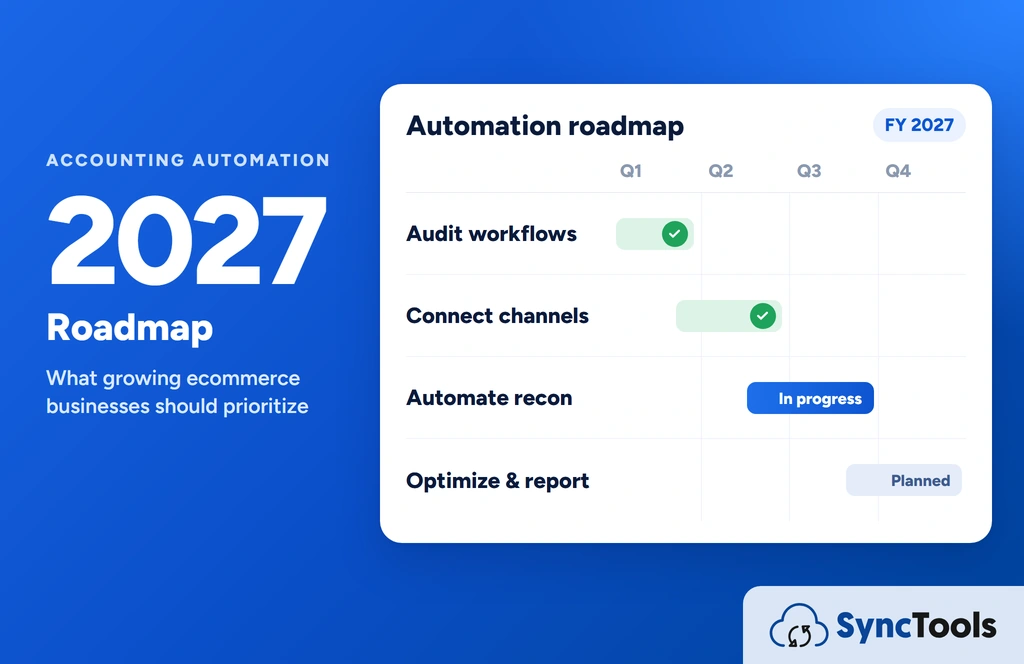
The 2027 ecommerce accounting automation roadmap offers a structured approach to evaluating existing workflows, identifying automation opportunities, and implementing appropriate accounting controls.
The goal is not to automate every financial decision. It is to reduce repetitive work while maintaining accurate records, traceability, and human oversight.
Why Ecommerce Accounting Automation Matters in 2027
The complexity of ecommerce accounting extends beyond the number of orders a business receives.
Each sales channel may have different settlement schedules, fee structures, refund procedures, and reporting formats.
For businesses planning their 2027 operations, this highlights the importance of reviewing how financial information moves between ecommerce platforms and accounting software.
Three areas deserve particular attention:
- Transaction accuracy: Sales, refunds, taxes, fees, and adjustments must be classified correctly.
- Reconciliation: Marketplace settlements should be traceable to bank deposits and accounting records.
- Financial visibility: Product costs, channel profitability, and outstanding balances should be available for management review.
Accounting automation can support these objectives when integration configurations, account mappings, and review procedures are established correctly.
The 2027 Ecommerce Accounting Automation Roadmap
The following roadmap divides implementation into four practical phases. Businesses can adapt the schedule according to their transaction volume, existing systems, and accounting requirements.
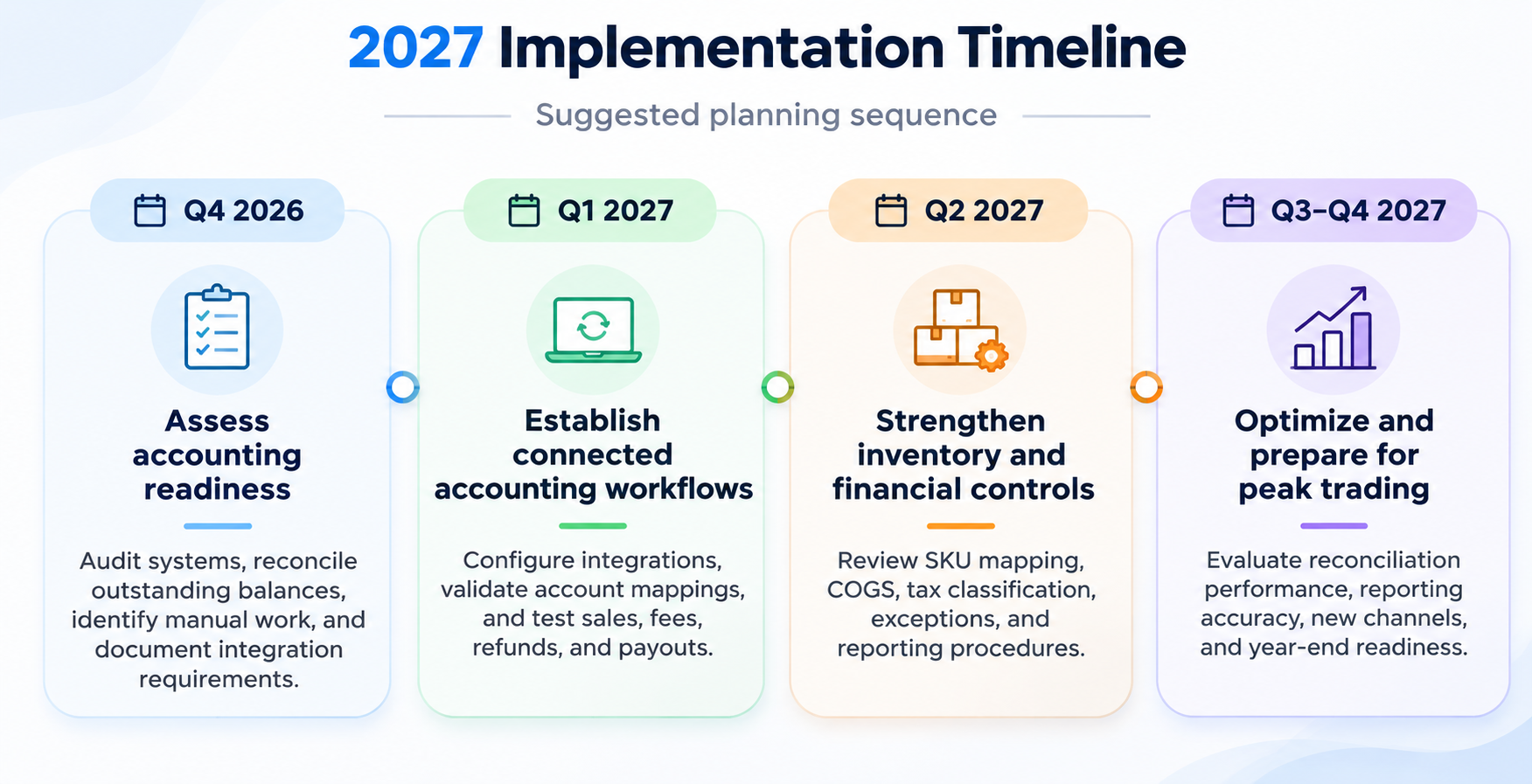
Phase 1: Audit Your Existing Accounting Workflows Before 2027
Before investing in accounting automation, businesses should understand how they currently record and reconcile financial data.
Start by documenting every system involved in the accounting process, including e-commerce storefronts, marketplaces, payment processors, inventory systems, and general ledger software.
Next, examine how transactions move between these systems.
For example, a Shopify business using QuickBooks may spend considerable time:
- exporting sales records
- categorizing payment processing fees
- matching settlements with bank deposits
As transaction volumes increase, these activities can become more difficult to manage manually.
A Shopify QuickBooks integration can help connect sales and accounting data, reducing repetitive data entry while supporting more consistent transaction recording and reconciliation
What should your accounting audit cover?
| Accounting area | Questions to investigate |
|---|---|
| Sales recording | Are gross sales and discounts recorded separately? |
| Payout reconciliation | Can you trace every settlement to its underlying transactions? |
| Refund management | Are refunds and chargebacks classified correctly? |
| Inventory and COGS | Do product costs match approved inventory records? |
| Tax accounting | Are tax liabilities separated from revenue? |
| Financial reporting | Can finance teams identify unexplained differences before month-end? |
Expected outcome: A documented list of accounting gaps, existing controls, and workflows suitable for automation.
Phase 2: Connect Ecommerce Sales Channels With Accounting Software
Once the accounting assessment is complete, the next priority is establishing reliable connections between sales channels and accounting systems.
The objective is to transfer relevant transaction information without repeatedly preparing manual exports.
How SyncTools fits into this phase
SyncTools provides e-commerce accounting integrations connecting supported sales channels with accounting platforms.
Its website identifies integrations involving:
- Shopify, Amazon, eBay, WooCommerce, and Linnworks
- QuickBooks, Xero, and Zoho Books
Depending on the integration and configuration, accounting data can include sales, refunds, fees, taxes, payouts, products, and other relevant records.
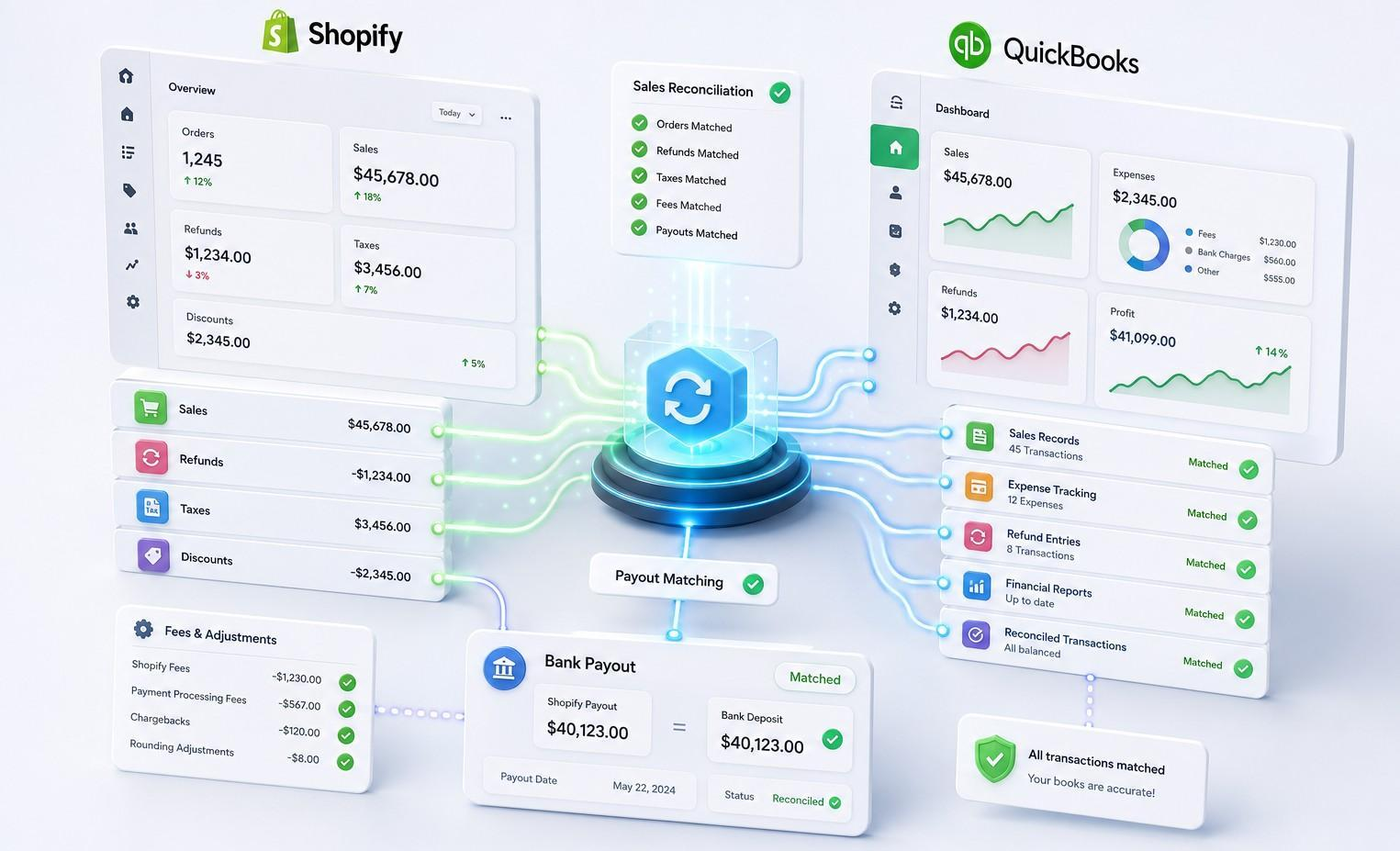
Integration planning should begin with the systems and transaction types a business actually uses.
Before implementation, finance teams should confirm the supported data fields, synchronization approach, account mappings, and reconciliation requirements for their selected integration.
Test a representative accounting period before broader adoption.
Phase 3: Prioritize Payout Reconciliation, COGS, and Tax Mapping
After establishing the initial integrations, businesses should focus on accounting processes that affect financial reporting accuracy.
1. Automate payout reconciliation
Marketplace settlements frequently include deductions that make the bank deposit different from gross sales.
Consider this illustrative example:
| Transaction component | Amount |
|---|---|
| Gross sales | $25,000 |
| Refunds | −$1,200 |
| Payment processing fees | −$650 |
| Marketplace fees | −$900 |
| Other settlement adjustments | −$250 |
| Net bank payout | $22,000 |
The example assumes taxes and other settlement components are not included.
Recording only the $22,000 deposit as revenue would omit important financial activity.
A properly configured accounting workflow should preserve the relevant transaction categories and support reconciliation between settlement reports, accounting entries, and bank deposits.
2. Improve product mapping and COGS accounting
For inventory-based ecommerce businesses, accurate cost accounting depends on reliable product identifiers and approved cost information.
Finance teams should establish consistent SKU mapping, verify the inventory costing method, and review how returns and adjustments affect COGS.
Automation can help transfer and classify relevant records, but inventory valuation policies and source data still require appropriate oversight.
3. Review sales tax and VAT classification
Businesses operating across jurisdictions may need to distinguish collected taxes from revenue and identify the appropriate tax liabilities.
Tax rules depend on the seller's location, customer location, transaction type, and applicable legislation.
Accounting integrations can support the recording and mapping of tax-related transaction data. They should not be assumed to replace tax determination, filing, or compliance review unless they explicitly support those capabilities.
Phase 4: Optimize Accounting Operations for Growth
By the second half of 2027, businesses should evaluate whether their accounting workflows are performing as expected.
Useful performance indicators include:
| KPI | What it measures |
|---|---|
| Reconciliation completion rate | Percentage of settlements reconciled for a reporting period |
| Unresolved payout differences | Number and value of outstanding discrepancies |
| Month-end close duration | Time required to finalize financial records |
| Manual accounting adjustments | Volume of corrections requiring human intervention |
| Product mapping exceptions | SKUs requiring mapping investigation |
| Transaction processing exceptions | Failed, duplicated, or incomplete transfers |
Businesses should establish their own baseline measurements and realistic improvement targets.
Next, review whether new marketplaces, product lines, or accounting requirements call for changes to the existing integration configuration.
Industry-Specific Accounting Automation Priorities for 2027
Different ecommerce industries face different accounting challenges. A suitable automation roadmap should account for the business's product structure, transaction activity, and reporting needs.
| Industry | Accounting challenge | 2027 automation priority |
|---|---|---|
| Fashion & Apparel | Size and color variants, seasonal discounts, returns | SKU mapping, refunds, COGS |
| Health & Beauty | Promotions, subscriptions, product bundles | Sales classification, product mapping |
| Consumer Electronics | High-value inventory, marketplace fees, returns | Product costs, settlement reconciliation |
| Home & Furniture | Freight costs, high-ticket orders, returns | COGS, cost allocation, refunds |
| Sports & Outdoor | Multichannel sales, seasonal inventory | Marketplace payouts, product mapping |
SyncTools identifies these industries among its target ecommerce verticals. Businesses should evaluate which workflows their chosen integrations and configurations support.
SyncTools
How to Evaluate Ecommerce Accounting Automation Software for 2027
Selecting an accounting automation platform requires more than checking whether it connects to Shopify or QuickBooks.
Finance teams should assess how the software handles their actual accounting transactions.
Consider the following questions before making a purchasing decision:
- Does the platform support our existing sales channels and accounting software?
- Can it distinguish gross sales, refunds, processing fees, and settlement adjustments?
- Does it support the transaction-level or summarized accounting approach we require?
- How does it handle product mappings, inventory costs, and COGS?
- What happens when a transaction fails to synchronize?
- Can our accountants trace accounting entries to supporting transaction records?
- What implementation, review, and ongoing maintenance responsibilities remain with our team?
A product demonstration using representative business transactions can help determine whether the solution fits existing accounting policies and operational requirements.
Is Your Ecommerce Business Ready for Accounting Automation?
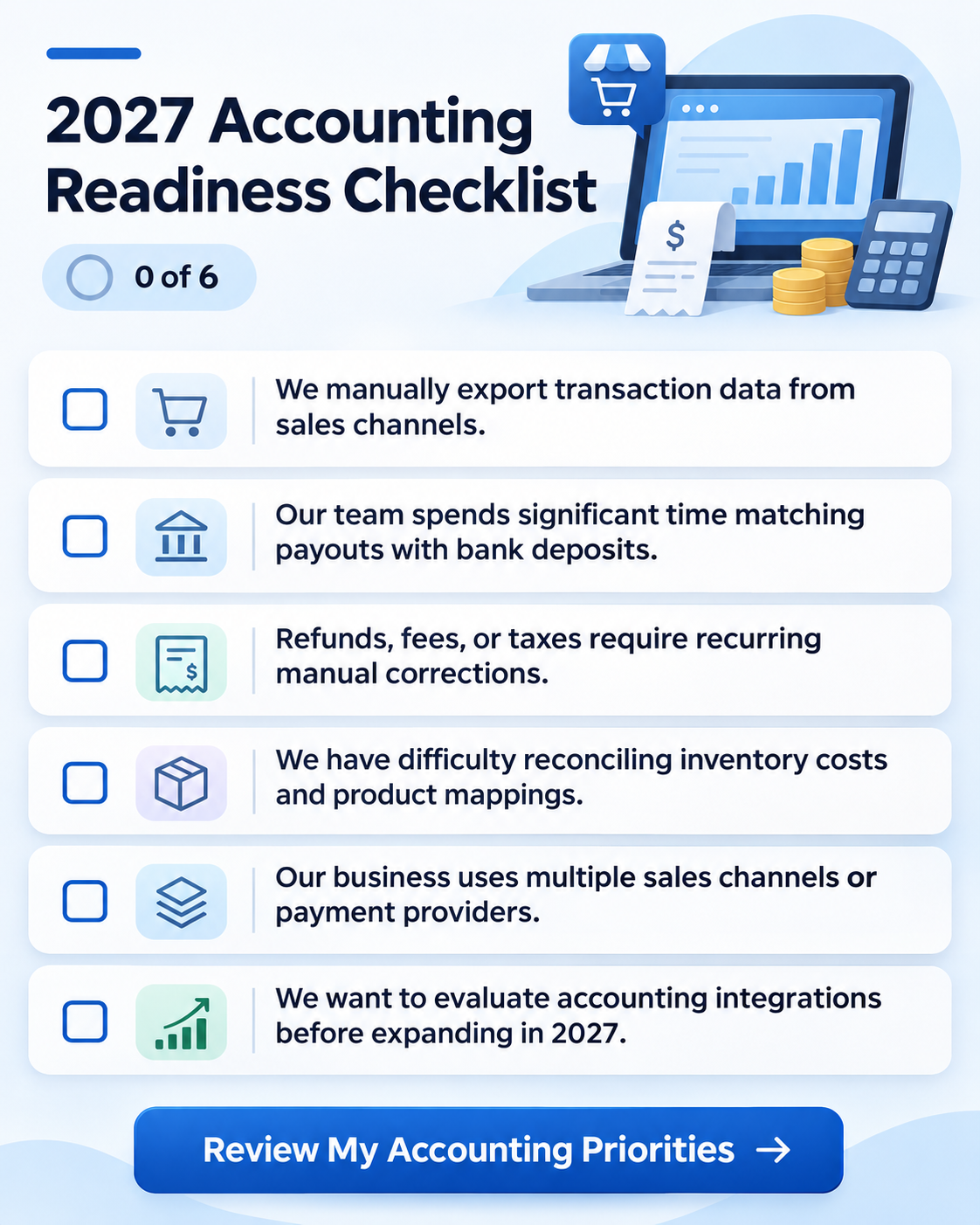
Build Your 2027 Accounting Roadmap With SyncTools
Preparing for 2027 is an opportunity to reassess how ecommerce financial data moves between sales channels, payment systems, and accounting software.
If your business faces recurring payout differences, manual transaction entry, inconsistent product mappings, or growing reconciliation workloads, it may be worth evaluating accounting automation.
SyncTools offers ecommerce accounting integrations designed to support connected transaction recording and reconciliation workflows.
Rather than committing to a platform based on features alone, start by evaluating your existing accounting stack and identifying which workflows need attention.
Frequently Asked Questions
What is ecommerce accounting automation?
Ecommerce accounting automation uses connected software to reduce manual transaction imports, account classification, and reconciliation work between sales channels and accounting systems.
When should an ecommerce business automate its accounting?
Businesses should consider automation when transaction complexity, reconciliation exceptions, or manual processing requirements begin affecting accounting efficiency and financial reporting.
Can Shopify accounting be automated with QuickBooks or Xero?
Yes. Supported integrations can transfer e-commerce accounting data between Shopify and accounting software such as QuickBooks or Xero. Available transaction types and workflows depend on the integration configuration.
Does accounting automation replace an accountant?
No. Accountants remain responsible for reviewing accounting policies, exceptions, reconciliations, and financial statements.
How should businesses begin their 2027 automation roadmap?
Start with an accounting workflow assessment, prioritize reconciliation and data accuracy, test integrations using representative transactions, and measure results before expanding.
Ready to automate your accounting?
Connect Shopify, WooCommerce, or Linnworks to QuickBooks, Xero & more. Setup in minutes.