How to Choose the Right Ecommerce Accountant for Your Business
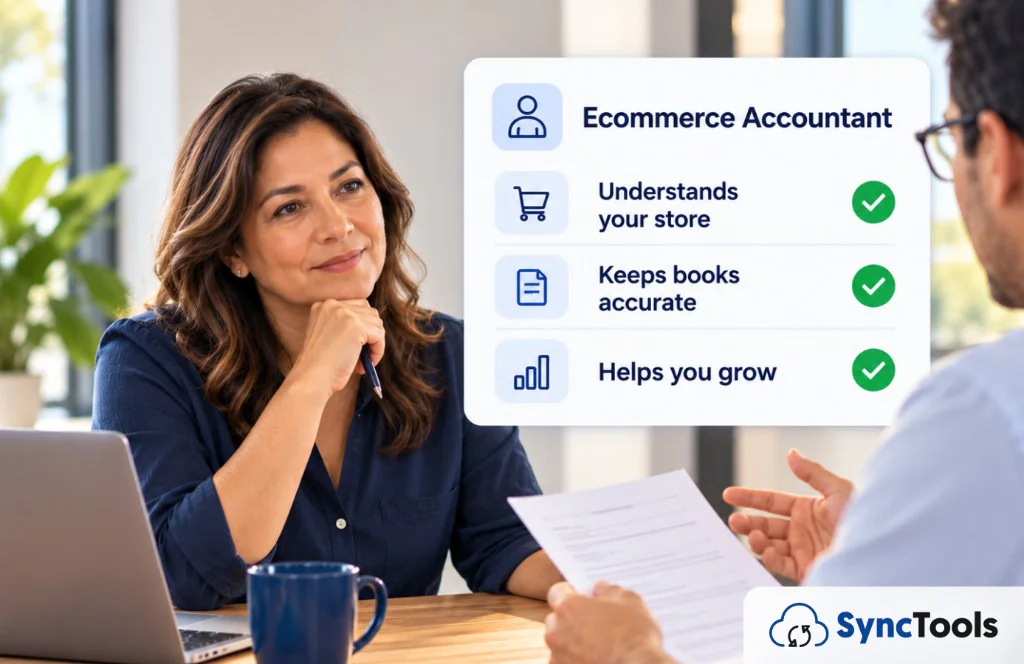
Choosing an ecommerce accountant is not just about finding someone who knows QuickBooks, has a CPA credential, or offers a competitive monthly fee.
The more important question is:
Do they understand how money actually moves through your ecommerce business?
A $100 ecommerce sale may not result in a $100 bank deposit. Discounts, refunds, payment processing fees, marketplace commissions, taxes, chargebacks, currency conversion, and payout timing can all affect the amount that finally reaches your bank account.
That means an ecommerce accountant needs to understand more than bookkeeping. They should understand the transaction flow connecting your store, payment providers, marketplaces, payouts, bank account, inventory, and accounting system.
Before hiring one, give them a simple test:
"Walk me through how you would reconcile one real ecommerce payout from the underlying transactions to the bank deposit and then into QuickBooks or Xero."
Their answer can reveal more about their ecommerce accounting experience than a long list of credentials.
This guide explains what to look for, what questions to ask, which red flags to watch for, when you may need an ecommerce CPA or tax specialist, and how accounting technology can support the relationship.
What Does an Ecommerce Accountant Actually Do?
An ecommerce accountant helps manage and interpret the financial activity generated by an online business.
That can include:
- Bookkeeping oversight
- Payout reconciliation
- Revenue recognition
- Refund accounting
- Payment and marketplace fee recording
- Inventory accounting
- COGS
- Sales tax, VAT, or GST coordination
- Multi-currency accounting
- Financial reporting
- Cash flow analysis
- Month-end close
- Tax preparation or coordination
- Financial planning
The exact services vary by firm and professional qualifications.
The important distinction is that ecommerce accountants understand how online selling platforms create financial data.
For example, they should understand that a Shopify Payments deposit isn't necessarily the same as sales revenue.
Shopify allows merchants to review the transactions, fees, and payouts that contribute to Shopify Payments activity. Refunds can also reduce upcoming payouts, and the original credit card processing fee generally is not returned when an order is refunded.
That creates an accounting problem a traditional bank-feed-only workflow may not fully explain.
Why Ecommerce Accounting Requires Specialized Knowledge
Consider a simplified example.
Your Shopify store records the following activity:
| Activity | Illustrative Amount |
|---|---|
| Gross sales | $50,000 |
| Discounts | -$1,500 |
| Refunds | -$2,000 |
| Payment processing fees | -$1,300 |
| Other payout adjustments | -$200 |
| Illustrative amount available through payouts | $45,000 |
These figures are illustrative, but the accounting problem is real.
If someone sees $45,000 entering the bank and simply records:
Sales: $45,000
Important information disappears.
The business may lose visibility into:
- Gross revenue
- Refunds
- Discounts
- Processing fees
- Other adjustments
Your accountant should be able to trace the activity behind the deposit.
The Ecommerce Money Trail
If a prospective accountant can clearly explain that flow for your business, you are already asking a better question than:
"Have you worked with Shopify before?"
When Do You Need an Accountant for an Ecommerce Business?
Not every online seller needs a specialist from day one.
Your need usually increases with accounting complexity, not a specific revenue or order threshold.
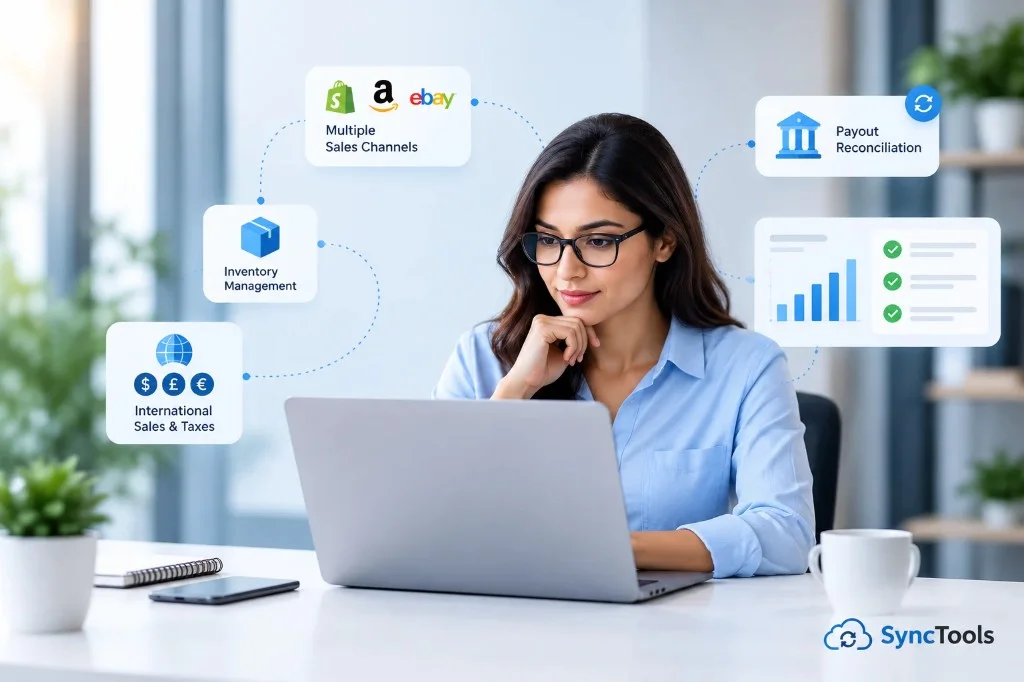
Consider specialized ecommerce accounting support when:
- You sell through multiple channels.
- Payouts no longer reconcile easily.
- You carry meaningful inventory.
- Refunds and chargebacks are increasing.
- You sell internationally
- You operate in multiple currencies.
- Sales tax, VAT, or GST obligations are becoming more complicated.
- Your bookkeeping depends heavily on spreadsheets.
- Month-end close takes too long.
- You cannot confidently explain your gross margin.
- You are preparing for investment, financing, or a sale.
- Financial reports are no longer giving management the information it needs.
A Useful Test
Ask yourself:
Could I explain exactly how last month's ecommerce sales became the deposits appearing in my bank and the numbers appearing in my P&L?
If the answer is no, getting specialist help may be worthwhile.
Ecommerce Accountant vs Bookkeeper vs Ecommerce CPA
One of the first questions should be:
What type of professional does my business actually need?
| Need | Ecommerce Bookkeeper | Ecommerce Accountant | Ecommerce CPA |
|---|---|---|---|
| Day-to-day bookkeeping | Strong fit | Yes | Yes |
| Payout reconciliation | Yes, with ecommerce experience | Yes | Yes |
| Monthly close | Yes | Yes | Yes |
| Financial reporting | Basic to moderate | Strong | Strong |
| Inventory/COGS accounting | Depends on experience | Strong | Strong |
| Financial analysis | Limited to moderate | Strong | Strong |
| Tax preparation | Depends on qualifications | Depends | Often |
| Tax planning | Usually limited | Depends | Stronger fit where relevant |
| IRS representation in the US | Generally no | Depends on credential | Yes |
| Strategic financial advice | Limited | Yes | Yes |
A CPA is not automatically a better ecommerce accountant.
A CPA might have excellent tax credentials but limited experience with Shopify settlements or Amazon marketplace accounting.
Conversely, an experienced ecommerce accountant or bookkeeper may understand marketplace reconciliation extremely well but not provide the tax services your business requires.
For US businesses, the IRS confirms that tax professionals can have different credentials, education, expertise, and representation rights. CPAs, enrolled agents, and attorneys generally have unlimited representation rights before the IRS.
The question is therefore not:
"Is a CPA better?"
It is:
"What work do I need this person to perform?"
Need the Right Ecommerce Accounting Support?
Whether you need day-to-day bookkeeping, payout reconciliation, financial reporting, inventory accounting, or tax support, the right professional depends on your business needs.
Do You Need an Ecommerce Tax Accountant?
An ecommerce tax accountant becomes particularly relevant when tax complexity increases.
Examples include:
- Selling across US states
- Expanding internationally
- VAT or GST registrations
- Multiple legal entities
- Inventory stored in different jurisdictions
- Marketplace sales
- Cross-border transactions
- Business restructuring
- Tax planning
Tax rules depend heavily on where your business and customers are located.
Don't assume someone who understands ecommerce bookkeeping automatically understands every jurisdiction where you operate.
For US businesses specifically, the IRS recommends checking a tax professional's qualifications and credentials and provides its own preparer directory.
Important distinction
An ecommerce accountant can help build reliable accounting records.
An ecommerce tax accountant or appropriately qualified tax professional helps determine how relevant tax rules apply.
Depending on your business, you may need both.
9 Things to Look for When Comparing Ecommerce Accountants
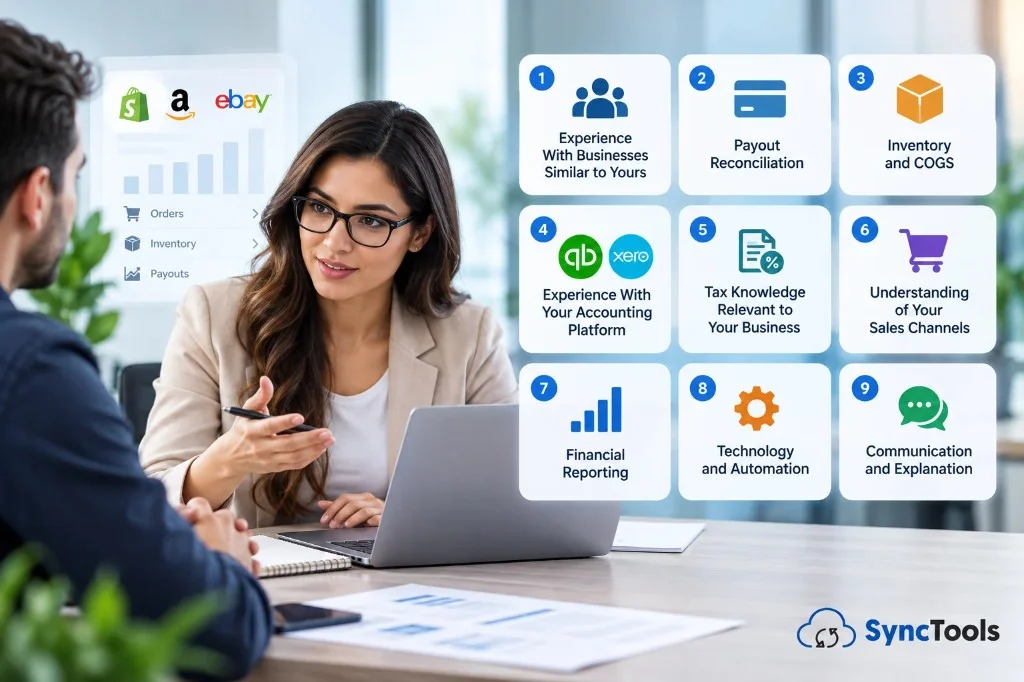
Searching for ecommerce accountants will produce plenty of options.
The harder part is evaluating them.
1. Experience With Businesses Similar to Yours
Don't stop at:
"Do you have ecommerce clients?"
Instead ask:
"How many clients do you work with that have a similar sales-channel and accounting setup to ours?"
Compare experience based on:
- Selling platforms
- Payment gateways
- Monthly transaction volume
- Countries
- Currencies
- Inventory model
- Accounting software
- Reporting complexity
An accountant supporting a small Shopify-only retailer may face very different accounting challenges from one handling Shopify, Amazon, wholesale, international currencies, and multiple entities.
Relevant experience matters more than the broad label ecommerce specialist accountant.
2. Understanding of Payout Reconciliation
This should be near the top of your evaluation.
Ask:
"How do you reconcile an ecommerce payout to the bank?"
A strong answer should go beyond matching the final deposit.
The accountant should consider the transactions that created it.
Depending on the platform, those can include:
- Sales
- Refunds
- Fees
- Chargebacks
- Taxes
- Adjustments
- Currency conversion
- Payout timing
Shopify provides merchants with payout and activity reporting to review transactions, fees, and payouts.
If an accountant focuses only on the bank deposit, ask more questions.
A strong reconciliation process should also account for refunds, fees, chargebacks, timing differences, failed transactions, and other adjustments that may explain why the payout differs from gross sales.
3. Understanding of Inventory and COGS
Inventory accounting deserves special attention for product businesses.
Your accountant should understand the relationship between:
Inventory purchases → Inventory asset → Product sale → COGS
Depending on your operation, they may also need to understand:
- Landed costs
- Freight
- Bundles
- Kits
- Returns
- Damaged goods
- Write-offs
- Multiple warehouses
- Inventory adjustments
Ask:
"How would you verify whether our inventory and COGS numbers are accurate at month-end?"
The answer should include more than simply accepting whatever number appears in the e-commerce platform.
4. Experience With Your Accounting Platform
If you use QuickBooks Online, your accountant should understand how ecommerce activity should fit into QuickBooks.
Relevant topics can include:
- Chart of accounts
- Clearing accounts
- Bank reconciliation
- Journal entries
- Inventory
- COGS
- Classes or locations where applicable
- Ecommerce integrations
QuickBooks provides a ProAdvisor directory where businesses can find accounting professionals and filter by location, industry, and other criteria.
However, Intuit explicitly notes that ProAdvisors are independent professionals and encourages businesses to evaluate whether each advisor is genuinely right for them.
The same principle applies to Xero.
Xero's advisor directory includes firms with staff trained in Xero and at least eight Xero clients. It also lets businesses search for advisors with relevant industry experience, including ecommerce.
Certification is useful evidence of software knowledge.
It does not automatically prove ecommerce expertise.
5. Tax Knowledge Relevant to Your Business
Don't ask:
"Do you understand ecommerce tax?"
Ask:
"Which tax jurisdictions relevant to our business does your firm regularly work with?"
Then provide context:
- Business registration location
- Customer locations
- Warehouse locations
- Marketplaces
- Existing tax registrations
- Expansion plans
Be cautious when a professional makes definitive tax claims before understanding those facts.
6. Understanding of Your Sales Channels
An accountant should understand that different sales channels can create different transaction and payout structures.
Shopify, Amazon, eBay, wholesale orders, and other channels do not necessarily send financial data to your accounting system in the same way.
Ask:
"Which of our sales channels have you worked with, and how does the accounting workflow differ between them?"
Look for whether they understand:
- How each platform handles payouts
- Marketplace and payment fees
- Refunds and chargebacks
- Tax data
- Settlement timing
- Channel-specific reconciliation
- How transactions reach QuickBooks or Xero
The goal is not simply to find someone who has heard of your platforms. You want someone who understands how their financial activity should be accounted for.
7. Financial Reporting
Good bookkeeping answers:
"Are the transactions recorded?"
Good ecommerce accounting should also help answer:
"What are these numbers telling us?"
Ask what reports you will receive.
| Report | Business Question |
|---|---|
| Profit & Loss | Are we profitable? |
| Balance Sheet | What do we own and owe? |
| Cash Flow | Where is cash going? |
| Gross Margin | What remains after product costs? |
| Sales by Channel | Which channel generates revenue? |
| Refund Analysis | How much revenue is being reversed? |
| Inventory Report | How much capital sits in stock? |
| Payout Reconciliation | Do platform settlements match bank activity? |
Your exact reporting requirements will differ.
What matters is whether the accountant understands the decisions those reports need to support.
8. Technology and Automation
Modern ecommerce accounting usually involves more than one system.
A typical technology stack may include:
An accountant does not need to develop integrations personally.
They should understand how accounting data moves between systems and which controls are required.
Ask:
"Which parts of our workflow would technology handle, and which parts would your team review?"
Good candidates should be comfortable explaining that boundary.
9. Communication and Explanation
Technical knowledge matters.
Communication matters too.
Your accountant should be able to clearly explain:
- two reports differ
- a payout does not equal sales
- a clearing balance remains open
- changed in gross margin
- inventory changed
- assumptions sit behind a tax treatment
- exceptions require investigation
If every explanation requires accounting jargon you cannot understand, the relationship may become frustrating.
A good accountant should make your numbers clearer, not more confusing.
Find the Right Ecommerce Accounting Partner
Get reliable support for reconciliation, inventory, reporting, tax, and multi-channel ecommerce accounting.
The Best Way to Test an Ecommerce Accountant Before Hiring
Here is where we recommend going beyond the standard interview checklist.
Give the candidate a realistic payout scenario.
The Ecommerce Accountant Payout Test
Scenario
"My Shopify store shows $80,000 in gross sales for the period, but only $71,400 reached the bank. How would you investigate the difference and reconcile the activity in QuickBooks Online or Xero?"
Do not ask them to calculate the answer immediately.
Ask them to explain what they would investigate.
A capable accountant should start considering factors such as:
They should also explain how those components would be represented in your accounting records.
Why this test works
Anyone can say:
"Yes, we specialize in ecommerce."
It is much harder to fake an understanding of the transaction flow.
You are not testing whether they memorize Shopify documentation.
You are testing whether they think like someone who regularly reconciles ecommerce businesses.
15 Questions to Ask an Ecommerce Accountant
When speaking with prospective ecommerce accountants, ask questions that require explanations, not yes/no answers.
Business experience
- How many businesses similar to ours does your firm currently support?
- Which ecommerce platforms and marketplaces do those clients use?
- What transaction volumes and business sizes do you typically work with?
Reconciliation
- Walk me through how you reconcile Shopify or marketplace payouts to the bank.
- How do you account for fees, refunds, chargebacks, and payout adjustments?
- How do you identify missing, duplicate, or incorrectly recorded transactions?
Inventory and accounting
- How do you handle inventory and COGS?
- What experience do you have with QuickBooks Online or Xero?
- How do you use clearing accounts in ecommerce accounting?
Technology
- What ecommerce accounting software or integrations do you typically use?
- Which accounting tasks are automated and which are reviewed manually?
Reporting
- What reports will we receive each month?
- How quickly after month-end should we expect reviewed financials?
Relationship
- Who will actually work on our account?
- What information would you need from us before recommending an accounting workflow?
The final question is especially useful.
Good accountants should have plenty of questions for you.
What Happens When Something Doesn't Reconcile?
A strong answer should describe a clear investigation process rather than simply saying they will "fix the difference."
Look for whether they explain how they would:
- Identify the payout in question
- Trace the underlying transactions
- Check refunds
- Review fees
- Check payout timing
- Identify failed or duplicate transactions
- Review account mappings
- Investigate unmatched entries
- Document any required adjustment
- Resolve the exception
- Review the resulting accounting entry
This question is particularly useful because reconciliation problems are rarely solved by looking at only one number.
What Should an Ecommerce Accountant Ask You?
The evaluation should work both ways.
An accountant cannot properly assess your business without understanding how it operates.
Expect them to ask about:
| Information | Why It Matters |
|---|---|
| Selling channels | Identifies transaction sources |
| Accounting platform | Defines ledger workflow |
| Payment gateways | Affects reconciliation |
| Order volume | Helps assess accounting complexity |
| Countries | Creates tax/currency considerations |
| Inventory | Affects inventory and COGS |
| Warehouses | Can affect inventory and tax considerations |
| Currencies | Adds FX complexity |
| Existing integrations | Shows how data currently moves |
| Tax registrations | Identifies existing obligations |
| Legal entities | Affects reporting |
| Management reporting | Determines required detail |
If an accounting firm quotes a monthly price immediately without understanding any of these details, ask what assumptions that quote is based on.
Ecommerce Accounting Firm vs Independent Accountant
Another decision is whether to work with an individual professional or anecommerce accounting firm.
Neither is automatically better.
| Independent Accountant | Ecommerce Accounting Firm |
|---|---|
| Often more direct communication | Broader team resources |
| You may work with the same person | May have specialists for different areas |
| Potentially simpler relationship | Better capacity as complexity grows |
| Can provide highly personalized service | May provide bookkeeping, tax, and advisory under one roof |
| Capacity can depend heavily on one person | Work may be shared across team members |
When comparing ecommerce accounting firms, ask:
Who will actually perform the work?
A firm's website may feature senior partners, while another team manages your monthly bookkeeping.
That is not necessarily a problem.
You need to know:
- Who performs bookkeeping?
- Who reviews it?
- Who handles tax?
- Who answers questions?
- Who reviews financial reports?
- What happens if your primary contact is unavailable?
Understanding the service model also makes pricing easier to evaluate.
How to Evaluate Ecommerce Accounting Services
Don't compare accounting providers based on monthly price alone.
Compare what is actually included.
For example:
| Service | Provider A | Provider B | Provider C |
|---|---|---|---|
| Monthly bookkeeping | ✓ | ✓ | ✓ |
| Payout reconciliation | ✓ | ✓ | ? |
| Inventory/COGS | ✓ | Extra | No |
| Tax preparation | Extra | ✓ | Extra |
| Monthly reporting | ✓ | ✓ | Quarterly |
| Advisory calls | Monthly | Quarterly | Extra |
| Ecommerce integrations | ✓ | Limited | ✓ |
| Historical cleanup | Extra | Extra | Included |
A $500 monthly package and an $800 package may not be comparable.
Define your requirements first.
Then compare.
Ecommerce Accountant Near Me: Does Location Really Matter?
Search demand shows that many business owners still search terms such as:
ecommerce accountant near me
or
ecommerce CPA near me
There is nothing wrong with wanting a local professional.
But ecommerce accounting itself is already digital.
Your sales platform, payment gateway, bank, QuickBooks/Xero account, reports, and supporting documents may all exist online.
That means expertise can often be more important than proximity.
QuickBooks and Xero both maintain directories that allow businesses to find accounting professionals, including by location and industry experience.
A better selection hierarchy may be:
- Relevant ecommerce expertise
- Accounting software knowledge
- Tax/jurisdiction knowledge
- Experience with your operational complexity
- Communication
- Location
There are exceptions.
If you need jurisdiction-specific tax services or a regulated professional service, location and professional licensing can matter more.
Red Flags When Choosing Ecommerce Accountants
Pay attention to how prospective accountants answer your questions.
Red Flag 1: They Treat Net Deposits as Revenue
If they routinely record the entire payout as sales without reviewing the underlying transactions, your books can lose important detail.
Red Flag 2: They Cannot Explain Payout Reconciliation
An ecommerce specialist should be able to explain what goes into a settlement.
Red Flag 3: They Never Ask About Inventory
For product businesses, inventory and COGS can materially affect financial reporting.
Red Flag 4: They Don't Ask About Sales Channels
Amazon, Shopify, wholesale, and other channels can create different accounting workflows.
Red Flag 5: They Say Ecommerce Accounting Is Basically the Same as Every Other Business
The basic accounting rules may be the same, but ecommerce businesses often deal with more complex transaction flows and day-to-day processes.
Red Flag 6: They Recommend Software Before Understanding Your Workflow
Technology should support the accounting design.
It should not define it blindly.
Red Flag 7: They Promise That Automation Removes the Need for Review
Automation can reduce repetitive work.
Accounting controls and professional judgment are still required.
Red Flag 8: They Make Broad Tax Guarantees
Tax treatment depends on the business, transaction, and jurisdiction.
Red Flag 9: They Cannot Tell You What Your Monthly Reports Will Include
You should know what you are buying.
Red Flag 10: Nobody Can Explain Who Owns the Account
Know who prepares, reviews, advises, and responds.
Compare Ecommerce Accountants With a Practical Evaluation Matrix
A weighted total can hide important weaknesses.
For example, someone could perform very well in general bookkeeping but still lack tax or marketplace reconciliation expertise.
Replace the entire section beginning:
"Use This Ecommerce Accountant Fit Scorecard"
Through the 85–100 / 70–84 scoring interpretation with this:
Rather than combining every capability into one overall score, compare candidates area by area.
A provider may be excellent at tax planning but less experienced with marketplace reconciliation.
Another may understand Shopify payouts extremely well but have limited experience with your tax jurisdiction.
That distinction matters more than one total number.
SyncTools Ecommerce Accountant Comparison Matrix
| Evaluation Area | Provider A | Provider B | Provider C |
|---|---|---|---|
| Ecommerce transaction knowledge | /5 | /5 | /5 |
| Payout reconciliation | /5 | /5 | /5 |
| Your sales channels | /5 | /5 | /5 |
| Inventory & COGS | /5 | /5 | /5 |
| Tax expertise | /5 | /5 | /5 |
| QuickBooks/Xero | /5 | /5 | /5 |
| Technology approach | /5 | /5 | /5 |
| Communication | /5 | /5 | /5 |
How to use the matrix
Score each provider from 1 to 5 based on the quality of their answers, relevant experience, and evidence they provide.
Don't choose solely based on the highest total.
Pay particular attention to low scores in areas that are critical to your business. For example, if you sell heavily through marketplaces, weak marketplace reconciliation should carry more weight in your decision than a high score in an area that is less important to your current setup.
Specialist Ecommerce Networks and Communities
Ecommerce communities, professional networks, software partner ecosystems, and referrals from other online businesses can also help you find accountants with relevant experience.
However, being listed in a specialist network should only be a starting point.
Use the same evaluation process to check their platform experience, payout reconciliation knowledge, inventory understanding, accounting software expertise, and tax capabilities.
Should Your Accountant Use Ecommerce Accounting Software?
Usually, the more useful question is:
Which parts of the accounting workflow should software handle?
Software is good at repeatable activity.
Examples include:
- Importing transaction data
- Applying configured account mappings
- Recording sales
- Capturing fees
- Processing refund data
- Organizing tax data
- Recording COGS
- Transferring payout information
Human accounting expertise remains important for:
- Determining accounting policies
- Approving mappings
- Tax decisions
- Exception handling
- Financial review
- Month-end controls
- Interpretation
- Advice
Think about the relationship this way:
Technology handles repeatable accounting data movement.
The accountant controls accounting judgment.
That distinction matters when evaluating both accountants and software.
Where SyncTools Fits Into the Accountant Relationship
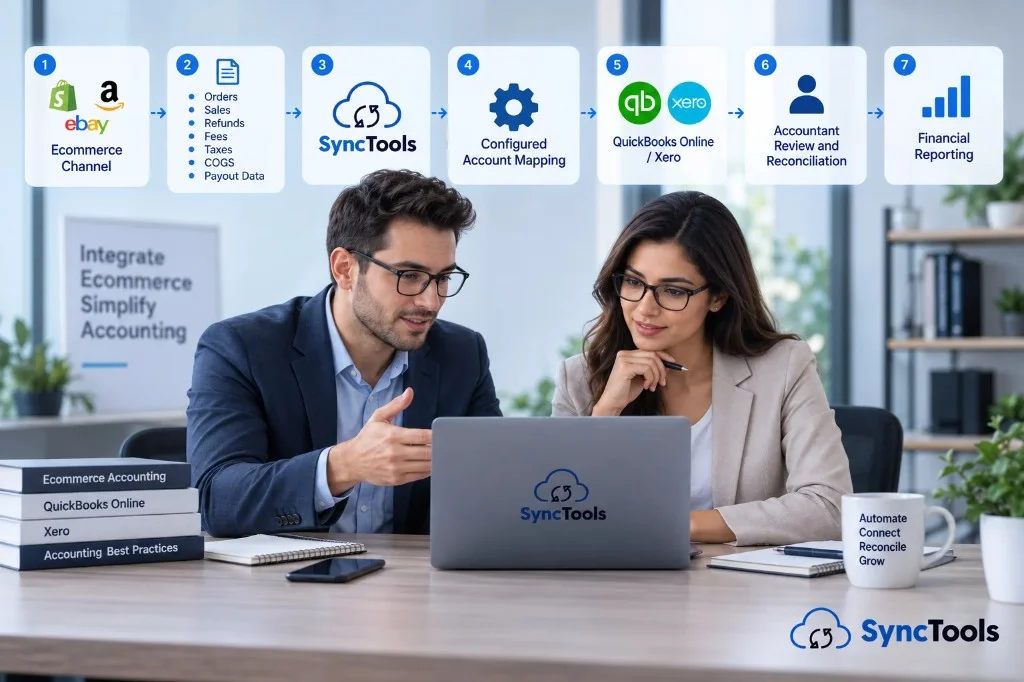
This is where the accounting problem becomes a systems problem.
Your ecommerce accountant might know exactly how sales, fees, refunds, taxes, COGS, and payouts should appear in QuickBooks or Xero.
But someone or something still has to get that information there.
Without an appropriate integration, businesses can end up relying on:
- CSV exports
- Spreadsheet transformations
- Manual journal entries
- Bank-feed categorization
- Repeated month-end adjustments
That creates repetitive work before the accountant can even begin reviewing the numbers.
SyncTools connects ecommerce platforms with accounting systems such as QuickBooks Online and Xero.
For its Shopify and QuickBooks integration, SyncTools currently supports accounting workflows involving Shopify orders, refunds, fees, taxes, COGS, and payout settlements. It also offers summarized and individual transaction sync options, so businesses can configure the accounting flow to fit their needs.
The important point is what SyncTools doesn't replace.
It does not replace:
- Your accountant's judgment
- Tax advice
- Accounting policy decisions
- Financial interpretation
- Professional review
Instead, the relationship can work like this:
Ecommerce Accounting Workflow
Your accountant decides how the books should be structured.
SyncTools moves and maps the underlying ecommerce data according to the configured accounting setup.
That lets the accounting team spend less time rebuilding transaction activity and more time reviewing exceptions, reconciling accounts, checking reporting, and advising the business.
When Does the Accountant + Automation Model Make Sense?
You may benefit from combining an ecommerce specialist accountant with accounting integration technology when:
- Transaction volume is growing.
- Multiple sales channels are involved.
- Payout reconciliation requires significant manual work.
- Fees are being manually categorized.
- Refunds create reconciliation issues.
- COGS needs better tracking
- Your team repeatedly exports CSV files.
- QuickBooks or Xero requires regular manual journals.
- Month-end involves extensive spreadsheet work.
- Your accountant spends too much time preparing data before reviewing it.
The trigger does not have to be a particular number of orders.
A better signal is:
How much accounting complexity has the business accumulated?
Before Hiring, Run This Final Five-Question Check
Before signing an engagement agreement, make sure you can answer these five questions confidently.
1. Does the accountant understand my ecommerce platforms?
Not just ecommerce generally.
Your platforms.
2. Can they explain how payouts reconcile to the bank?
They should understand the transaction activity behind the deposit.
3. Do they understand my inventory, COGS, refunds, fees, and taxes?
These are central parts of product-based ecommerce accounting.
4. Can they explain what technology handles and what their team reviews?
Responsibilities should be clear.
5. Will their reporting help me make decisions?
Clean books are important.
Useful financial information is better.
If you receive strong answers across all five areas, you are much closer to finding the right accountant for your ecommerce business.
Final Thoughts: Choose the Accountant Who Understands the Money Trail
The best ecommerce accountant is not automatically:
- The closest
- The cheapest
- The largest firm
- The person with the most certifications
- The person who uses the most software
The right professional understands how your business actually generates financial activity.
When evaluating ecommerce accountants, start with this flow:
Order → Payment → Refunds → Fees → Taxes → Payout → Bank → Accounting → Reconciliation
Then ask them to explain it.
If they understand that flow, ask good questions about your operation, know the systems you use, recognize where specialist tax expertise is required, and can explain how they'll review the numbers, you have a much stronger basis for choosing them.
Technology comes next.
Once the accounting rules are clear, you should not need highly skilled accountants spending their time repeatedly rebuilding ecommerce transactions from spreadsheets.
That is where SyncTools fits.
It connects ecommerce transaction data to QuickBooks Online or Xero based on your configured accounting workflow, while keeping your accountant responsible for the judgment, controls, review, and advice that require professional expertise.
See Whether Your Accounting Problem Is Really a Data-Flow Problem
If you already have a good accountant but month-end still depends on manually explaining Shopify sales, fees, refunds, COGS, and payouts, changing accountants may not be the first thing you need.
Map this process instead: Ecommerce platform → transaction data → account mapping → accounting system → payout reconciliation → accountant review
If the gap sits between your ecommerce platform and QuickBooks or Xero, explore how SyncTools can support that part of the workflow while your accountant remains in control of the accounting setup and review.
Frequently Asked Questions
How do I choose an ecommerce accountant?
Choose an accountant who understands your sales channels, payouts, refunds, fees, inventory, COGS, taxes, and accounting platform. Ask them to explain how they would reconcile one real payout from your ecommerce platform to your bank and QuickBooks or Xero.
What does an ecommerce accountant do?
An ecommerce accountant manages and reviews financial activity created by online selling. This may include payout reconciliation, bookkeeping oversight, inventory and COGS accounting, refunds, fees, tax coordination, month-end close, and financial reporting.
What should I ask an ecommerce accountant before hiring them?
Ask about their ecommerce clients, sales-channel experience, payout reconciliation process, inventory and COGS knowledge, QuickBooks or Xero experience, tax expertise, reporting, technology use, and what happens when something does not reconcile.
Do I need an ecommerce accountant or an ecommerce CPA?
It depends on the work you need. An experienced ecommerce accountant may be suitable for bookkeeping, reconciliation, reporting, and financial management. A CPA or other qualified tax professional may be more appropriate when you need specialized tax, regulatory, assurance, or representation services.
How do I find an ecommerce accountant?
You can search QuickBooks and Xero advisor directories, professional accounting and tax directories, ecommerce communities, industry referrals, LinkedIn, and specialist accounting firms. Always evaluate the candidate's actual ecommerce experience before hiring.
What should an ecommerce accountant know about Shopify?
They should understand how Shopify orders, payments, refunds, fees, taxes, chargebacks, payouts, and payout timing affect the accounting workflow. They should also understand how Shopify activity reaches QuickBooks or Xero and how those records are reconciled.
How should ecommerce payouts be reconciled?
Start with the underlying transactions that make up the payout, including sales, refunds, fees, taxes, adjustments, and timing differences. The payout should then be matched to the corresponding bank deposit and accounting entries, with any differences investigated.
What is the difference between an ecommerce accountant and a bookkeeper?
An ecommerce bookkeeper generally focuses on recording transactions and maintaining accurate books. An ecommerce accountant may also handle financial analysis, accounting policies, reporting, month-end review, planning, and broader financial guidance.
Does an ecommerce business need a CPA?
Not every ecommerce business needs a CPA for day-to-day accounting. A CPA may become important when the business requires specialized tax planning, financial reporting, assurance work, regulatory support, or representation before tax authorities.
Should an ecommerce accountant use accounting software?
Yes, but software should support the accounting process rather than replace professional judgment. Your accountant should understand tools such as QuickBooks or Xero and know where integrations can help manage repeatable ecommerce transaction data.
Ready to automate your accounting?
Connect Shopify, WooCommerce, or Linnworks to QuickBooks, Xero & more. Setup in minutes.