UAE e-Invoicing: B2B vs B2C, Which E-commerce Orders Actually Need Reporting?
Imagine this.
A Dubai-based online electronics store receives two orders within five minutes.
The first is a laptop an individual buys for personal use. The second is an identical laptop purchased by a company for its employees.
Same product. Same e-commerce website. Same payment gateway.
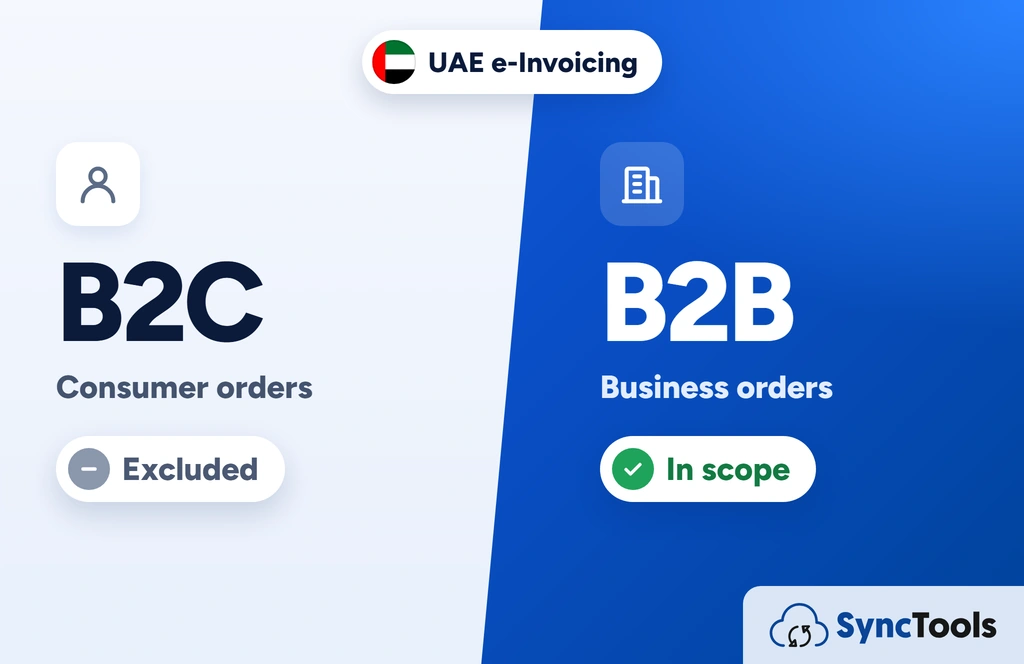
But under the UAE's incoming e-invoicing requirements, these two transactions may have very different reporting obligations. Consumer purchases are currently excluded from mandatory UAE e-invoicing. The qualifying business purchase, however, may require a structured electronic invoice to be exchanged and reported through the prescribed system.
This is where many e-commerce businesses misunderstand UAE e-invoicing: the obligation is not determined simply by whether a sale happens online.
It depends on who is buying, the nature of the transaction, the supplier's obligations, and the applicable exclusions.
With mandatory implementation beginning in January 2027, understanding these distinctions is becoming increasingly important for UAE retailers, wholesalers, marketplace sellers, and finance teams.
One Ecommerce Store, Two Different Reporting Outcomes
Let's consider a UAE retailer selling electronics through Shopify.
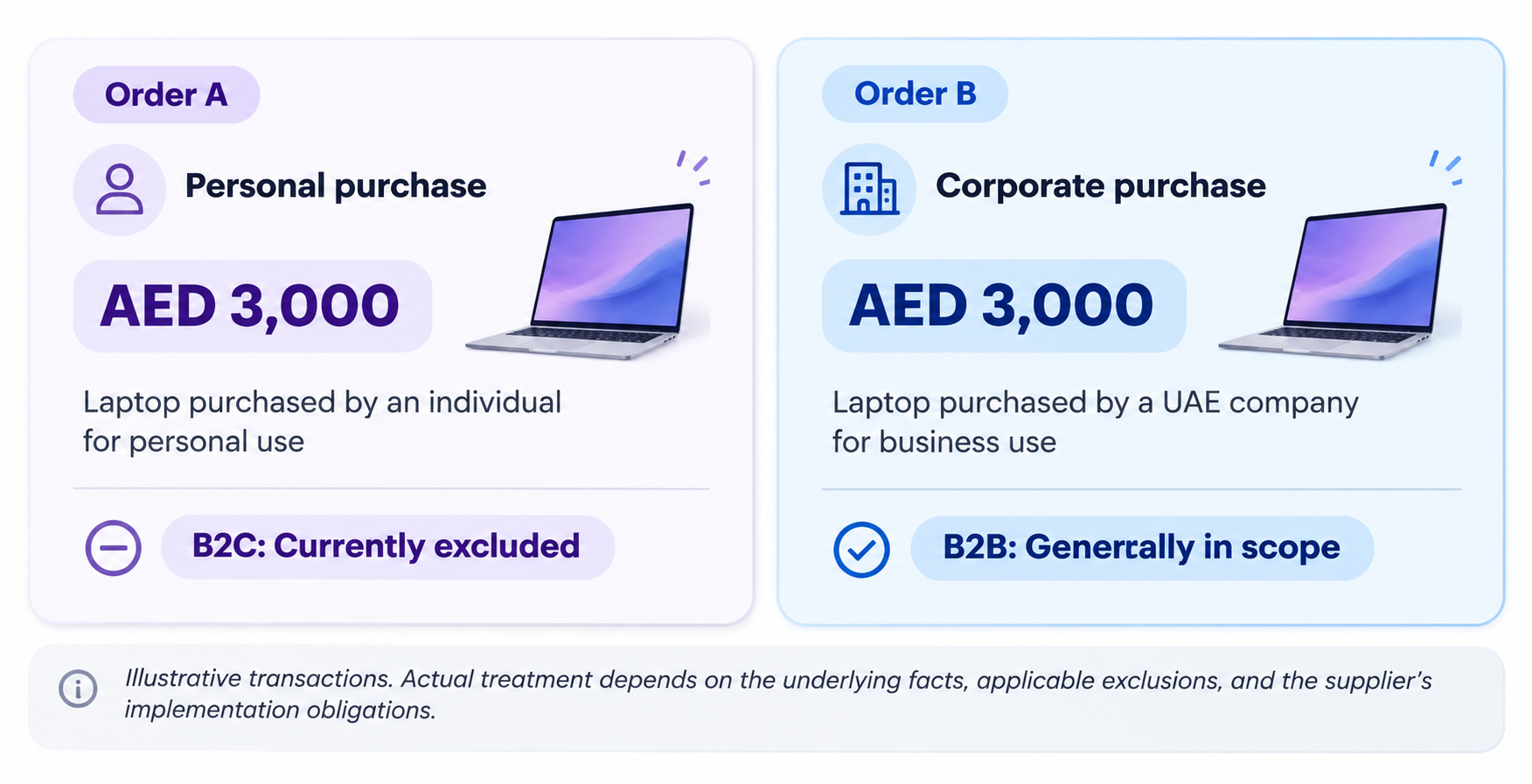
For Order A, the seller must continue fulfilling relevant VAT invoicing and recordkeeping obligations, but the transaction is presently excluded from mandatory electronic invoicing.
For Order B, the seller may need to issue a structured electronic invoice using an Accredited Service Provider (ASP), once the seller's applicable implementation phase begins.
The distinction matters because ecommerce platforms typically focus on capturing and fulfilling orders, while UAE e-invoicing requires businesses to evaluate the legal and tax treatment of the underlying supply.
A successful checkout does not necessarily mean the transaction has all the information required for electronic invoicing.
The Misconception: Every Ecommerce Sale Needs an eInvoice
The UAE Ministry of Finance has clarified that the electronic invoicing framework generally applies to business-to-business (B2B) and business-to-government (B2G) transactions, subject to specified exclusions.
Business-to-consumer (B2C) transactions are currently excluded until a further ministerial decision.
That does not mean B2C transactions are free from tax or accounting requirements.
A UAE retailer may still need to issue the appropriate VAT documentation, maintain sales records, calculate applicable VAT, and record returns and refunds.
The difference concerns whether the transaction must enter the new structured electronic invoice exchange and reporting system.
A B2C exclusion is an e-invoicing exclusion, not a blanket tax exemption.
For businesses with mixed customer bases, the distinction becomes more complicated.
A fashion retailer might sell directly to consumers during the day and fulfill wholesale orders for corporate buyers in the evening. A furniture brand might serve households, interior design firms, and government buyers through the same e-commerce operation.
These businesses cannot assume that one invoicing treatment automatically applies to every order.
Source: UAE Ministry of Finance: Scope of e-invoicing obligations.
Five Ecommerce Transactions That Deserve a Closer Look
Real ecommerce operations rarely fit into a simple B2B-versus-B2C checkbox.
Consider the following situations.
| Ecommerce transaction | Likely treatment | What the seller should examine |
|---|---|---|
| Individual orders of skincare products for personal use | B2C, currently excluded | Maintain applicable VAT and sales records |
| UAE company buys 50 office chairs | Generally B2B, in scope | Buyer details, invoice requirements, tax treatment |
| Government department orders IT equipment | Generally B2G, in scope | Government buyer information and applicable procedures |
| UAE distributor sells inventory to an overseas business | Requires transaction-specific assessment | Supplier obligations, cross-border treatment, applicable exclusions |
| Customer orders through an online marketplace | Depends on the underlying transaction | Identify the actual supplier, buyer, and marketplace arrangement |
Two particularly important lessons emerge.
First, a marketplace transaction is not automatically B2C. The buyer's identity and contractual supply arrangement still matter.
Second, a foreign customer does not automatically make a transaction exempt from UAE e-invoicing. Cross-border transactions need to be assessed under the applicable rules.
This is why e-commerce sellers should examine their sales processes rather than relying only on order labels or payment methods.
Your Checkout Captures an Order. Does It Capture the Right Invoice Information?
Many online stores collect enough information to deliver products and process payments.
However, that information may not always be sufficient for an in-scope B2B electronic invoice.
A typical consumer checkout might capture a customer's name, delivery address, email, product details, and payment method.
For a qualifying B2B transaction, you may need additional business information and prescribed invoice fields.
That creates a practical data challenge.
Imagine a company purchases AED 18,000 worth of office equipment through an online store but enters only an employee's personal name at checkout.
The transaction could be incorrectly treated as a consumer purchase if the business relies solely on the checkout information.
A finance team may subsequently need to investigate the purchasing entity, verify the relevant details, and determine the correct invoice treatment.
The objective is not simply to add more checkout fields for every customer.
It is to ensure that business purchases can be identified and that necessary information is collected through an appropriate process.
What finance teams should check
For qualifying transactions, businesses should review their ability to capture and validate relevant information such as the buyer's legal name, business identifiers, address, transaction details, tax categories, and other prescribed fields.
The UAE's official mandatory-field specifications should determine the final data requirements.
A customer's email address or the presence of a company name alone should not be treated as conclusive evidence of B2B status.
The Hidden Problem: Your Payout Report Cannot Tell You Which Orders Need e-Invoicing
Here's a situation that ecommerce finance teams may recognize.
A business processes 600 orders through its online store. At the end of the week, the payment provider deposits the collected funds after deducting processing fees, refunds, and other adjustments.
The accounting team reconciles the payment deposit with the e-commerce sales report.
Everything appears correct.
But can that same settlement report identify which orders were B2B transactions requiring electronic invoices?
Not necessarily.
A payout report focuses on money collected and settled. An e-invoicing workflow needs to identify the underlying transaction and determine whether it is within scope.
Consider an illustrative settlement:
| Transaction component | Amount |
|---|---|
| Gross customer payments | AED 120,000 |
| Refunds | -AED 8,000 |
| Payment processing fees | -AED 3,000 |
| Net settlement | AED 109,000 |
All values are illustrative.
The AED 109,000 bank deposit tells the accounting team how much money arrived.
It does not establish how many sales were B2B, which were B2C, whether electronic invoices were required, or whether the necessary invoice data was available.
This creates two different responsibilities.
E-invoicing compliance: Identify in-scope supplies, prepare the required structured electronic invoices or credit notes, and complete the prescribed exchange and reporting process.
E-commerce accounting: Record the underlying revenue, taxes, fees, refunds, settlement balances, and associated adjustments accurately.
These processes serve different purposes, but both depend on reliable transaction information.
A business can reconcile its bank balance perfectly and still have gaps in its electronic invoicing process.
Why Accounting Automation Matters Even When B2C Sales Are Excluded
For many ecommerce sellers, B2C transactions represent a significant part of daily sales activity.
Their current exclusion from mandatory e-invoicing does not reduce the importance of accurate accounting.
A fashion retailer processing 1,000 consumer orders still needs to account for sales revenue, applicable VAT, product returns, discounts, cost of goods sold, and payment fees.
A consumer electronics business may also need to reconcile multiple payment providers and marketplace settlements.
If accounting entries are based only on net bank deposits, you can lose important financial details.
For example, a business recording AED 109,000 as sales revenue from the settlement above would overlook the difference between gross customer payments and the deductions applied before settlement.
The correct accounting treatment depends on the underlying transactions and applicable accounting policies, but the net payout alone is not sufficient evidence of gross revenue.
This is where ecommerce accounting integrations become commercially relevant.
How SyncTools Supports the Underlying Accounting Workflow
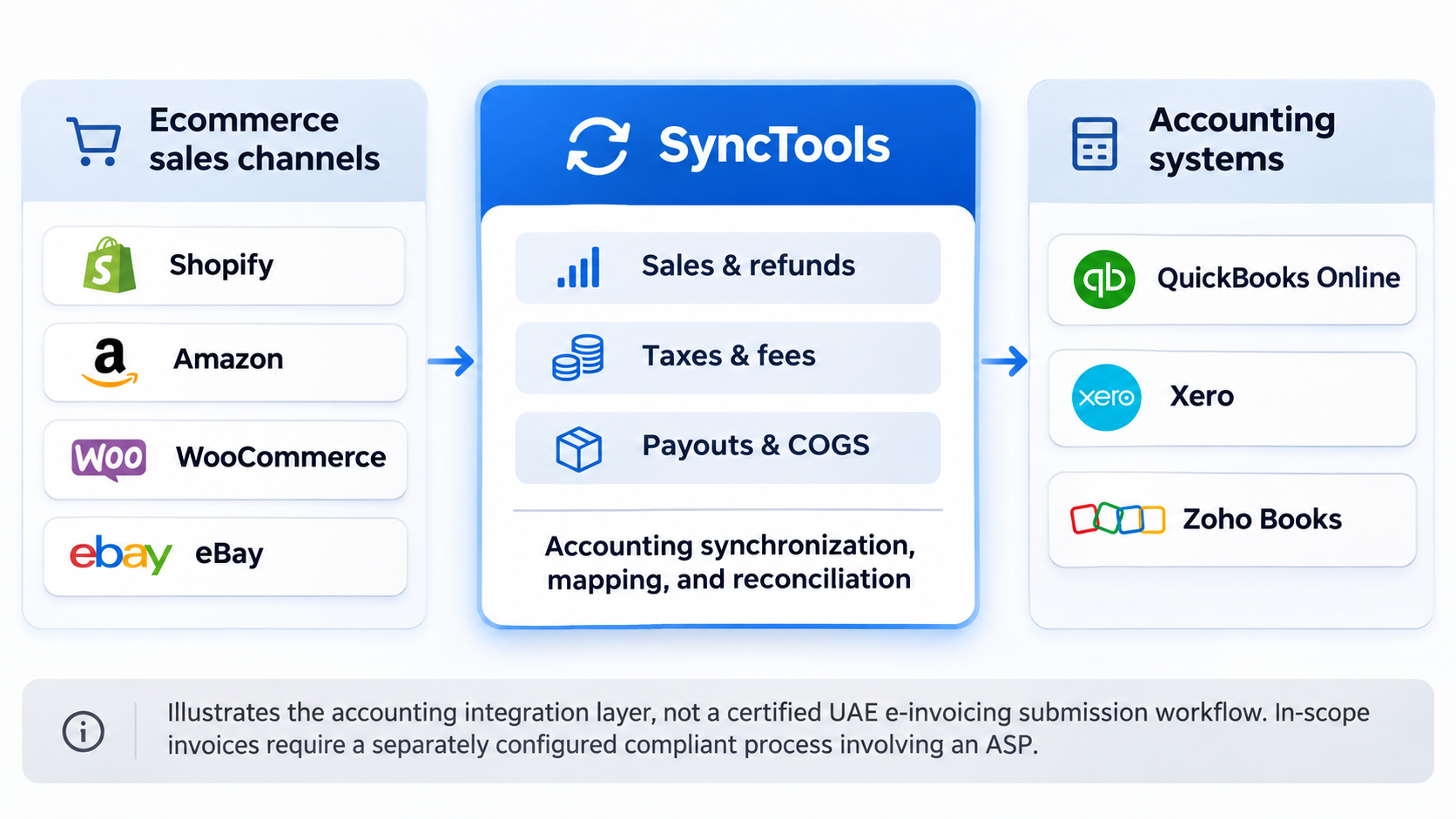
SyncTools connects ecommerce activity with accounting platforms such as QuickBooks Online and Xero.
Its published capabilities include synchronizing orders, taxes, discounts, refunds, fees, COGS, and payouts, with configurable accounting mappings.
These capabilities help finance teams maintain a clearer record of ecommerce financial activity.
For example, a retailer using the Shopify and QuickBooks Online integration can configure how supported transaction information is recorded in its accounting system.
Businesses using Xero can explore the Shopify and Xero integration, including individual and summarized accounting synchronization options.
There is an important distinction here.
SyncTools' documented accounting integrations should not be interpreted as automatically classifying UAE B2B transactions, creating compliant UAE electronic invoices, or reporting them through an Accredited Service Provider.
Those functions require separate compliance processes and appropriate integration arrangements.
For in-scope electronic invoices, businesses must also retain the source-level information necessary for compliant issuance. A summarized accounting journal should not be treated as a substitute for the prescribed invoice data.
Different Industries, Different Ecommerce Reporting Challenges
The most relevant operational challenges vary according to how businesses sell.
Fashion and Apparel
A clothing brand may sell individual garments to consumers while supplying uniforms or inventory to corporate customers.
The challenge is distinguishing commercial orders from retail sales while accurately accounting for returns, discounts, and seasonal promotions.
Consumer Electronics
Electronics sellers may fulfill high-value orders for individuals, corporate procurement teams, and resellers.
Buyer identification, correct invoice treatment, warranty returns, and marketplace payment reconciliation become particularly important.
Home and Furniture
A furniture supplier may receive consumer purchases alongside orders from hotels, property developers, and commercial offices.
Partial deliveries, deposits, returns, and commercial invoicing arrangements can complicate transaction tracking.
Health and Beauty
Beauty brands often combine direct-to-consumer sales with wholesale distribution to salons, spas, and retailers.
The accounting team must distinguish sales channels, maintain correct tax records, and reconcile promotions and refunds.
The lesson is that an industry does not determine whether a transaction requires e-invoicing. The underlying supply does.
SyncTools' industry-oriented accounting capabilities can help businesses manage sales, refunds, fees, and related accounting entries, while the regulatory classification remains a separate responsibility.
A Practical Test: Is Your Ecommerce Business Prepared to Identify In-Scope Orders?
The following is an operational self-assessment, not a legal determination of compliance.
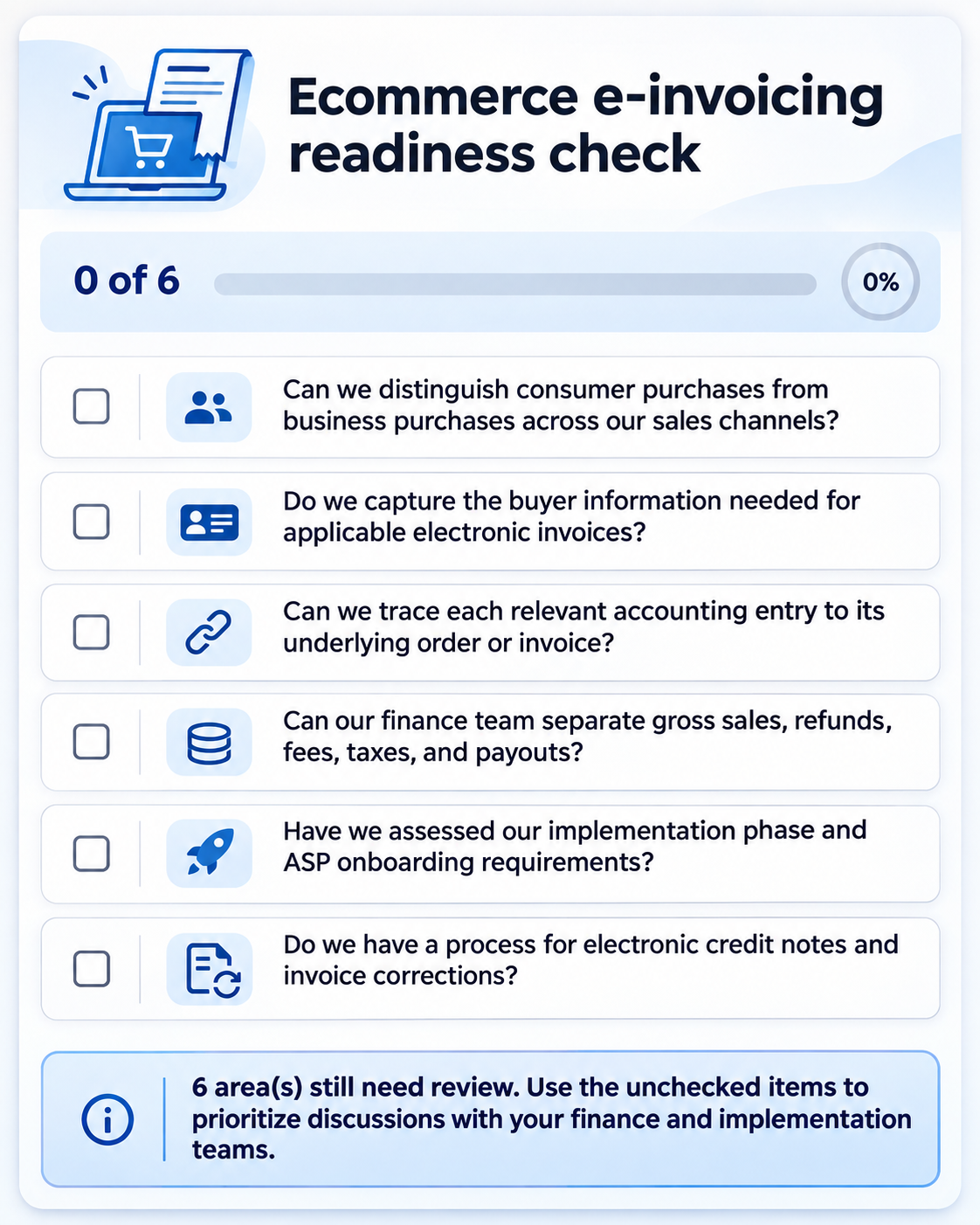
The answers can help determine where the business needs better information collection, accounting controls, or compliance-system integration.
What the Latest October 2026 Changes Mean for Ecommerce Sellers
The regulatory framework is still evolving.
On October 19, 2026, the UAE Ministry of Finance announced amendments under Ministerial Decision No. 197 of 2026, effective from October 1, 2026.
Among the changes:
- Transactions between members of the same tax group receive a temporary 24-month exclusion beginning January 1, 2027.
- The previous requirement to store electronic invoice data specifically within the UAE was removed, while retention and accessibility obligations remain.
- Certain system-failure notification provisions were repealed.
These changes are especially relevant to e-commerce groups operating multiple legal entities or centralized accounting environments.
They do not remove the general B2B and B2G e-invoicing obligations or extend the B2C exclusion indefinitely.
For in-scope businesses with annual revenue of AED 50 million or more, the amended deadline to appoint an ASP is October 30, 2026, with mandatory implementation scheduled for January 1, 2027.
Businesses with revenue below AED 50 million have a later implementation date of July 1, 2027, and an ASP appointment deadline of March 31, 2027.
Conclusion: The Biggest Risk Is Treating Every Online Order the Same
For UAE ecommerce businesses, the challenge is not simply generating electronic invoices.
It is recognizing that transactions processed through the same store, marketplace, or payment gateway may have different reporting obligations.
A consumer purchasing a laptop and a company purchasing that same laptop may require different invoicing treatment, even when both orders appear identical in the e-commerce platform.
Businesses therefore need to connect their invoicing decisions with reliable customer, transaction, and accounting information.
The right starting point is to understand which transactions are in scope, then ensure that the underlying financial records are accurate and traceable.
SyncTools supports the accounting side of that equation by connecting e-commerce sales activity with accounting platforms and helping manage transaction mapping and reconciliation.
Keep Your Ecommerce Accounting Ready for What Comes Next
Connect supported ecommerce channels with QuickBooks Online or Xero, manage transaction mapping, and maintain clearer records of sales, refunds, fees, and payouts.
SyncTools is an ecommerce accounting integration platform, not a substitute for a UAE-accredited e-invoicing provider.
Frequently Asked Questions
Do all UAE online stores need to implement e-invoicing in 2027?
No. Businesses engaged exclusively in B2C transactions are currently outside mandatory implementation until a further ministerial decision. Mixed B2B/B2C businesses must assess their in-scope transactions and implementation obligations.
What if a business customer purchases through a normal consumer checkout?
The checkout format does not automatically determine the transaction's classification. The seller must assess the underlying purchase and applicable requirements, and collect any missing information necessary for compliant invoicing.
Are online marketplace sales automatically excluded from e-invoicing?
No. Marketplace sales require assessing the parties involved and the legal supply arrangement. The supplier may retain electronic invoicing responsibility even when a marketplace issues documents on its behalf.
Does a business need to be VAT-registered to fall under UAE e-invoicing?
Not necessarily. The UAE Ministry of Finance guidelines indicate that e-invoicing scope is not determined solely by VAT registration status. You must evaluate the underlying business transaction and any applicable exclusions.
Can SyncTools replace an Accredited Service Provider?
No. SyncTools' published ecommerce accounting integrations do not establish ASP accreditation or direct UAE e-invoice submission capabilities. A business must use the applicable accredited-provider process for regulated electronic invoice exchange.
Ready to automate your accounting?
Connect Shopify, WooCommerce, or Linnworks to QuickBooks, Xero & more. Setup in minutes.