UAE e-Invoicing 2027: What Ecommerce Businesses Need to Do Before the Deadline
UAE e-Invoicing is approaching, and for ecommerce businesses, preparing involves more than changing how invoices are generated.
Mandatory implementation begins on 1 January 2027 for businesses with annual revenue of AED 50 million or more. Businesses below AED 50 million move into mandatory implementation from 1 July 2027.
For ecommerce businesses selling through Shopify, WooCommerce, marketplaces, or multiple channels, the bigger question is:
Is the transaction data behind your invoices ready?
Orders, taxes, discounts, refunds, fees, credit notes, customer information, and accounting records can sit across several systems. Before relevant transactions can move through the UAE Electronic Invoicing System, businesses need to understand how this data reaches their accounting or ERP environment.
And for the first group, the timeline is already tight.
UAE e-Invoicing Deadlines Ecommerce Businesses Need to Know
The UAE is introducing mandatory e-Invoicing in phases.
| Business category | ASP appointment deadline | Mandatory implementation |
|---|---|---|
| Annual revenue ≥ AED 50 million | 30 October 2026 | 1 January 2027 |
| Annual revenue < AED 50 million | 31 March 2027 | 1 July 2027 |
| Government entities | 31 March 2027 | 1 October 2027 |
Important: The June 2026 UAE Electronic Invoicing Guidelines show 31 July 2026 as the ASP appointment deadline for the ≥ AED 50 million group. The Ministry of Finance subsequently extended this deadline to 30 October 2026. The mandatory implementation date of 1 January 2027 remains unchanged.
For businesses in the first phase, e-Invoicing preparation is therefore no longer something to put on a 2027 roadmap.
It needs attention now.
Why Ecommerce Businesses Have a Different Readiness Challenge
For a traditional business, an invoicing process may look relatively straightforward:
Sale → Invoice → Accounting
Ecommerce can look very different:
Store/Marketplace → Payment → Order → Fees → Tax → Refund/Adjustment → Accounting/ERP → Reconciliation
One transaction can involve multiple systems before the final amount reaches the bank.
A Shopify order, for example, can include:
- product-level sales
- VAT
- shipping
- discounts
- payment fees
- refunds
- partial refunds
- currency information
- customer information
- payout adjustments
Marketplace transactions can add another layer because the marketplace, payment processor, seller, customer, and accounting platform may each hold different parts of the transaction.
That is why ecommerce businesses should not treat UAE e-Invoicing as an invoice-generation project alone.
It is also a data-readiness and systems-readiness project.
First, Understand What UAE e-Invoicing Actually Means.
Sending a PDF invoice by email does not make it an Electronic Invoice under the UAE framework.
The UAE Ministry of Finance defines an Electronic Invoice as structured invoice data that can be issued, transmitted, received, and processed electronically.
The UAE framework uses XML based on the applicable PINT-AE specifications.
So the transition is not simply:
Paper invoice → PDF invoice
It is closer to:
Business transaction → Structured invoice data → Accredited Service Provider → Peppol network → Buyer + tax reporting
For ecommerce businesses already using digital invoices, this distinction is important.
Your invoicing process may already be digital but not ready for the UAE Electronic Invoicing System.
How Peppol Fits Into UAE e-Invoicing
The UAE Electronic Invoicing System uses a 5-Corner Model based on the Peppol framework.
In simplified terms:
Relevant tax information is also reported to the Federal Tax Authority (FTA).
The supplier's Accredited Service Provider validates and processes invoice data and transmits the required information through the network.
This introduces another important consideration for ecommerce businesses.
The ASP cannot fix every upstream data issue.
If required transaction information is incomplete, misclassified, or unavailable from the ecommerce and accounting systems feeding the process, businesses may face problems later in the invoice workflow.
That is why readiness needs to start before the ASP connection.
B2B and B2G vs B2C: Know Which Transactions Matter
This distinction is particularly important for ecommerce businesses.
Under the current UAE framework, relevant transactions involving businesses and government entities fall within e-Invoicing requirements, subject to applicable rules and exclusions.
Transactions made to natural persons who are not conducting business are outside the Electronic Invoicing System.
In simple terms:
| Transaction | Current UAE e-Invoicing treatment |
|---|---|
| Business → Business | In scope |
| Business → Government | In scope |
| Government → Business | In scope |
| Government → Government | In scope |
| Business → Consumer | Outside the current scope |
For a pure B2C ecommerce store, this distinction may reduce the immediate transaction scope.
For businesses operating both B2C and B2B ecommerce, however, it creates another data requirement.
Imagine the same Shopify store receives:
- an order from an individual consumer
- a wholesale purchase from a UAE business
- an order from a government entity
- an order from an overseas company
They may all enter through the same storefront.
Their invoicing treatment may differ.
Businesses therefore need a reliable way to identify who the customer is and determine how the transaction should flow downstream.
Know Which Transactions Are in Scope
Understand how B2B, B2G, and B2C transactions are treated under UAE e-Invoicing requirements.
Shopify and WooCommerce Businesses Need to Look Beyond the Storefront
Shopify and WooCommerce can hold rich transaction information.
But the more important question is:
What information actually reaches your accounting or ERP system?
Businesses should review how information such as the following moves downstream:
- invoice and order identifiers
- buyer information
- transaction dates
- product lines
- quantities
- discounts
- shipping
- VAT categories
- VAT amounts
- currencies
- refunds
- credit note references
- transaction classifications
This becomes particularly important when e-commerce data is being summarised, manually entered, exported through spreadsheets, or passed between multiple applications.
The Ministry of Finance's own readiness guidance asks businesses to determine whether their accounting or ERP systems can extract the required Electronic Invoice data points.
That makes accounting integration part of e-Invoicing preparation, not an unrelated back-office project.
Marketplace Sellers Need to Map Who Does What
Marketplace sellers have another question to answer:
Who is responsible for the invoice?
A marketplace may process the transaction, collect payment, deduct fees, issue documentation, and transfer a net settlement to the seller.
That does not necessarily move the supplier's responsibility to the marketplace.
The UAE MoF guidelines state that for e-commerce supplies, responsibility for issuing an Electronic Invoice remains with the supplier even where an e-commerce platform issues an invoice on the supplier's behalf.
For every marketplace you sell through, document:
- Who is the supplier?
- Who is the buyer?
- Where is the original sales data stored?
- Who generates the invoice today?
- What data reaches accounting?
- How are marketplace fees recorded?
- How are refunds handled?
- How are subsequent adjustments recorded?
Do not assume every marketplace follows the same transaction flow.
Refunds Cannot Stop at the Payment Gateway.
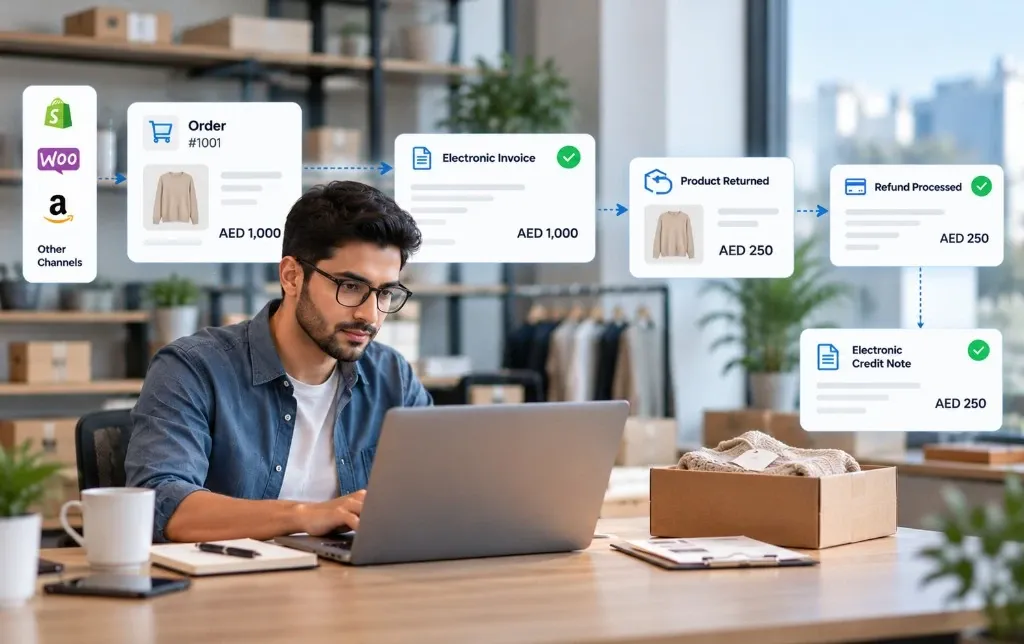
Returns and refunds are routine ecommerce events.
But they matter more when invoice and accounting workflows need to stay connected.
Consider:
AED 1,000 order → Electronic Invoice → AED 250 product returned → AED 250 refund
The payment platform may process the refund.
But the financial story does not end there.
Accounting records and the applicable Electronic Credit Note process must also reflect what happened.
Under the UAE framework, Electronic Credit Notes can be required for circumstances including:
- cancellation of a transaction
- reduction in consideration
- full return
- partial return
- certain administrative or numerical errors
Ecommerce businesses should therefore test:
Order → Invoice → Full refund → Credit note
Order → Invoice → Partial refund → Partial credit note.
Order → Invoice → Subsequent adjustment → Correct accounting treatment.
The important question is whether these events remain connected across ecommerce, payment, accounting, and invoicing systems.
Your Accounting or ERP System Sits at the Center of Readiness
The Ministry of Finance specifically recommends that businesses identify changes required within their accounting, ERP, and invoicing systems.
For ecommerce companies, that means finance and technology teams need to work together.
Finance understands what needs to be recorded.
Your ecommerce platform holds the commercial transaction.
Your accounting or ERP environment holds the financial record.
Your ASP provides the connection required for the Electronic Invoicing System.
The complete workflow may therefore look something like:
Every connection matters.
Where SyncTools Fits Into UAE e-Invoicing Readiness
For ecommerce businesses, preparing the ASP connection is only part of the picture.
The data reaching your accounting system also matters.
This is where SyncTools can support the ecommerce-to-accounting side of the readiness journey.
SyncTools helps connect ecommerce transaction data with accounting workflows, including areas such as:
- sales transactions
- product mapping
- refunds
- fees
- tax mapping
- COGS
- payout accounting
- accounting reconciliation
For businesses operating across ecommerce platforms and accounting systems, this can help reduce the gap between what happens in the storefront and what appears in the books.
For example:
Ecommerce platform → SyncTools → Accounting system → ASP/e-Invoicing workflow
SyncTools should not be considered a replacement for an Accredited Service Provider or represented as the Peppol/e-Invoicing compliance layer.
Its role is earlier in the process:
helping ecommerce businesses organize their transaction and accounting data before it supports downstream financial and e-Invoicing processes.
That distinction matters.
An ASP can connect to the UAE Electronic Invoicing System.
But e-commerce businesses still need to make sure the accounting data feeding that process reflects what actually happened across their stores, marketplaces, payments, refunds, and adjustments.
Selecting an ASP Is Only One Step
Businesses within scope need to appoint an Accredited Service Provider and complete the required onboarding.
The MoF readiness guidance includes steps such as:
- selecting an ASP
- completing contractual requirements
- onboarding through EmaraTax
- obtaining the Peppol participant identifier
- determining how invoice data will be transmitted
- integrating relevant systems
- conducting end-to-end testing
But appointing an ASP does not automatically make the rest of your ecommerce technology stack ready.
If your business has disconnected ecommerce and accounting data, address that problem alongside ASP onboarding.
Test Real Ecommerce Scenarios, Not Just One Successful Invoice
End-to-end testing is an important part of the MoF implementation guidance.
For ecommerce businesses, testing should reflect what actually happens after customers start placing orders.
Do not test only a clean B2B sale.
Test:
- B2B order
- B2G transaction, where applicable
- consumer order
- marketplace order
- discounted order
- multi-line order
- full refund
- partial refund
- cancelled transaction
- credit note
- cross-border transaction
- failed transmission
- incorrect customer information
- duplicate transaction
- applicable VAT scenarios
Testing unusual transactions before go-live can reveal where data, integrations, or internal processes need attention.
Test Every Ecommerce Scenario
Validate real-world orders, refunds, cancellations, and exceptions before going live.
UAE e-Invoicing Readiness Checklist for Ecommerce Businesses
1. Confirm your deadline
- Determine whether annual revenue is ≥ AED 50 million or below AED 50 million.
- Confirm your mandatory implementation date.
- Confirm your ASP appointment deadline.
2. Identify transaction types
- Identify B2B transactions.
- Identify B2G transactions.
- Separate B2C transactions.
- Review cross-border scenarios.
- Review any applicable exclusions.
3. Map e-commerce channels
- List Shopify stores.
- List WooCommerce stores.
- List marketplaces.
- List B2B ordering channels.
- Identify payment gateways.
4. Map transaction data
- Sales
- Customer information
- Product lines
- Discounts
- Shipping
- VAT
- Marketplace fees
- Refunds
- Adjustments
- Credit notes
5. Review accounting/ERP readiness
- Confirm required data reaches accounting.
- Review tax mappings.
- Review product mappings.
- Review customer information.
- Identify spreadsheet/manual processes.
- Check transaction-level traceability.
6. Review refunds and credit notes
- Test full refunds.
- Test partial refunds.
- Connect adjustments with original transactions.
- Define Electronic Credit Note processes.
7. Prepare your ASP connection
- Select an Accredited Service Provider.
- Complete onboarding requirements.
- Obtain the required Peppol participant identifier.
- Agree on the data transmission method.
- Complete accounting/ERP integration.
8. Test before go-live
- Test successful invoices.
- Test rejected transactions.
- Test refunds and credit notes.
- Test reporting confirmations.
- Test incoming invoices.
- Define who handles errors.
Don't Start With the Deadline. Start With Your Data.
The UAE e-Invoicing deadline tells you when your business needs to be ready.
It does not tell you whether the systems behind your invoices are ready.
For ecommerce businesses, preparation starts further upstream.
Can you trace a Shopify, WooCommerce, or marketplace transaction from the original order through taxes, fees, refunds, accounting, and reconciliation?
Can your accounting system access the downstream information it needs?
Can you distinguish B2B transactions from consumer orders?
Can you trace a partial refund back to the original sale?
And can your ecommerce data reach the accounting environment that will ultimately connect with your chosen ASP?
These are questions worth answering before go-live.
Prepare Your Ecommerce Accounting Data for What's Coming
SyncTools helps ecommerce businesses connect sales, refunds, fees, product data, tax mappings, COGS, and payout information with their accounting workflows.
If your business is preparing for UAE e-Invoicing, now is the time to review what happens before your accounting data reaches the ASP.
Review your ecommerce-to-accounting workflow with SyncTools and identify the data gaps you need to address before 2027.
Get your ecommerce accounting foundation ready for UAE e-Invoicing → Explore SyncTools.
Frequently Asked Questions
1. When will UAE e-Invoicing become mandatory?
Businesses with annual revenue of AED 50 million or more must implement it from 1 January 2027.
Businesses with annual revenue below AED 50 million must implement it from 1 July 2027.
Government entities follow from 1 October 2027.
Businesses should also note the earlier deadline for appointing an Accredited Service Provider.
2. What is the ASP deadline for businesses with revenue of AED 50 million or more?
The latest Ministry of Finance update extended the ASP appointment deadline for this group to 30 October 2026.
The mandatory implementation date remains 1 January 2027.
Businesses relying on the June 2026 guidelines should therefore be aware that the original 31 July 2026 ASP date has subsequently been amended.
3. Does UAE e-Invoicing apply to B2C ecommerce orders?
Under the current framework, supplies to natural persons who are not conducting business are outside the Electronic Invoicing System.
Businesses operating both B2B and B2C ecommerce should therefore be able to distinguish between different customer and transaction types.
4. Does UAE e-Invoicing apply to Shopify and WooCommerce businesses?
The ecommerce platform itself does not determine whether a transaction falls within scope.
Businesses selling through Shopify, WooCommerce, marketplaces, or other ecommerce channels need to assess their transactions against the UAE e-Invoicing requirements.
Where transactions fall within scope, businesses also need to ensure the required transaction information reaches their accounting/ERP and downstream e-Invoicing workflow.
5. Are PDF invoices compliant with UAE e-Invoicing?
A PDF sent by email is not, by itself, an Electronic Invoice under the UAE framework.
Electronic Invoices use structured data capable of automated electronic processing and follow the applicable UAE technical specifications.
6. What happens when an ecommerce customer receives a refund?
Depending on the transaction and circumstances, a refund, cancellation, reduction in consideration, or return may require an Electronic Credit Note.
Ecommerce businesses should therefore connect refund workflows with their accounting and invoice-adjustment processes rather than treating payment refunds as isolated events.
7. Do ecommerce businesses need an Accredited Service Provider?
Businesses subject to the UAE Electronic Invoicing System need to appoint an Accredited Service Provider according to the applicable implementation requirements and deadlines.
Businesses should use the official Ministry of Finance information when reviewing accredited providers.
8. Does SyncTools provide UAE e-Invoicing or Peppol compliance?
SyncTools should not be considered a replacement for an Accredited Service Provider.
Its role is on the ecommerce-to-accounting side of the workflow, helping businesses move and organize ecommerce transaction data within accounting processes.
Businesses will still need to address their applicable ASP, Peppol, and UAE e-Invoicing requirements separately.
9. When should ecommerce businesses start preparing?
Businesses with revenue of AED 50 million or more should already be preparing, as mandatory implementation begins 1 January 2027.
Businesses below the threshold have more time, but mapping e-commerce systems, cleaning accounting data, selecting an ASP, integrating systems, and testing workflows can require significant preparation.
Waiting until the mandatory implementation date means leaving the most important work until the end.
Ready to automate your accounting?
Connect Shopify, WooCommerce, or Linnworks to QuickBooks, Xero & more. Setup in minutes.