Product Mapping & COGS for Brands with Thousands of Variants
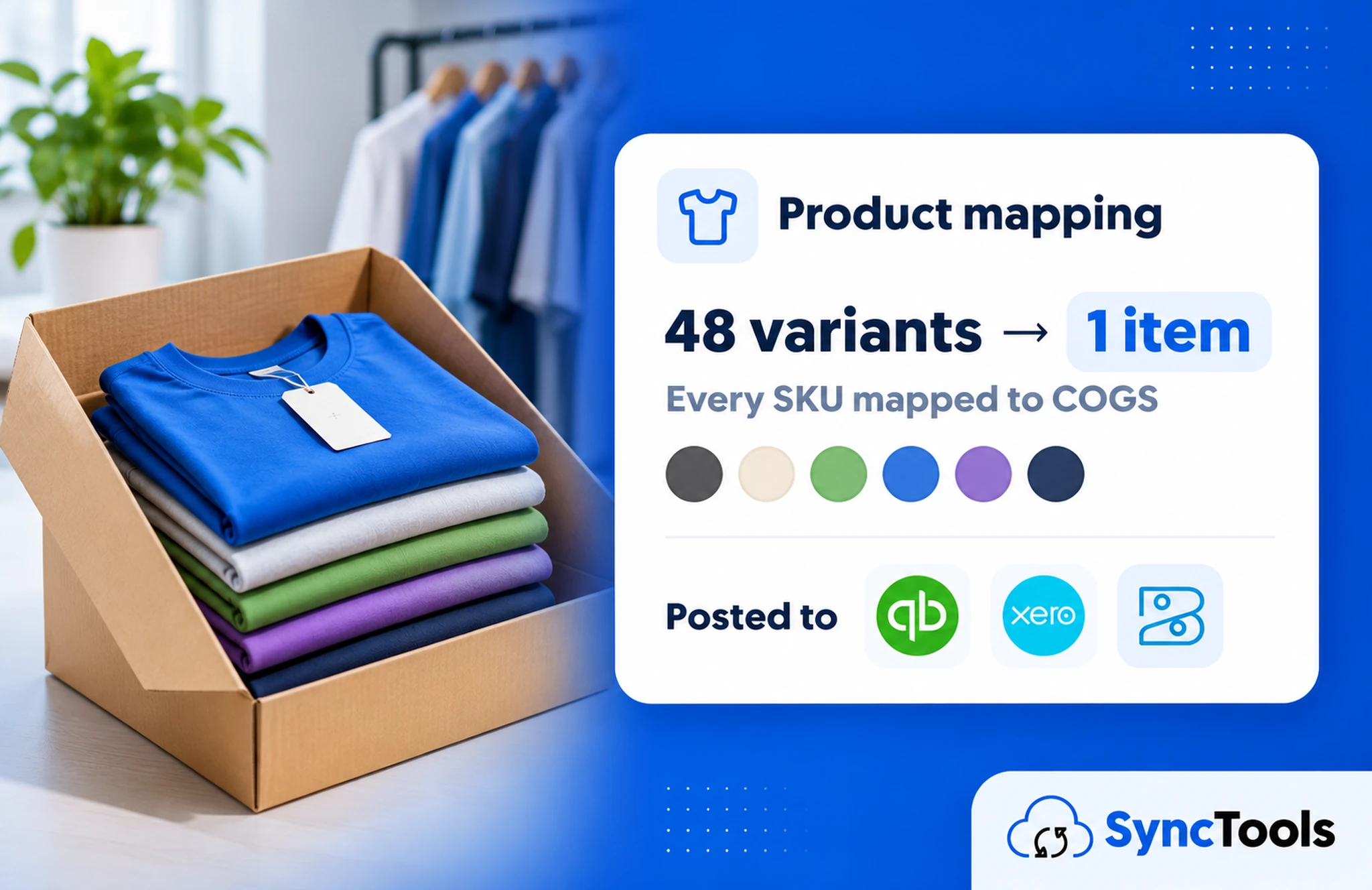
A fashion brand may offer hundreds of clothing styles, with each available in different sizes and colors. As new collections arrive and product ranges expand, managing thousands of individual variants becomes increasingly complex.
Offering multiple sizes, colors, and styles helps fashion brands meet customer preferences, but it also complicates inventory accounting.
Each product variant must be accurately tracked across ecommerce platforms, inventory systems, and accounting software. Incorrect product mapping can lead to inaccurate COGS calculations, misclassified sales transactions, and unreliable gross profit figures.
This becomes especially challenging for fashion retailers selling through Shopify, Amazon, WooCommerce, and other channels while maintaining financial records in QuickBooks, Xero, or Zoho Books.
Product mapping and cost of goods sold (COGS) automation help fashion brands connect product variants to the right accounting records and cost information.
However, successful automation depends on more than recognizing a SKU. Businesses also need reliable inventory costs, consistent product identifiers, and properly configured accounting rules.
This guide explains how fashion brands can structure product mapping, manage COGS across thousands of variants, avoid common accounting errors, and use SyncTools integrations to support more reliable financial reporting.
What Is Product Mapping in Fashion Ecommerce?
Product mapping connects product identifiers from ecommerce platforms to the corresponding products, categories, and financial accounts in an accounting system.
For fashion businesses, these relationships matter because one product style can have multiple sellable variations.
Consider a basic example:
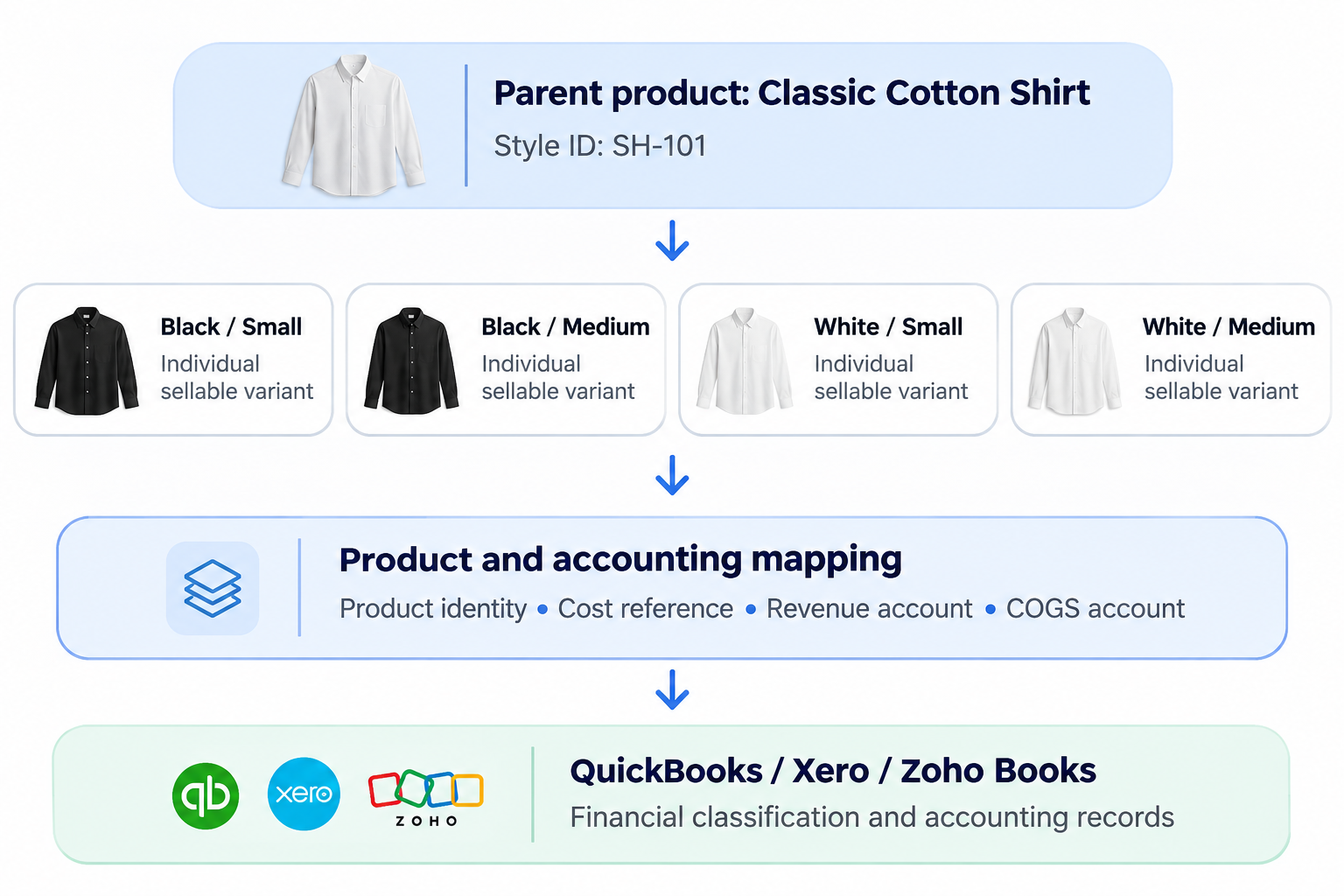
Each variation represents a different sellable SKU. Although these products belong to the same style, their inventory quantities, sales activity, and potentially their underlying costs may differ.
Proper product mapping helps maintain these relationships without requiring a separate general ledger account for every size or color.
SKU Mapping vs. Accounting Mapping
These terms are closely related but serve different purposes.
| Mapping type | Purpose |
|---|---|
| SKU mapping | Connects product identifiers across selling and inventory systems |
| Variant mapping | Identifies the specific size, color, or configuration sold |
| Account mapping | Assigns transactions to appropriate revenue, inventory, and expense accounts |
| COGS mapping | Connects product-related costs to appropriate COGS classifications |
| Channel mapping | Associates sales with the correct ecommerce or marketplace channel |
A fashion brand needs these relationships to work together.
For instance, identifying the correct Shopify variant does not automatically guarantee accurate COGS. The accounting workflow must also have access to the applicable inventory cost and use the company's approved costing policy.
Why Thousands of Fashion Variants Create Accounting Problems
Fashion inventory is different from a conventional product catalog.
A retailer selling electronics may have relatively stable product identifiers for established models. A fashion brand frequently introduces seasonal styles, new colorways, updated sizes, and discontinued collections.
These changes increase the number of product relationships that finance teams must maintain.
1. Product identifiers differ across platforms
A black medium-sized jacket might have the following identifiers:
| System | Product identifier |
|---|---|
| Shopify | JKT-BLK-M |
| Amazon | JACKET-BLACK-M |
| Warehouse system | JK204-BK-M |
| Internal inventory database | STYLE204-03 |
Although all four records may represent the same product, the systems do not necessarily recognize them as identical.
Without an approved cross-platform mapping, the business risks creating duplicate product records or recording transactions against the wrong item.
2. Product costs may vary by size or color
Some apparel variants have different manufacturing or acquisition costs.
Extended sizes may require more fabric, certain colorways may involve different materials, and individual production batches may have different purchase costs.
However, not every size or color requires a different accounting cost.
The correct treatment depends on actual cost differences and the inventory costing method the business adopts.
3. Seasonal collections increase mapping maintenance
Fashion brands regularly introduce new products and retire old ones.
Each collection may require new product identifiers, category assignments, inventory cost references, and accounting mappings.
When teams maintain these records manually, missing or outdated configurations can go unnoticed until the next accounting reconciliation.
4. Returns and exchanges affect multiple SKUs
A customer exchanging a medium-sized dress for a large-sized dress creates inventory activity involving two different variants.
The associated accounting treatment may also affect revenue, COGS, inventory, and payment adjustments.
If the replacement SKU is incorrectly identified, the accounting records can become inconsistent with actual inventory movements.
For a closer examination of these transactions, explore the Apparel Ecommerce Returns & Refund Accounting Guide.
How Incorrect Product Mapping Affects COGS
Cost of goods sold represents the inventory cost recognized for products sold during an accounting period.
For fashion brands, correctly matching each sale with its applicable inventory cost is essential for gross profit reporting.
Consider an illustrative fashion retailer selling the following jacket variants.
| SKU | Product variant | Selling price | Unit cost |
|---|---|---|---|
| JKT-BLK-S | Black / Small | $120 | $42 |
| JKT-BLK-M | Black / Medium | $120 | $45 |
| JKT-BLK-L | Black / Large | $120 | $48 |
| JKT-NVY-M | Navy / Medium | $125 | $47 |
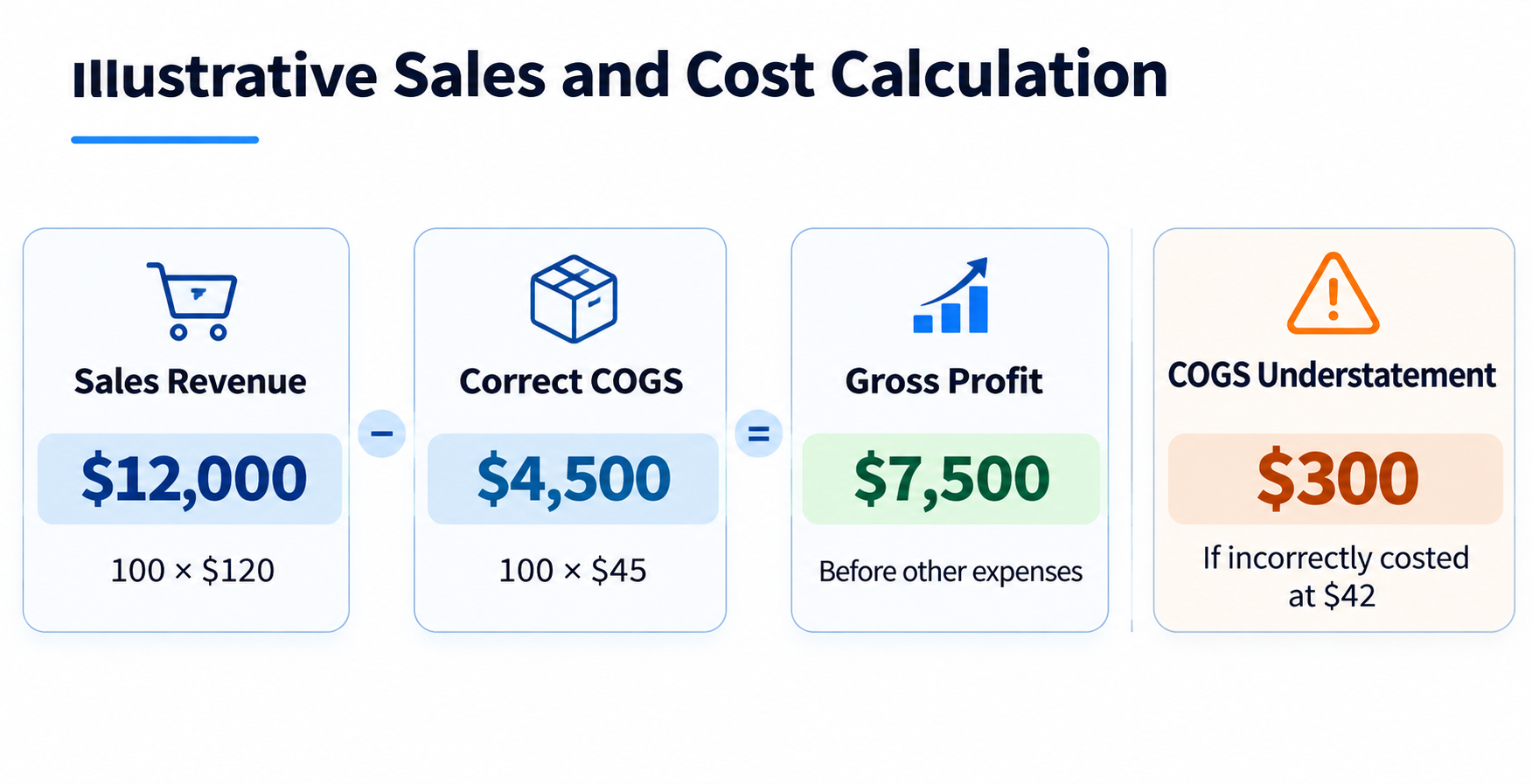
Assume the retailer sells 100 units of the Black / Medium jacket.
If the accounting workflow incorrectly uses the Small variant's $42 cost, it records $4,200 in COGS instead of $4,500.
The result is a $300 overstatement of gross profit.
Across thousands of transactions, repeated mapping discrepancies can significantly distort product profitability analysis.
This example assumes a fixed applicable unit cost for illustration. Actual COGS may differ under FIFO, weighted-average, or another permitted inventory costing method.
The connection between product mapping and inventory costing
Distinguish between identifying a product and determining its accounting cost.
Product mapping answers: Which product was sold, and where should the resulting accounting activity be classified?
Inventory costing answers: What inventory cost should be recognized for that sale?
Both must work correctly to produce reliable COGS records.
Visual: How SKU Mapping and COGS Flow Across Fashion Accounting Systems
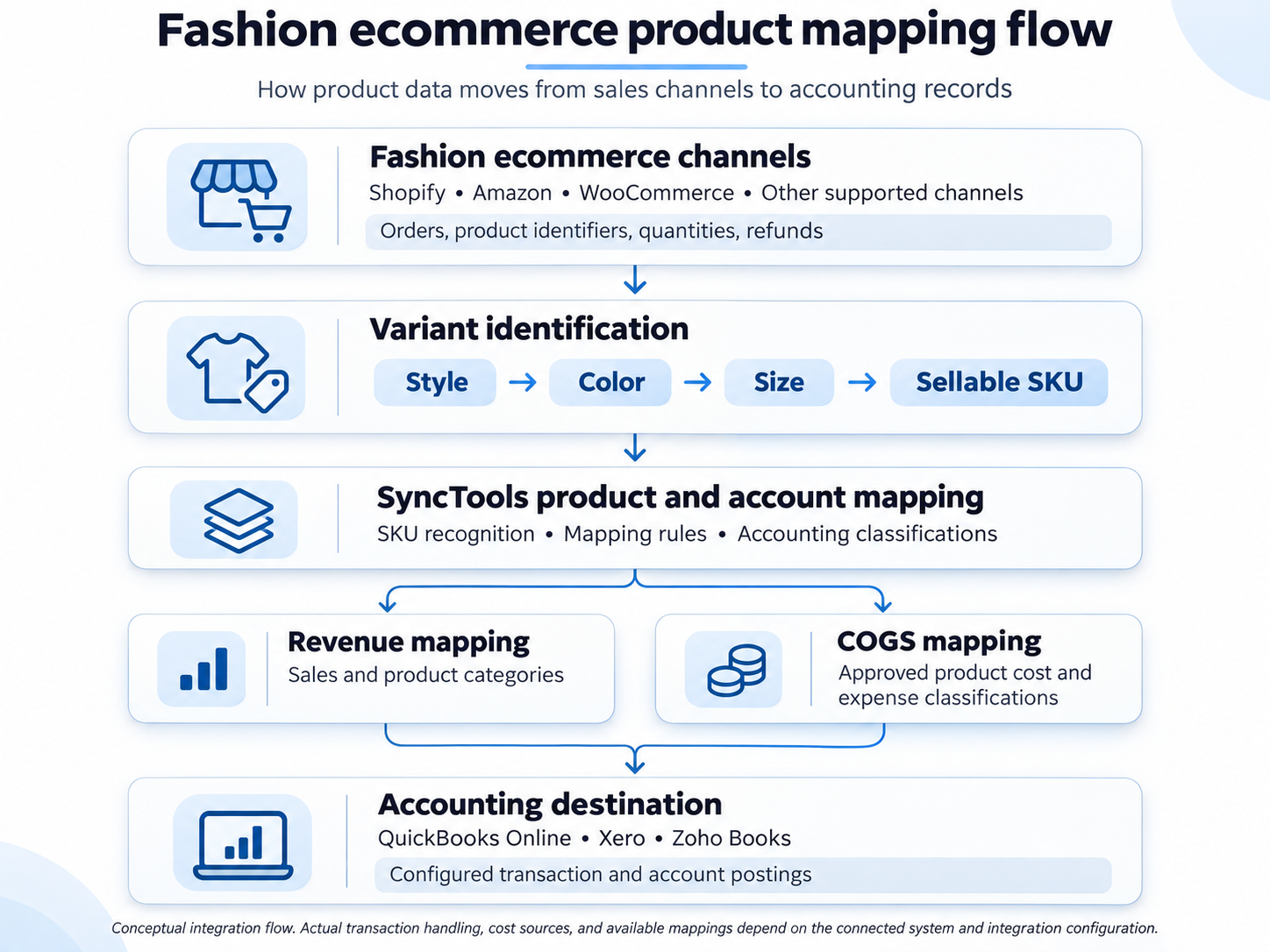
This architecture helps explain why ecommerce brands need more than simple order synchronization.
Product identity, applicable inventory cost, accounting category, and financial transactions must stay connected throughout the process.
Five Product Mapping Challenges Fashion Brands Should Address Before Automating COGS
1. Unmapped SKUs from new collections
Newly launched products may generate transactions before their accounting mappings are configured.
Finance teams should establish a process to identify new SKUs, confirm their cost information, and assign appropriate accounting classifications.
Treat an unmapped product as an exception that requires review, rather than silently assigning an inappropriate cost or account.
2. Duplicate product mappings across marketplaces
A single garment can appear under different listing identifiers across sales channels.
Businesses should maintain a master SKU reference that links channel-specific identifiers to the same physical product.
This helps prevent duplicate records and makes transaction-level reconciliation easier.
3. Incorrect cost information
Product mapping cannot correct inaccurate source costs.
If the e-commerce or inventory system contains outdated costs, the corresponding COGS calculation may also be inaccurate.
Before automating, finance teams should confirm the source of inventory costs and establish procedures for updating costs after purchases, production runs, and relevant adjustments.
4. Duplicate COGS postings
Some businesses use dedicated inventory management software that already calculates and posts COGS.
If another integration independently posts the same expenses, it may duplicate costs.
The accounting architecture should therefore establish one authoritative process for inventory valuation and prevent duplicate financial postings.
5. Bundles and product kits
Fashion businesses often sell coordinated outfits, gift sets, and bundled products.
For example, a three-piece outfit may contain a jacket, shirt, and trousers with separate underlying costs.
Correct accounting depends on whether the bundle is managed as its own stocked item or as a combination of component products.
The integration must follow the business's inventory and costing structure, rather than assuming every bundle has a single predefined cost.
How SyncTools Helps Fashion Brands Manage Product Mapping and COGS
For ecommerce fashion businesses, maintaining consistent product and accounting mappings becomes increasingly difficult as catalogs and sales channels expand.
SyncTools provides ecommerce accounting integrations designed to connect sales activity with accounting platforms.
Its SyncHub product and SKU mapping capabilities include product and variant recognition, configurable account mappings, and support for COGS classifications.
These capabilities can support fashion businesses in several ways.
1. Product and variant recognition
SyncHub supports automatic SKU and variant recognition during initial synchronization.
This provides a starting point for configuring product-level accounting rules rather than manually recreating every product relationship from transaction records.
Businesses should still review duplicate identifiers, missing products, and unmatched records.
2. Configurable revenue and COGS mappings
SyncTools supports configuring income and COGS account assignments by product and category.
For example, a fashion retailer might use different revenue and expense accounts for apparel, footwear, and accessories.
This enables financial classification at a useful reporting level without requiring an individual general ledger account for every variant.
3. Shopify accounting integration
Fashion brands using Shopify and QuickBooks Online can use SyncTools Shopify QuickBooks integration to synchronize supported sales, refunds, taxes, fees, COGS, and payout data.
SyncTools supports configurable transaction and account mappings, allowing businesses to align the integration with their existing chart of accounts.
4. COGS configuration and review
SyncTools' Shopify COGS integration documentation explains how businesses can configure COGS accounts, synchronization frequency, and cost review settings.
For example, the documented monthly workflow allows users to review product costs before the corresponding COGS information is posted.
This makes cost verification an important part of the configuration process rather than assuming that all source product costs are automatically correct.
5. Accounting reconciliation
Product-level accounting should ultimately support reliable financial records.
SyncTools also addresses ecommerce transactions such as refunds, payment fees, taxes, and payout settlements.
These processes matter because even correctly mapped COGS entries don't guarantee that ecommerce deposits and accounting balances will reconcile automatically.
The practical objective is to reduce repetitive mapping and transaction-handling work while giving finance teams defined points to review costs, exceptions, and accounting results.
Which Fashion Businesses Can Benefit from Product Mapping Automation?
Different fashion business models encounter different mapping and costing problems.
| Fashion business | Common challenge | Relevant accounting priority |
|---|---|---|
| DTC clothing brands | Frequent product launches and size/color combinations | Variant recognition and accounting mapping |
| Footwear retailers | Large catalogs of sizes and styles | SKU consistency and COGS accuracy |
| Luxury fashion brands | High-value inventory with varying acquisition costs | Accurate cost sources and inventory valuation |
| Fast fashion retailers | Rapid product turnover and seasonal collections | New SKU mapping and exception management |
| Multi-brand fashion retailers | Products from multiple suppliers | Product identity and category classification |
| Omnichannel apparel sellers | Different marketplace and storefront identifiers | Channel mapping and reconciliation |
| Fashion accessories brands | Product kits, gift sets, and bundles | Bundle cost treatment and account mapping |
For growing fashion companies, the primary advantage of accounting automation is maintaining more consistent processes as catalog and transaction complexity increases.
How to Build a Reliable SKU Mapping and COGS Workflow
Automation should follow a defined accounting structure.
Fashion businesses can start with the following approach.
Step 1: Establish a master product catalog
Create a reliable product reference containing the parent style, individual SKUs, sizes, colors, product categories, and identifiers used in each sales channel.
Avoid using product names alone as unique identifiers because names can change or repeat.
Step 2: Verify the source of inventory costs
Determine whether product costs are maintained in Shopify, an inventory management system, an ERP, or another financial system.
Confirm that the source supports the business's adopted inventory costing method.
Step 3: Configure accounting mappings
Define the revenue, inventory, COGS, and other relevant account classifications.
Maintain enough detail for financial reporting without creating unnecessary general ledger complexity.
Step 4: Test representative transactions
Before expanding synchronization, review example transactions involving different sizes, colors, cost amounts, bundles, discounts, and returns.
Compare the generated accounting entries against the expected results.
Step 5: Review exceptions
Establish a recurring process for identifying unmapped products, missing costs, duplicate records, and unexpected accounting classifications.
Step 6: Reconcile inventory and COGS
Compare the inventory valuation and COGS generated by the approved costing process with the corresponding general ledger balances.
Investigate discrepancies before relying on margin reports.
For a broader explanation of inventory valuation, product variants, and reconciliation, read the Fashion Ecommerce Inventory Accounting Guide.
When Should Fashion Brands Move Beyond Manual SKU Mapping?
No fixed number of product variants automatically makes manual accounting unsuitable.
The decision depends on how much effort it takes to maintain mappings and how often errors appear.
Businesses should evaluate automation when they experience:
- Recurring SKU mismatches between ecommerce and accounting systems.
- Frequent launches of new styles or seasonal collections.
- Missing or outdated product costs.
- Difficulty identifying the cause of COGS discrepancies.
- Multiple marketplaces with different product identifiers.
- Repeated manual adjustments during month-end reconciliation.
- Growing dependence on spreadsheets for accounting classifications.
A useful starting point is to test the proposed integration against a representative sample of existing orders and product variants.
The evaluation should measure mapping accuracy, exception handling, reconciliation requirements, and the accounting work that remains manual.
Product Mapping and COGS Checklist for Fashion Finance Teams
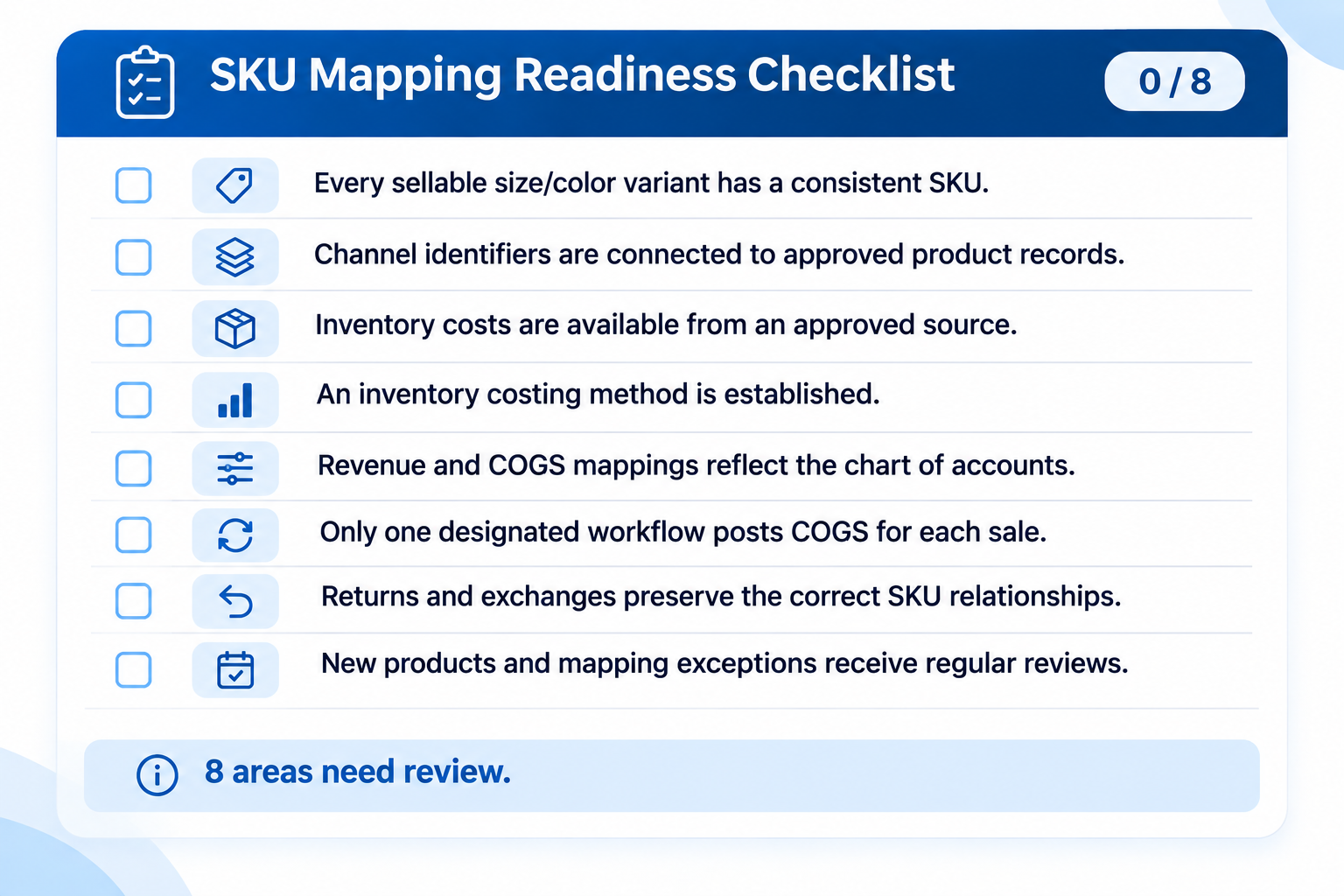
Completing these checks helps finance teams identify mapping and costing issues before they become recurring reconciliation problems.
Conclusion: Accurate Fashion COGS Starts with Reliable Product Mapping
Managing thousands of fashion variants is not simply a catalog management challenge.
For finance teams, every variant must remain connected to the appropriate product identity, inventory information, cost source, and accounting classification.
When these relationships are inconsistent, businesses can encounter inaccurate COGS, duplicate product records, unreliable margins, and reconciliation difficulties.
A reliable product mapping structure, supported by properly configured accounting automation, can reduce these risks and make financial reporting easier to manage as the business grows.
SyncTools provides e-commerce accounting integrations with product mapping and COGS configuration capabilities that can support fashion brands operating across multiple product categories and sales channels.
Frequently Asked Questions
What is SKU mapping in fashion ecommerce?
SKU mapping connects individual product identifiers across ecommerce, inventory, and accounting systems. It helps businesses associate sales and inventory movements with the correct product variants and financial classifications.
How do fashion brands calculate COGS for different sizes and colors?
Fashion brands calculate COGS using the applicable inventory cost and their adopted inventory costing method. Different variants may have different costs when materials, manufacturing, purchasing, or other attributable inventory costs differ.
Does every fashion SKU need a separate COGS account?
No. Businesses can track inventory and product costs at the SKU level while grouping accounting entries into appropriate COGS accounts by product category or another approved reporting structure.
Can SyncTools support SKU mapping and COGS for Shopify fashion stores?
Yes. SyncTools provides configurable product and account mappings and documented COGS integration capabilities for supported ecommerce accounting workflows. The exact configuration depends on the connected systems, available cost information, and accounting requirements.
What happens when a fashion product has no cost assigned?
Missing cost information can result in incomplete or incorrect COGS calculations. Businesses should review these products, confirm the applicable cost, and resolve exceptions before relying on financial reports.
Can product mapping solve multi-channel inventory reconciliation?
Product mapping helps establish consistent identifiers across channels, but it does not replace inventory reconciliation. Businesses still need to compare inventory quantities, valuations, sales, returns, and accounting balances across the relevant systems.
When is COGS automation worthwhile for a fashion brand?
COGS automation becomes valuable when transaction complexity, recurring cost adjustments, mapping exceptions, or manual reconciliation workloads make existing processes difficult to maintain accurately.
Ready to automate your accounting?
Connect Shopify, WooCommerce, or Linnworks to QuickBooks, Xero & more. Setup in minutes.