Ecommerce Demand Forecasting: How to Predict Sales, Plan Inventory, and Improve Profitability

Ecommerce businesses have plenty of data to work with, from product sales and customer orders to inventory, refunds, advertising, and marketplace fees. The challenge is turning that data into a useful view of what might happen next.
That is where ecommerce demand forecasting comes in. It uses past sales and other relevant factors to estimate future demand, helping businesses decide what to stock, when to reorder, and how much cash to set aside.
A good forecast is not about predicting sales perfectly. It is about giving teams better information for purchasing, inventory, promotions, and financial planning.
This guide explains how ecommerce demand forecasting works, what data you need, which methods you can use, and how to connect forecasting with inventory and profitability decisions.
What Is Ecommerce Demand Forecasting?
Ecommerce demand forecasting is the process of estimating how much customers are likely to buy over a future period using historical sales, market conditions, seasonality, pricing, promotions, and other relevant factors.
Past sales are a useful starting point, but they do not tell the whole story. Instead of simply adding a percentage to last year’s numbers, look at trends, promotions, competitor activity, stock availability, and other factors that may have affected sales.
Demand and sales forecasting are related, but they focus on different things. Sales forecasting estimates expected revenue or orders, while demand forecasting estimates how many units customers are likely to want, even when stock shortages affect actual sales.
This is important because a drop in sales does not always mean lower demand. For example, if a product was out of stock in July, customers may still have wanted to buy it. A good forecast helps businesses decide what to buy, when to buy it, and how much money to set aside.
Why Is Demand Forecasting Important for Ecommerce?
Forecasting helps ecommerce teams plan ahead with more confidence. It can guide stock levels and purchase timing, prepare for seasonal demand, and help set aside cash for inventory and supplier payments.
Too much stock ties up cash and increases storage costs, while too little stock can lead to missed sales and lost revenue. It also helps with supplier planning. Since orders often need to be placed weeks or months in advance, a forecast helps businesses decide what to order and prepare for busy seasons.
Forecasting can also help businesses make smarter promotion and product decisions. It shows whether a discount is likely to drive enough extra sales to be worthwhile. It can also help identify which products to promote more and which ones may not be worth keeping.
What Data Do You Need for Ecommerce Demand Forecasting?
A forecast is only as good as the data behind it. Revenue alone is not enough because it shows what customers paid, not why sales changed or what the business earned from those sales.
Historical sales data gives you the starting point for a forecast. This includes the number of units sold for each SKU, across different sales channels and time periods. Having 12–24 months of data can also help reveal seasonal trends and recurring changes in demand.
Inventory data is just as important. If a product has lower sales for a few weeks, it does not necessarily mean customers are losing interest. The product may have been out of stock. Without considering inventory levels, a forecast can mistake limited availability for lower demand and lead to the same stockout happening again.
Separate pricing and promotion data from baseline sales. A spike caused by a 30%-off promotion should not automatically become the new expected demand level.
Customer and marketing data—such as traffic, ad spend, and conversion rates can help explain whether sales growth came from lasting demand or a temporary acquisition push.
Returns and refunds also matter. A product with a high return rate may generate strong gross sales but much lower net demand. Forecasting should account for that difference.
COGS and profitability data complete the picture. They help answer a question that sales data alone cannot: is rising demand for this product actually good for the business?
The key point is simple: looking only at revenue does not show the full picture. A useful forecast also needs to consider sales, inventory, and other factors that affect demand.
What Factors Affect Ecommerce Demand?
Demand does not move in a vacuum. A useful ecommerce forecasting process considers the factors that can change customer behavior.
Seasonality can be calendar-driven, such as holiday or back-to-school demand, but some categories also move with weather, school years, or industry-specific cycles.
Pricing affects both how much a product sells and how much profit it makes. A lower price may bring in more sales but reduce profit, while a higher price may mean fewer sales but better margins.
Promotions can also cause a short-term jump in sales. Keep these spikes separate from the normal sales trend when forecasting.
Product lifecycle also matters. A new SKU, a growing bestseller, a mature product, and a declining product should not all be forecast in the same way.
Competitor pricing, launches, promotions, and stock availability can shift demand even when nothing changes within your own business.
Customer behavior can also change through repeat purchase rates, average order value, and changing category preferences.
Supply constraints affect demand indirectly. Repeated stockouts can cause customers to switch permanently to another seller or product.
Finally, broader conditions such as inflation, consumer confidence, or category-wide slowdowns can affect demand independently of product performance.
Types of Ecommerce Demand Forecasting
The right forecast depends on two things: how far ahead you are planning and how detailed the forecast needs to be.
By Forecasting Period
Short-term forecasting covers the next few weeks or months. It helps with reorder timing, stock levels, fulfillment, and near-term promotions.
Medium-term forecasting looks further ahead to support supplier orders, seasonal inventory builds, and cash planning.
Long-term forecasting supports broader decisions such as product launches, warehouse capacity, and annual planning. These forecasts are useful for identifying direction, but they are naturally less precise.
By Level of Detail
SKU-level forecasting estimates demand for individual products and is especially useful for purchasing and replenishment decisions.
Category-level forecasting looks at broader product groups and can help identify changing customer preferences or category growth.
Channel-level forecasting helps businesses understand expected demand across websites, marketplaces, or other sales channels.
In practice, businesses may use several levels at once. For example, a seller might use SKU-level forecasts for replenishment while using category and channel forecasts for broader purchasing and financial planning.
Forecast Demand With Confidence
From SKU-level replenishment to channel and seasonal planning, get the insights you need to predict demand, optimize inventory, and make smarter purchasing decisions.
Ecommerce Forecasting Methods
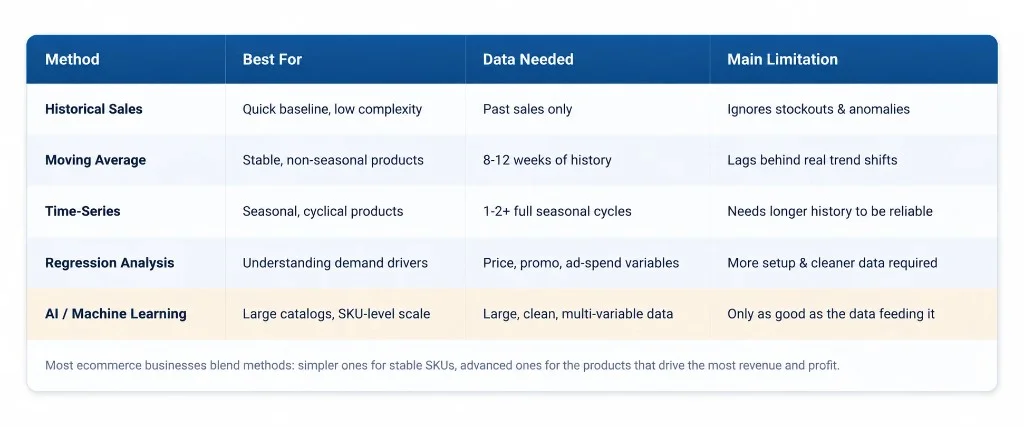
There is no single best method. The right approach depends on the amount and quality of historical data, demand stability, seasonality, and the decision being made.
Historical sales analysis is the simplest starting point. It works well for stable products but can be misleading if stockouts, promotions, or unusual events aren't identified and adjusted for.
Moving averages use sales from a recent period to calculate an average and estimate future demand. They are simple and work well for products with fairly steady sales, but they may not react quickly when demand suddenly changes.
Time-series forecasting uses past sales to spot trends and seasonal patterns. It works well when products have consistent buying patterns and enough sales history.
Regression analysis looks at how factors such as price, promotions, advertising, or the day of the week affect demand. It helps explain what drives changes in sales.
AI and Machine Learning can work with large datasets and forecast demand across many SKUs. However, the results are only as reliable as the data being used.
For most ecommerce businesses, you don't need one method for everything. Simpler methods may work well for steady products, while more advanced models can help with products with higher sales volumes or more complex demand.
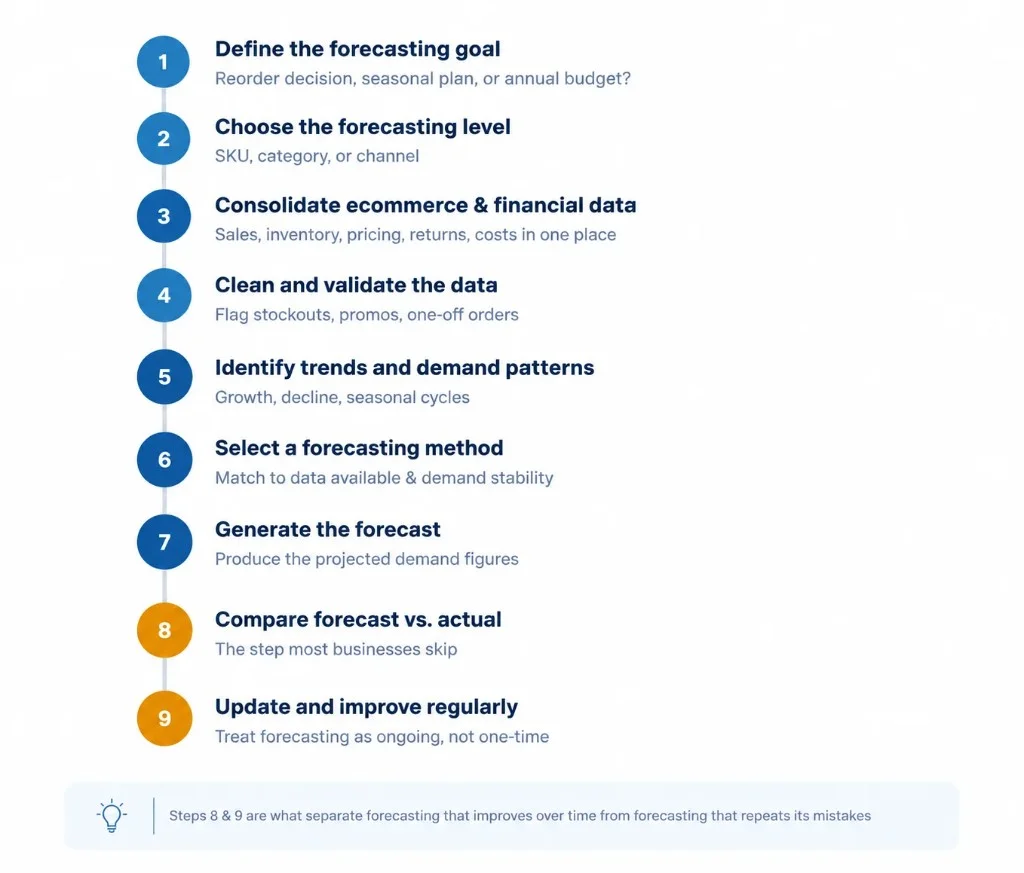
How to Create an Ecommerce Demand Forecast
Building a forecast should be a repeatable process, not a one-time analysis.
- Define the forecasting goal. Decide whether you are planning a purchase order, preparing for a seasonal peak, or setting a budget.
- Choose the forecasting level. Use SKU, category, channel, or business-level forecasting based on the decision you need to make.
- Consolidate ecommerce and financial data. Bring sales, inventory, pricing, promotions, returns, and cost data together before forecasting.
- Clean and check the data. Remove errors and flag stockouts, unusual orders, and other events that could affect the forecast.
- Look for demand patterns. Check for trends, seasonal changes, and regular weekly or monthly sales patterns.
- Select the forecasting method. Match the method to the product, available data, and required level of precision.
- Generate the forecast. Project demand for the chosen period and level of detail.
- Compare forecasted and actual results. Measure the gap and investigate why it occurred.
- Update the forecast. Treat it as a living process and revise it when meaningful new information becomes available.
How Demand Forecasting Helps With Inventory Planning
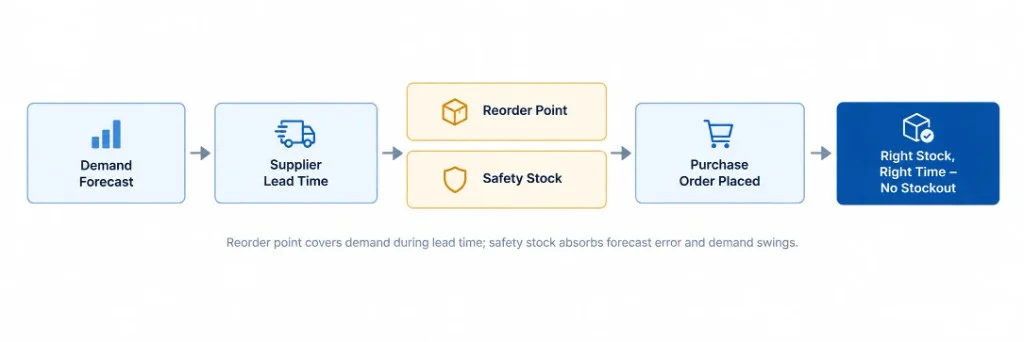
Forecasting and inventory planning go hand in hand. Forecasting shows how much customers may buy, while inventory planning helps decide what to order, when to order it, and how much extra stock to keep.
Supplier lead time determines how far ahead the forecast needs to look. With an eight-week lead time, for example, the purchasing decision is based on a forecast made well before actual demand is known.
The reorder point is the stock level that tells you when to place a new order. It covers expected demand while you wait for the shipment, plus some extra stock as a buffer.
Safety stock acts as a backup when demand is higher than expected, or deliveries are delayed. Products with less predictable sales or longer lead times usually need more safety stock, while stable products can get by with less.
Purchase planning combines expected demand, reorder points, safety stock, supplier lead times, and minimum order quantities to determine the order quantity and timing.
When these pieces are disconnected, businesses can end up holding too much stock in slow-moving SKUs while running out of products with stronger demand.
| Forecasting Input | Inventory Decision it Drives |
|---|---|
| Expected demand during lead time | Reorder point |
| Demand volatility | Safety stock level |
| Full forecast period demand | Purchase order quantity |
| Supplier lead time | How far ahead the order must be placed |
How Demand Forecasting Can Improve Ecommerce Profitability
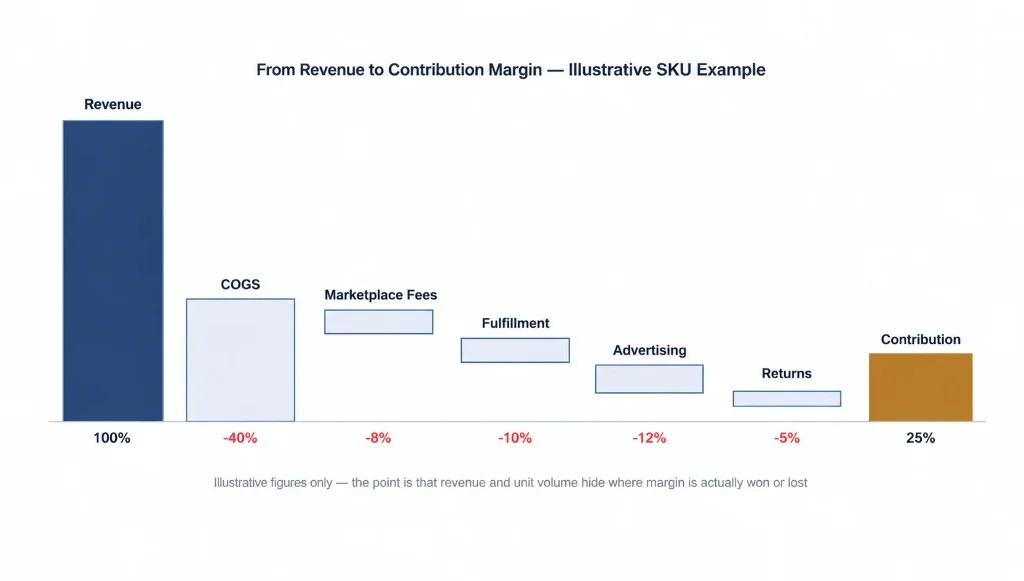
Higher sales do not always mean higher profit. A product may sell quickly but still deliver weak margins after COGS, marketplace fees, fulfillment costs, advertising, returns, and refunds are taken into account.
For example, a high-volume SKU with expensive fulfillment and frequent returns may contribute less profit than a lower-volume product with healthier margins. Looking at these costs alongside expected demand gives businesses a better basis for deciding what to stock, promote, discount, or scale.
- COGS — the direct cost of the product itself, since this determines gross margin before anything else is considered.
- Fulfillment and shipping costs — pick, pack, and ship costs, which vary by product size, weight, and fulfillment method, and which can quietly turn a profitable-looking product into a loss leader.
- Returns and refunds — every return typically comes with a cost beyond the lost sale: return shipping, restocking, and sometimes a write-off if the item can’t be resold.
- Marketplace and payment processing fees — referral fees, payment gateway costs, and any platform-specific charges that eat into the sale before it ever reaches your bank account.
- Advertising costs — particularly relevant for products that only move because of ongoing ad spend; a forecast should reflect that this demand may not be sustainable if the spend stops.
Together, these inputs help estimate contribution margin by SKU. That makes the forecast more useful for deciding what to stock, promote, discount, or scale.
Common Ecommerce Demand Forecasting Mistakes
Most forecasting issues come from a few common mistakes:
- Relying on revenue alone without looking at costs, margins, and actual profit.
- Ignoring stockouts, which can make demand look lower and lead to under-forecasting.
- Treating promotional sales as normal demand, which can make demand look higher and lead to over-forecasting.
- Ignoring returns and refunds, overstating net demand and leading to overordering.
- Forecasting only at the store or business level, missing the SKU-level detail needed for actual purchasing decisions.
- Ignoring supplier lead times, resulting in orders placed too late to prevent a stockout.
- Using fragmented or inaccurate data pulled from disconnected systems that don’t reconcile with each other.
- Assuming historical demand will always repeat, without adjusting for competitive, seasonal, or lifecycle changes.
- Not measuring forecast accuracy, so the same errors get repeated quarter after quarter.
- Treating forecasting as a one-time exercise rather than an ongoing process that needs regular updates.
Most of these aren’t methodology problems they’re data and process problems. A sophisticated forecasting model built on fragmented, uncleaned data will still produce an unreliable forecast.
How to Measure Ecommerce Forecast Accuracy
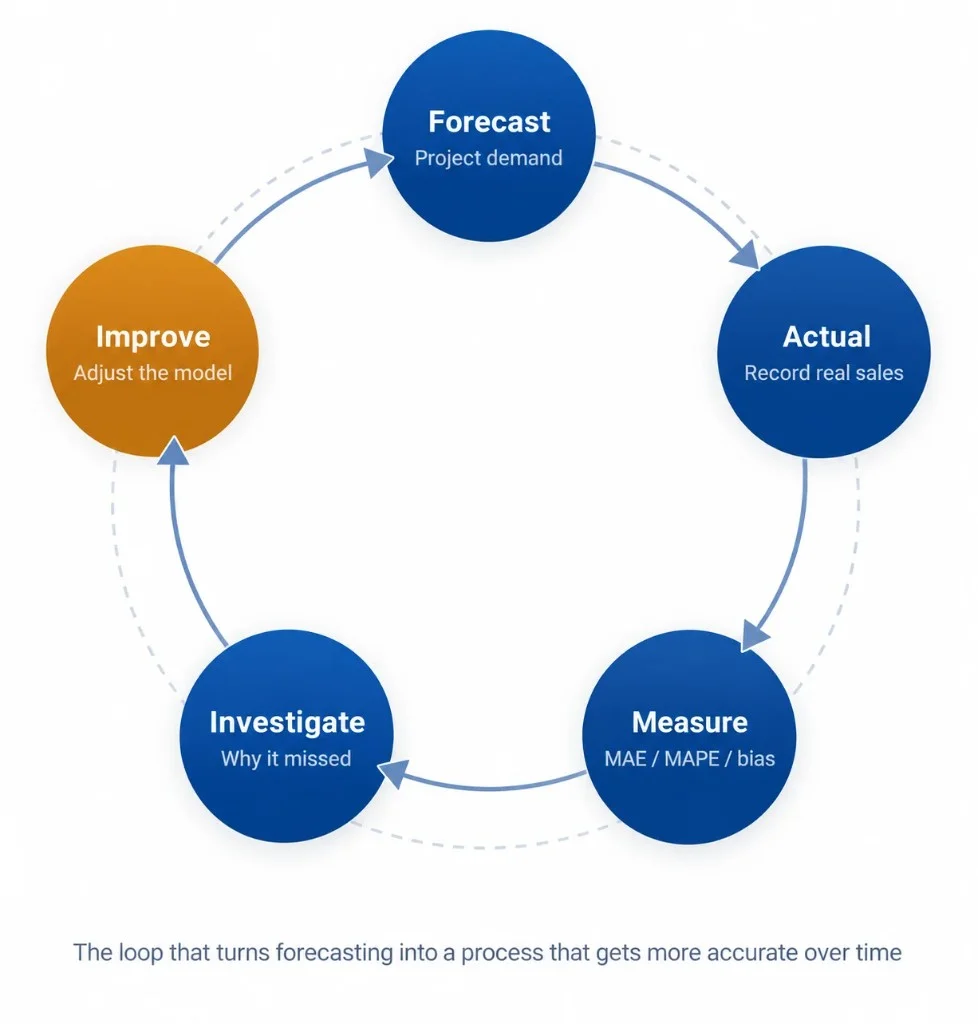
Forecasting only becomes useful when you check how closely it matches actual demand. Compare your forecast with actual sales for each period and SKU, then look at where the biggest gaps occurred.
A few common measures can help:
Forecast variance shows the difference between forecasted and actual demand. It helps identify which products or periods had the largest misses.
Forecast error shows how far the forecast was from actual demand, often as a percentage. This makes it easier to compare products with different sales volumes.
MAE (Mean Absolute Error) measures the average size of forecast errors in units. It gives you a simple view of how many units the forecast typically misses by.
MAPE (Mean Absolute Percentage Error) measures forecast error as a percentage, making it easier to compare accuracy across products of different sizes. For example, a MAPE of 10% is easier to interpret than being off by 43 units. However, MAPE can be misleading for products with very low or zero sales, so it should not be used on its own.
Forecast bias shows whether forecasts are consistently too high or too low. A repeated bias can point to an issue with the forecasting method or the assumptions behind it.
The numbers are useful, but the real value comes from understanding why the forecast was wrong. A stockout, unexpected promotion, supplier delay, or sudden change in demand can all affect the result.
A simple improvement cycle is:
Forecast → Compare → Investigate → Adjust → Forecast again
Can AI Improve Ecommerce Demand Forecasting?
AI can be useful for large ecommerce catalogs where many products and factors need to be considered. It can spot patterns across pricing, seasonality, promotions, and traffic, and update forecasts as new data comes in.
But AI still depends on good data. If important details such as stockouts, promotions, or returns are missing, the forecast may still be wrong.
Best Practices for Ecommerce Demand Forecasting
A simple checklist to review regularly:
- Keep sales, inventory, and financial data in sync.
- Forecast by SKU when it supports purchasing decisions.
- Account for periods when products were out of stock.
- Keep promotional sales separate from normal demand.
- Include returns and refunds.
- Factor supplier lead times into reorder decisions.
- Include COGS and other direct costs when evaluating profitability.
- Compare forecast vs. actual results regularly.
- Update forecasts when meaningful new information appears.
- Use multiple relevant data sources.
- Automate repetitive data preparation where it improves consistency.
The Role of Accurate Ecommerce Data in Demand Forecasting
Forecasting depends on having a clear picture of what happened before. In ecommerce, that information is often spread across multiple systems.
Sales may come from Shopify, Amazon Seller Central, or other marketplaces, while inventory, COGS, refunds, returns, and marketplace fees may be tracked separately. When these records do not line up, it becomes harder to understand actual product performance.
This is where accounting and forecasting overlap. Accurate product mapping, COGS allocation, settlement reconciliation, refund handling, and inventory records can give forecasting teams a more reliable starting point.
A platform like SyncTools can bring sales, inventory, COGS, fees, and returns into a more connected view, reducing the need to rely on manually reconciled reports.
The goal is not to use a more complicated forecasting model. It is to start with data you can trust.
Conclusion
Ecommerce demand forecasting is not about getting every number exactly right. It is about using the information available to make better decisions about inventory, purchasing, promotions, and cash.
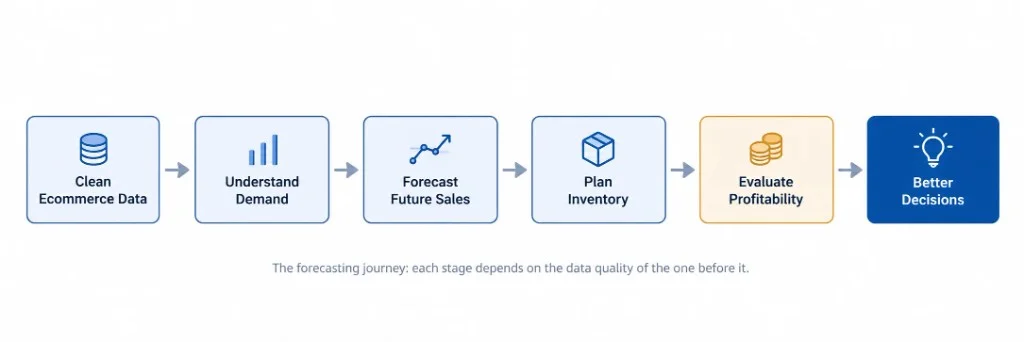
The process starts with reliable data. Sales history needs to be considered alongside inventory availability, promotions, returns, costs, and other factors that can change how demand looks. From there, businesses can choose a forecasting method that fits their products and review the results against actual sales.
The most useful forecast is the one that helps the business act with more confidence knowing what to order, when to reorder, and where to put its money next.
About the SyncTools Content Team
The SyncTools content team covers ecommerce accounting, marketplace reconciliation, inventory, COGS, fees, and financial reporting. Our content focuses on practical ways ecommerce businesses can organize their financial data and make better decisions across sales channels.
Frequently Asked Questions
Why is demand forecasting important for ecommerce businesses?
It helps businesses plan inventory, avoid excess stock, prepare for demand changes, and manage cash more effectively.
How do you forecast demand for an ecommerce product?
Start with past sales, then account for factors such as stockouts, promotions, and seasonal changes. Choose a forecasting method based on the product and available data.
What data is needed for ecommerce demand forecasting?
Start with sales history, inventory levels, pricing, promotions, returns, and refunds. COGS, fees, and fulfillment costs can provide additional context.
What is the difference between demand forecasting and sales forecasting?
Demand forecasting estimates how many units customers may want, while sales forecasting focuses on expected revenue or orders. Stock availability can make the two figures quite different.
What is the best forecasting method for ecommerce, and how accurate is it?
For steady sales, a simple forecasting method may be enough. Seasonal or unpredictable products may need time-series or AI-based methods. Review the results regularly and change the approach if it doesn't provide reliable forecasts.
How does demand forecasting help inventory and cash flow management?
A good forecast helps you decide how much stock to order and when to place the order. This makes it easier to avoid excess stock, prevent shortages, and plan for upcoming inventory payments.
Ready to automate your accounting?
Connect Shopify, WooCommerce, or Linnworks to QuickBooks, Xero & more. Setup in minutes.