Finding the Right Amazon Accountant: A Step-by-Step Guide
Finding the right Amazon accountant is not simply about finding someone who knows QuickBooks, prepares tax returns, or has worked with an e-commerce company before.
You need someone who understands what happens between an Amazon order and the numbers that eventually appear in your P&L, balance sheet, tax records, and bank reconciliation.
That includes Amazon settlements, FBA fees, refunds, reimbursements, inventory, cost of goods sold, marketplace-collected taxes, advertising costs, multiple currencies, and timing differences.
The best accountants for Amazon sellers should be able to explain that entire process clearly.
This guide will show you how to evaluate them, what questions to ask, what good answers should sound like, and how to determine whether an accountant's technology and accounting process can support your business as it grows.
Quick Answer: What Should You Look for in an Amazon Accountant?
A good Amazon seller accountant should understand:
- Amazon settlement accounting
- FBA and referral fees
- Refunds, reimbursements, reserves, and adjustments
- Inventory and COGS
- Amazon marketplace tax treatment
- Your local income tax obligations
- Multi-currency or international selling, where applicable
- QuickBooks, Xero, or your accounting platform
- Amazon accounting integrations and automation
- Month-end reconciliation
- Financial reporting beyond tax filing
Most importantly, they should be able to show you how Amazon transactions become reconciled accounting records, rather than simply telling you they "work with Amazon sellers."
Why Amazon Sellers Often Need Specialist Accounting Knowledge
Amazon accounting creates a basic problem that traditional bookkeeping does not always encounter:
The amount Amazon deposits into your bank account is not necessarily your sales revenue.
Amazon may process sales and then account for refunds, referral fees, FBA charges, shipping-related charges, advertising or other expenses, taxes, reimbursements, and adjustments before the money reaches the seller.
Amazon's own pricing information distinguishes selling plan fees, referral fees, FBA costs, advertising, and other optional services. Referral fees also vary by product category.
That distinction matters.
Consider this simplified example.
| Amazon activity | Illustrative amount |
|---|---|
| Gross product sales | $100,000 |
| Customer refunds | -$8,000 |
| Amazon/FBA fees | -$18,000 |
| Advertising charged through seller account | -$5,000 |
| Reimbursements | +$1,000 |
| Other adjustments | -$500 |
| Illustrative amount remaining | $69,500 |
Example only. Taxes, reserves, timing differences, and other settlement components have intentionally been excluded.
A bookkeeper who records the $69,500 bank deposit as revenue would hide important business information.
Your books should allow you to understand what was sold, what was refunded, what Amazon charged, what other adjustments occurred, and how the resulting payout reconciles with cash received.
That is one of the first things an Amazon seller accountant should understand.
Amazon Bookkeeper, Amazon Accountant, or CPA: Which Do You Actually Need?
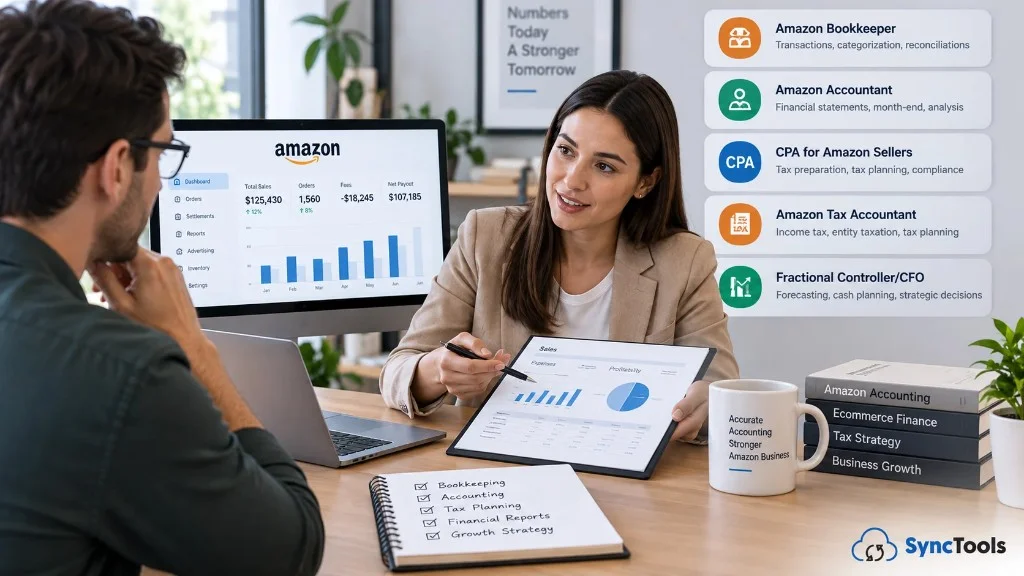
These roles overlap, but they are not identical.
| Role | Typically best suited for |
|---|---|
| Amazon bookkeeper | Recording transactions, categorization, reconciliations and maintaining books |
| Amazon accountant | Financial statements, accounting treatment, month-end processes, analysis and broader financial oversight |
| CPA for Amazon sellers | US tax preparation, tax planning, compliance and other services requiring or benefiting from CPA expertise |
| Amazon tax accountant | Income tax, entity taxation, tax planning, and potentially state or international tax matters depending on expertise |
| Fractional controller/CFO | Forecasting, cash planning, management reporting and strategic financial decisions |
One firm may provide several of these services.
The important question isn't the person's title.
Ask:
Which parts of my financial operation are you responsible for, and which parts require another specialist?
For example, a strong Amazon bookkeeper may handle settlement reconciliation exceptionally well but may not provide income-tax advice.
Likewise, an experienced Amazon CPA may handle tax planning but expect another team to maintain the monthly books.
Knowing the difference prevents expensive gaps in responsibility.
Step 1: Define What You Actually Need Before Comparing Accountants
Do not start by searching Google for "best amazon cpa."
Start with your business.
Write down:
- Countries where you sell
- Amazon marketplaces you use
- FBA, FBM, or both
- Approximate monthly order volume
- Number of SKUs
- Other channels such as Shopify, Walmart, eBay, or wholesale
- Accounting software
- Inventory system
- Number of currencies
- Current bookkeeping process
- Tax jurisdictions involved
- Reporting you need each month
Then classify your needs.
Level 1: Bookkeeping and Reconciliation
You primarily need:
- Amazon transaction recording
- Payout reconciliation
- Fee categorization
- Refund handling
- Bank reconciliation
- Basic monthly financials
An experienced Amazon bookkeeper may be sufficient.
Level 2: Bookkeeping + Tax
You also need:
- Income-tax preparation
- Estimated taxes
- Entity-level tax support
- State-specific advice
- Tax planning
You may need an Amazon tax accountant or CPA for Amazon sellers alongside bookkeeping support.
Level 3: Complex Amazon or Multi-Channel Finance
Your requirements may include:
- Multiple Amazon marketplaces
- Multiple entities
- International sales
- Multiple currencies
- Large inventory balances
- Shopify or other selling channels
- Cash forecasting
- SKU/category/channel profitability
- Management reporting
At this level, evaluate both the accountant and the accounting system they plan to operate.
Step 2: Ask Them to Explain an Amazon Settlement
This is one of the highest-value questions you can ask.
Do not ask:
"Do you understand Amazon settlements?"
They will almost certainly say yes.
Ask instead:
"Walk me through how you would take one Amazon settlement and reconcile it to my accounting system and bank deposit."
A strong answer should discuss separating relevant components such as:
- Sales
- Refunds
- Fees
- Taxes
- Reimbursements
- Adjustments
- Reserves where applicable
- Payout amount
They should also explain how those components map to your chart of accounts and how they verify that the recorded settlement matches the actual payout.
Red Flag
"We record whatever Amazon deposits into the bank account as Amazon income."
A net payout may be a useful reconciliation endpoint, but it should not automatically replace the underlying accounting detail needed to understand revenue and deductions.
Step 3: Test Their Knowledge of Amazon Fees
This is becoming more important, not less.
Amazon announced that US FBA fees would increase by an average of $0.08 per unit sold in 2026, while also stating that no new FBA fee types would be introduced for the year. Amazon provides tools such as its Revenue Calculator and Fee Preview reporting to help sellers assess fees and economics.
Your Amazon FBA accountant therefore needs to understand more than revenue.
Ask:
"How will my accounting reports show the financial impact of Amazon fees?"
Then ask which fee categories they normally separate.
You want reports that make economically important expenses visible instead of burying every Amazon deduction inside a single generic marketplace-fee account.
The exact level of detail should reflect your business and reporting needs.
Too little detail hides problems.
Too much detail can create accounting records nobody can realistically review.
A good Amazon FBA accountant should help find the useful middle ground.
Step 4: Find Out How They Handle Inventory and COGS
For product businesses, accounting does not stop when the sale is recorded.
Inventory affects the balance sheet, cost of goods sold, gross margin, cash planning, purchasing decisions, and tax reporting.
For US businesses, IRS guidance explains that businesses required to account for inventory generally need beginning and ending inventory values to determine COGS. However, specific rules and exceptions can apply to qualifying small businesses.
Ask your prospective accountant:
"How will you determine and validate COGS for products sold through Amazon?"
Follow with:
- Which system is the source of inventory cost?
- Are freight, duties, or other acquisition costs included where appropriate?
- How do you treat refunds and returned inventory?
- How are damaged or unsellable items handled?
- How do you reconcile inventory-related numbers between operational systems and accounting?
- What happens if Amazon data and the inventory system disagree?
There is no responsible one-size-fits-all answer.
Your accounting method, entity, jurisdiction, inventory system, and business circumstances matter.
A good accountant should explain the methodology they recommend and why it applies to you.
Step 5: Test Their Understanding of Amazon Taxes Without Accepting Over-Simplified Answers
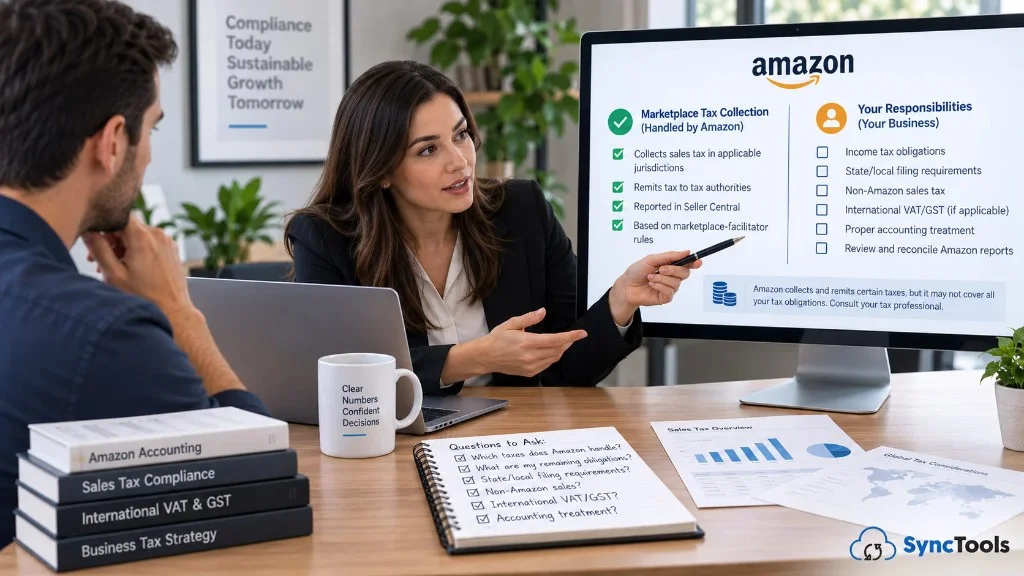
Tax expertise is another area where sellers should ask precise questions.
For US marketplace transactions, Amazon operates Marketplace Tax Collection in jurisdictions where marketplace-facilitator rules apply. Amazon's documentation explains that relevant tax collected and remitted through these rules appears in Seller Central reporting. Amazon also tells sellers to consult their tax professional regarding any remaining obligations.
Therefore, be cautious if an accountant says either:
"Amazon handles all your taxes."
or
"Every Amazon seller has the same sales-tax obligations."
Both are too simplistic.
Marketplace collection and your business's filing, registration, income-tax, non-marketplace, international, or other obligations are not necessarily the same thing.
Ask:
"Which taxes does Amazon handle in my situation, and which obligations still sit with my business?"
A competent Amazon seller CPA should clearly separate:
- Marketplace-collected tax
- Your accounting treatment of that tax
- Income-tax obligations
- State or local filing requirements where applicable
- Non-Amazon sales
- International VAT/GST obligations if you sell internationally
If your accountant does not personally cover every area, that is not automatically a problem.
The problem is when nobody knows who owns it.
Step 6: Ask How They Handle Form 1099-K
US sellers should understand another important distinction:
Form 1099-K is not your profit-and-loss statement.
Current IRS guidance states that for third-party settlement organizations, the federal reporting threshold is generally more than $20,000 and more than 200 transactions. The IRS also emphasizes that you still need to report business income even if you don't receive a Form 1099-K.
Ask a prospective CPA for Amazon sellers:
"How do you reconcile information reported on Form 1099-K with my accounting records and tax return?"
A good answer should recognize that a tax information form, Amazon settlement reporting, bank deposits, revenue, fees, refunds, and taxable profit are different concepts that need to be reconciled, not assumed to be equal.
Step 7: Evaluate Their Accounting Technology, Not Just Their Credentials
A seller with 50 orders per month and a seller with 20,000 orders per month should not necessarily use the same bookkeeping workflow.
Ask:
"How exactly does Amazon data get into my accounting software?"
Possible processes may include:
- Manual exports
- Spreadsheet transformation
- Direct integrations
- Ecommerce accounting software
- Summarized posting
- Individual transaction posting
- Custom integrations
There is no universal answer.
The right setup depends on volume, reporting requirements, tax requirements, audit trail, accounting software, and the level of transaction detail your finance team needs.
What matters is whether the accountant can explain the process clearly.
Ask These Five Technology Questions
- What is the source of truth for Amazon financial data?
- How do transactions enter QuickBooks, Xero, or our accounting system?
- How are accounts and tax codes mapped?
- What happens when a transaction fails or does not match?
- Who reviews exceptions before the month-end closes?
If the answer to question four is effectively "we hope that does not happen," keep interviewing.
Where SyncTools Fits Into the Amazon Accountant Relationship
Accounting software should not replace an accountant's judgment.
It should reduce the amount of accounting work spent moving, reformatting, and matching marketplace data.
For example, SyncTools can connect Amazon settlement data with accounting platforms including QuickBooks, Xero, and Zoho Books. Its current Amazon integrations can handle financial information including sales, refunds, fees, taxes, COGS, and payouts. SyncTools also supports summarized and individual posting approaches depending on how much transaction-level detail the business wants in its accounting system.
That changes the conversation you should have with an accountant.
Instead of asking:
"Will you manually enter my Amazon accounting?"
Ask:
"Which parts should the software process automatically, which exceptions should your team review, and what controls will you perform at month-end?"
That is a much more useful question.
Figure: What the Accounting Workflow Should Look Like
Automation isn't meant to remove the accountant.
It is to give the accountant a repeatable data process they can review and control.
Step 8: Ask What You Will Actually Receive Every Month
Many sellers compare accountants by monthly fee.
Compare deliverables first.
Ask each seller accountant to list exactly what you receive.
At minimum, determine whether the engagement covers:
| Deliverable | Included? | Frequency | Who reviews it? |
|---|---|---|---|
| Amazon settlement reconciliation | |||
| Bank reconciliation | |||
| P&L | |||
| Balance sheet | |||
| Inventory/COGS review | |||
| Amazon fee categorization | |||
| Refund/reimbursement review | |||
| Tax liability review | |||
| Cash-flow reporting | |||
| Management commentary | |||
| Tax filing | |||
| Year-end support |
This one table can prevent many misunderstandings.
"Monthly accounting" can mean very different things at different firms.
Step 9: Check Whether They Can Handle Your Future Business, Not Just Today's Business
Suppose you currently sell only through Amazon US.
Next year, you might add:
- Amazon UK
- Amazon Canada
- Shopify
- Walmart
- Wholesale
- A second entity
- Additional warehouses
- Additional currencies
Ask:
"If we add another marketplace or sales channel, what would have to change in our accounting architecture?"
Your accountant should understand whether that expansion affects:
- Chart-of-account structure
- Tax
- Inventory
- Currency
- Clearing accounts
- Reporting dimensions
- Consolidation
- Data integrations
This is particularly important when comparing Amazon FBA accountants for a business that expects to become multi-channel.
You do not want to rebuild the entire finance process every time the sales team adds a channel.
Step 10: Evaluate Security and Account Access
Your accountant may need access to Amazon, accounting software, bank statements, financial reports, tax records, and other sensitive systems.
Ask how access is managed.
Amazon advises sellers not to share their Seller Central password and recommends granting users only the permissions needed for their work. External service providers should use the appropriate authorized-access mechanisms.
Ask prospective accountants:
- Who inside the firm receives access?
- Are permissions role-based?
- Do former employees lose access immediately?
- Will anyone outside the firm access your data?
- How are accounting credentials handled?
- Does the firm maintain an audit trail for changes?
- Who owns integration configurations and mappings if you leave?
That final question is commonly overlooked.
Your financial system should remain usable if you change accountants.
Step 11: Ask for Evidence, Not Just Ecommerce Claims
"Amazon specialist" is easy to put on a website.
Ask for evidence.
Useful evidence may include:
- Number and type of Amazon clients they serve
- Experience with businesses at your volume
- Sample reports
- Amazon case studies
- QuickBooks/Xero certifications
- Month-end process examples
- Experience with your tools
- References from similar sellers
You do not necessarily need an accountant from your city.
You need someone who can handle your operating model.
If you are searching for an Amazon Seller Central business tax accountant, prioritize Amazon workflow expertise, relevant tax qualifications, jurisdiction knowledge, and communication over physical proximity.
Step 12: Give the Accountant a Practical Test
Here is a much better hiring method than asking 20 theoretical questions.
Give each shortlisted accountant a simplified scenario.
Example
"Our Amazon sales report shows $100,000 of sales. Amazon paid $69,500 after refunds, fees, advertising, and adjustments. Explain how you would record, reconcile, and review the month."
Then listen.
Do they ask:
- Which report the numbers came from?
- Whether sales figures include marketplace-collected tax?
- What period does the settlement cover?
- Whether refunds relate to earlier periods?
- Where does COGS come from?
- Whether Amazon Ads are charged through the seller account?
- Whether any reserve remains?
- Which accounting software is being used?
- Whether another system holds inventory cost?
Those questions tell you far more than a polished sales presentation.
A real specialist usually wants to understand the data before deciding how to record it.
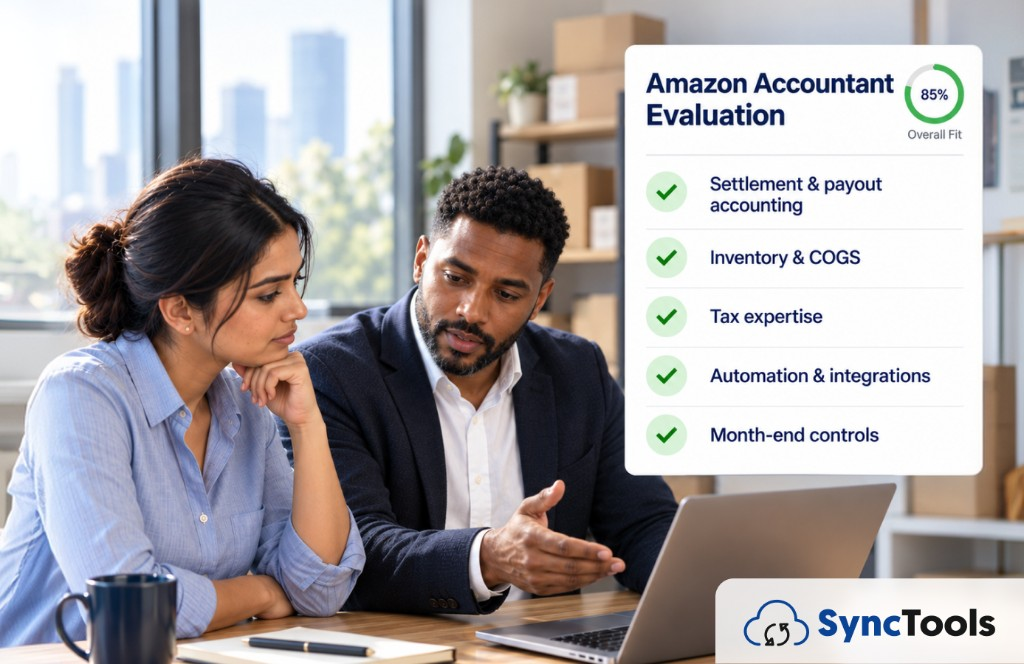
Amazon Accountant Evaluation Scorecard
Use the following scoring model to compare finalists.
This is a suggested evaluation framework, not an accounting industry standard.
| Evaluation area | Weight |
|---|---|
| Amazon settlement and payout accounting | 25% |
| Inventory and COGS knowledge | 15% |
| Tax expertise and ability to define tax responsibilities | 15% |
| Accounting technology and automation | 15% |
| Month-end controls and reporting | 15% |
| Multi-channel/international scalability | 10% |
| Communication and responsiveness | 5% |
| Total | 100% |
Suggested Interpretation
80–100: Strong fit.
65–79: Good option, but review the gaps.
Below 65: May not be the right fit.
Do not automatically select the highest-scoring candidate.
A tax-heavy business may need to weight tax expertise more heavily.
A high-volume seller may care more about accounting architecture and reconciliation.
The scorecard makes your reasoning visible.
15 Questions to Ask an Amazon Accountant Before Hiring
Take these questions into your discovery calls.
- How many active Amazon seller clients do you currently support?
- What size and transaction volumes are they?
- How do you reconcile an Amazon payout?
- How do you separate gross sales from refunds, fees, taxes, reimbursements, and adjustments?
- How do you handle settlements crossing accounting periods?
- What is your process for inventory and COGS?
- How do you handle Amazon marketplace-collected tax?
- Which tax responsibilities would you handle, and which require another specialist?
- How do you reconcile Form 1099-K information with the books?
- Which Amazon accounting software or integrations do you normally use?
- Do you recommend individual or summarized posting for our business, and why?
- How are failed syncs, duplicates, missing transactions, and other exceptions identified?
- What exactly will I receive at month-end?
- How quickly are books normally closed after month-end?
- What happens to our data, mappings, and accounting setup if we change firms?
The quality of the explanations matters more than whether every answer matches a predetermined script.
Red Flags When Hiring Accountants for Amazon Sellers
Be cautious when you hear statements like:
"Amazon deposits equal your revenue."
Ask them to demonstrate the reconciliation.
"Amazon handles all the tax."
Ask which tax, in which jurisdictions, and under which rules.
"We don't need to reconcile Amazon because the bank reconciles."
Bank reconciliation alone does not explain the financial components behind Amazon activity.
"Inventory doesn't really matter until year-end."
For a product-heavy business, inventory and COGS may materially affect gross margin and management decisions throughout the year.
"We use the same chart of accounts for every ecommerce client."
Standardization can be useful, but your reporting structure should still reflect what management needs to understand.
"Just give us your Amazon password."
Amazon recommends controlled access rather than password sharing.
"Our software handles everything automatically."
Automation still requires configuration, accounting rules, exception management, and review.
Software does not eliminate accounting responsibility.
What Does a Good Amazon Accounting Setup Look Like?
You should eventually be able to answer questions such as:
- What were gross Amazon sales?
- How much was refunded?
- How much did Amazon charge in relevant fees?
- What was COGS?
- What was gross margin?
- What amount is still being held or awaiting payout?
- Do Amazon settlements reconcile with bank deposits?
- Are Amazon-collected taxes treated correctly?
- Which marketplace or category is driving profitability?
- Are there unexplained differences that require investigation?
You should not need three spreadsheets and two hours of investigation every time management asks one of these questions.
This is where a capable accountant and the right accounting infrastructure matter.
Should Your Accountant Use SyncTools?
Not automatically.
The better question is:
Does SyncTools match the accountant's required Amazon accounting workflow and your reporting needs?
For Amazon businesses using supported accounting platforms, SyncTools can provide the connection layer between Amazon data and the accounting ledger.
For example, the Amazon-to-QuickBooks integration supports Amazon sales, refunds, fees, taxes, COGS, and payout settlements, with options for summarized or individual transaction posting. Its Amazon-to-Xero integration provides similar transaction and COGS workflows.
This can be especially relevant when your accountant currently spends significant time:
- Downloading Amazon files
- Reformatting transaction data
- Creating recurring entries
- Categorizing marketplace activity
- Matching payouts
- Investigating differences caused by fragmented data
The accountant should remain responsible for defining how that information is treated, mapped, reviewed, and reported.
Think of it this way:
SyncTools moves and organizes Amazon accounting data.
Your accountant decides what the numbers mean and whether the accounting is correct.
That division of responsibility is healthier than expecting either software or an accountant to do everything alone.
A Better Way to Choose Between Two Amazon Accountants
Suppose Accountant A charges less but relies heavily on manual spreadsheets.
Accountant B costs more but uses a defined Amazon accounting process, can explain settlement reconciliation, understands inventory, documents tax responsibilities, uses controlled integrations, and provides monthly management reporting.
The cheaper option is not automatically cheaper.
Compare the total finance process, including:
- Accountant fees
- Bookkeeper fees
- Software costs
- Internal staff time
- Time spent fixing errors.
- Month-end delays
- Tax preparation cleanup
- Reporting quality
- Ability to scale transaction volume
Likewise, the most expensive accountant is not automatically the best.
You are buying a reliable financial process, not prestige.
Final Checklist Before Signing
Before appointing an accountant for Amazon sellers, make sure you can answer yes to the following:
- They understand Amazon settlements.
- They can explain how payouts reconcile.
- They understand FBA and marketplace fees.
- They have a defined inventory and COGS process.
- Tax responsibilities are clearly divided.
- They understand your accounting software.
- Their Amazon-to-accounting workflow is documented.
- Exceptions have an owner.
- Month-end deliverables are written into the scope.
- They can support your expected growth.
- Access to financial systems is controlled.
- You retain ownership of your data.
- You understand what happens if you leave the firm.
- Their fee structure is clear.
- You have tested their knowledge with a practical scenario.
If several of these remain unclear after the sales call, do not rush the decision.
Conclusion: Hire the Process, Not Just the Accountant
The right Amazon accountant should do more than prepare tax returns and categorize bank transactions.
They should understand how your Amazon operation produces financial data and how that data becomes trustworthy books.
That means being able to explain:
Amazon sale → fees/refunds/tax/COGS → settlement → accounting entry → payout → bank reconciliation → financial reporting.
The strongest Amazon accountants will also tell you what software should handle and where professional judgment still matters.
That is the bigger hiring test.
Do not ask only:
"Are you an Amazon accountant?"
Ask:
"Show me how you would make my Amazon numbers reliable every month."
Their answer will tell you whether you have found an accountant who merely recognizes Amazon Seller Central or one who can actually support an Amazon business.
Test the Amazon Accounting Workflow Before You Hire
Before choosing your next Amazon accountant, test the accounting workflow they plan to use.
If your business uses QuickBooks, Xero, or Zoho Books, explore how SyncTools can move Amazon sales, refunds, fees, taxes, COGS, and payout data into your accounting workflow. Then ask your accountant how they would configure the mappings, review exceptions, reconcile payouts, and close the month.
See how Amazon accounting works with SyncTools and decide whether the workflow fits your accountant before committing to another manual process.
Frequently Asked Questions
Do I need an accountant who understands Amazon?
Yes, especially if Amazon is a major sales channel. They should understand settlements, fees, refunds, inventory, COGS, taxes, and Seller Central reporting.
What is the difference between an Amazon accountant and a bookkeeper?
A bookkeeper manages day-to-day records and reconciliations. An accountant typically handles reporting, accounting decisions, month-end review, and financial analysis.
What should I ask an Amazon FBA accountant before hiring them?
Ask how they reconcile Amazon settlements with your accounting software and bank deposits. Their answer should cover fees, refunds, taxes, COGS, and month-end checks.
Can QuickBooks or Xero manage Amazon accounting on their own?
They can store the accounting records, but Amazon data still needs to be imported, categorized, and reconciled. Tools like SyncTools can help connect Amazon data with QuickBooks or Xero.
Does Amazon collect sales tax for sellers?
Amazon collects and remits sales tax in many marketplace-facilitator jurisdictions. However, sellers may still have other filing or tax obligations depending on where and how they operate.
Is SyncTools a replacement for an Amazon CPA or accountant?
No. SyncTools is accounting automation software. It can help transfer and organize Amazon financial data into supported accounting systems, while the accountant remains responsible for accounting decisions, review, reconciliation, tax advice, and financial interpretation.
Ready to automate your accounting?
Connect Shopify, WooCommerce, or Linnworks to QuickBooks, Xero & more. Setup in minutes.