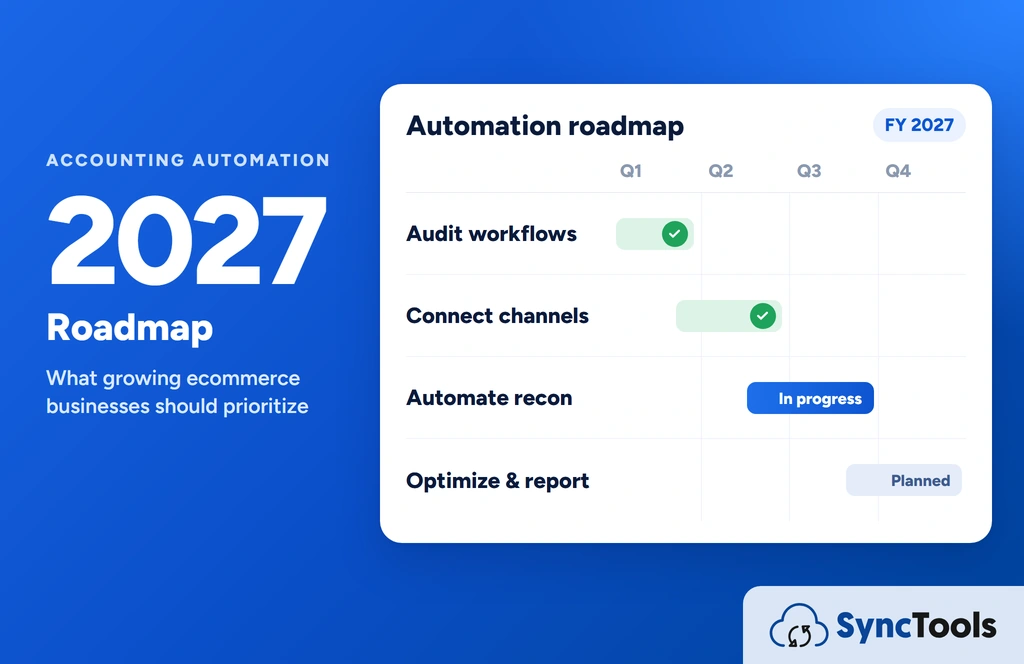
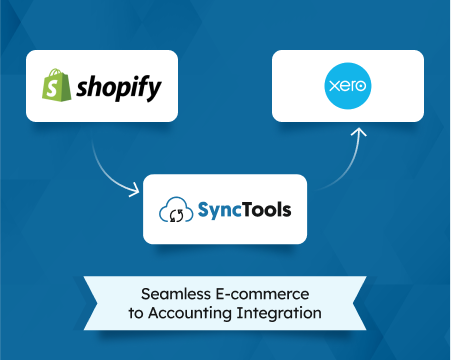
AED 375K vs AED 50M: UAE Ecommerce VAT & e-Invoicing Thresholds Explained
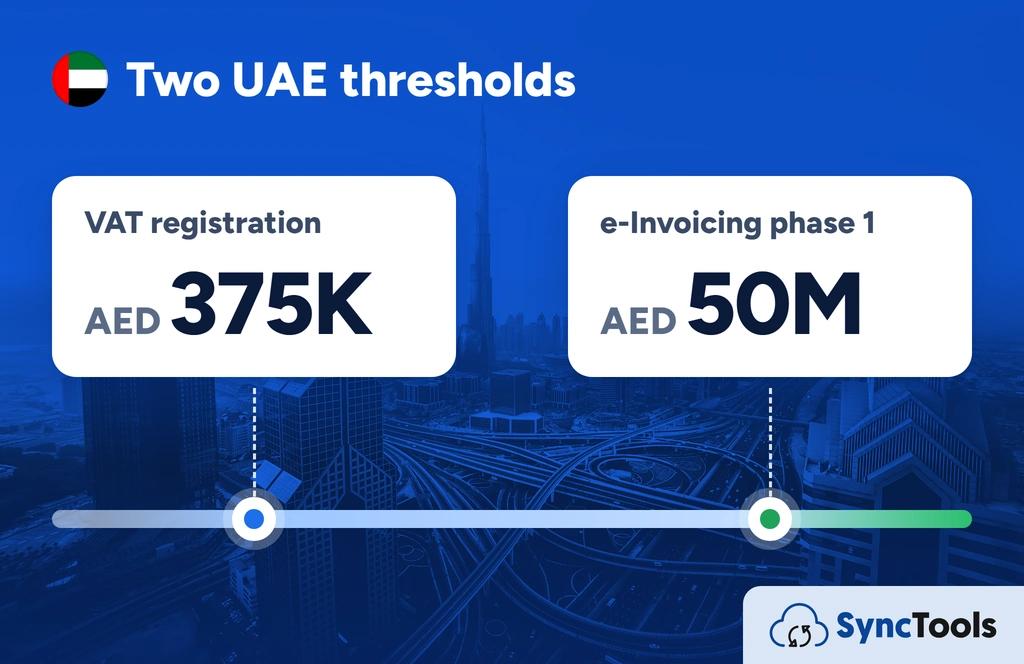
The UAE's e-commerce tax landscape is entering a new phase. Businesses already monitoring the AED 375,000 VAT registration threshold must now understand another important figure: AED 50 million.
But these thresholds serve different purposes.
AED 375,000 sets the threshold for mandatory VAT registration for qualifying UAE-resident businesses. AED 50 million triggers the first mandatory phase of the UAE's new electronic invoicing system for in-scope businesses.
For e-commerce sellers operating through Shopify, Amazon, WooCommerce, and other channels, understanding this distinction is essential.
With the first e-invoicing implementation deadline approaching on January 1, 2027, businesses need to evaluate more than their annual revenue. They must understand which transactions count toward VAT registration, whether their invoices fall within the e-invoicing framework, and whether their accounting systems can support accurate financial reporting.
This guide explains both thresholds, implementation deadlines, industry-specific considerations, and how accounting integrations and AI-assisted monitoring can support UAE e-commerce businesses.
UAE VAT vs E-Invoicing: What Is the Difference?
VAT registration and electronic invoicing are related, but they are not interchangeable obligations.
VAT registration determines whether a business must register and account for Value Added Tax.
Electronic invoicing establishes requirements for issuing, exchanging, and reporting qualifying invoices electronically through the UAE's prescribed framework.
| Requirement | UAE VAT Registration | UAE E-Invoicing |
|---|---|---|
| Primary threshold | AED 375,000 | AED 50 million |
| Threshold purpose | Mandatory VAT registration | Determines first implementation phase |
| Threshold measurement | Qualifying taxable supplies and imports | Annual revenue |
| Main authority | Federal Tax Authority | Ministry of Finance and Federal Tax Authority |
| Main obligation | VAT registration, accounting, and returns | Structured electronic invoice exchange and reporting |
| Businesses below threshold | May still have VAT obligations | May still fall within e-invoicing scope |
| Key consideration | Taxable turnover | Transaction scope and implementation phase |
The most important distinction is that AED 50 million is not a general exemption threshold for UAE e-invoicing.
Businesses below AED 50 million may still need to implement the system, depending on their transactions and applicable exclusions.
What Is the AED 375,000 VAT Threshold in the UAE?
The UAE's mandatory VAT registration threshold is AED 375,000.
For UAE-resident businesses, registration is generally mandatory when total taxable supplies and imports exceed AED 375,000 in the previous 12 months or are expected to exceed that amount within the next 30 days.
The UAE also provides a voluntary registration threshold of AED 187,500, subject to the applicable conditions.
Why Ecommerce Sellers Need to Monitor Taxable Turnover
Consider a UAE-based Shopify business selling beauty and personal care products.
Its taxable sales develop as follows:
| Period | Illustrative taxable sales |
|---|---|
| January–March | AED 75,000 |
| April–June | AED 95,000 |
| July–September | AED 120,000 |
| October | AED 45,000 |
| November | AED 55,000 |
| Total | AED 390,000 |
Assuming all these sales qualify toward the registration calculation, the business has exceeded AED 375,000.
It must evaluate when the threshold was crossed and meet the applicable VAT registration deadline.
The calculation should use qualifying taxable turnover, not simply bank deposits or net marketplace payouts.
Why Marketplace Payouts Can Create Confusion
An e-commerce seller may receive AED 90,000 from a marketplace after deductions.
However, the underlying transactions might include:
- AED 100,000 in customer sales
- AED 7,000 in marketplace commissions
- AED 3,000 in other deductions
The AED 90,000 settlement does not necessarily represent the seller's taxable turnover.
Finance teams must distinguish gross sales, VAT, refunds, marketplace deductions, and settlement amounts according to the applicable accounting and tax treatment.
This is where properly configured e-commerce accounting integrations add value.
What Is the AED 50 Million UAE E-Invoicing Threshold?
The AED 50 million threshold determines which in-scope businesses must implement the UAE Electronic Invoicing System during the first mandatory phase.
Businesses with annual revenue of AED 50 million or more must implement the system by January 1, 2027.
Businesses with annual revenue below AED 50 million generally enter the subsequent implementation phase, with a July 1, 2027 deadline.
UAE E-Invoicing Implementation Timeline
| Business category | Accredited Service Provider deadline | Implementation deadline |
|---|---|---|
| In-scope businesses with revenue ≥ AED 50 million | October 30, 2026 | January 1, 2027 |
| In-scope businesses with revenue < AED 50 million | March 31, 2027 | July 1, 2027 |
| In-scope government entities | March 31, 2027 | October 1, 2027 |
The October 30, 2026 deadline reflects the amendment introduced through Ministerial Resolution No. 66 of 2026.
Businesses should assess their obligations under current legislation rather than rely on earlier implementation announcements.
Does Every Ecommerce Business Need E-Invoicing?
Not necessarily.
The UAE framework currently excludes business-to-consumer transactions from mandatory electronic invoicing until a future ministerial decision specifies otherwise.
Businesses engaged exclusively in B2C transactions are therefore not subject to the current mandatory implementation requirement.
However, e-commerce companies serving both consumers and businesses must carefully assess their transactions.
For example, a Shopify retailer may sell products directly to consumers while also supplying wholesale customers.
The e-invoicing framework may treat its consumer transactions and qualifying business transactions differently.
The key question isn't simply how much an e-commerce business earns. It also depends on who the business sells to and whether those transactions fall within the system's scope.
Why UAE Ecommerce Businesses Should Prepare Before 2027
Electronic invoicing adds a new requirement: businesses must maintain accurate, structured transaction data.
For ecommerce companies, this can be challenging because financial information often exists across multiple systems.
A typical merchant may use Shopify for online sales, Amazon for marketplace transactions, payment gateways for collections, and QuickBooks or Xero for accounting.
Each platform records different aspects of a transaction.
An order may contain product revenue, shipping charges, discounts, taxes, and payment information. The subsequent marketplace settlement may include commissions, refunds, and other deductions.
Without appropriate reconciliation, these records may not agree.
Electronic invoicing makes accurate source data especially important because the prescribed structured format must exchange qualifying invoice information.
Why PDF Invoices Are Not Enough
Under the UAE framework, an ordinary PDF invoice is not equivalent to a compliant electronic invoice.
An e-invoice contains structured, machine-readable information that is exchanged and reported through the prescribed electronic invoicing system.
Businesses must therefore evaluate their invoicing applications, required data fields, transaction classifications, and connectivity with an Accredited Service Provider.
An ecommerce accounting integration alone does not replace this requirement.
How SyncTools Supports UAE Ecommerce Accounting Readiness
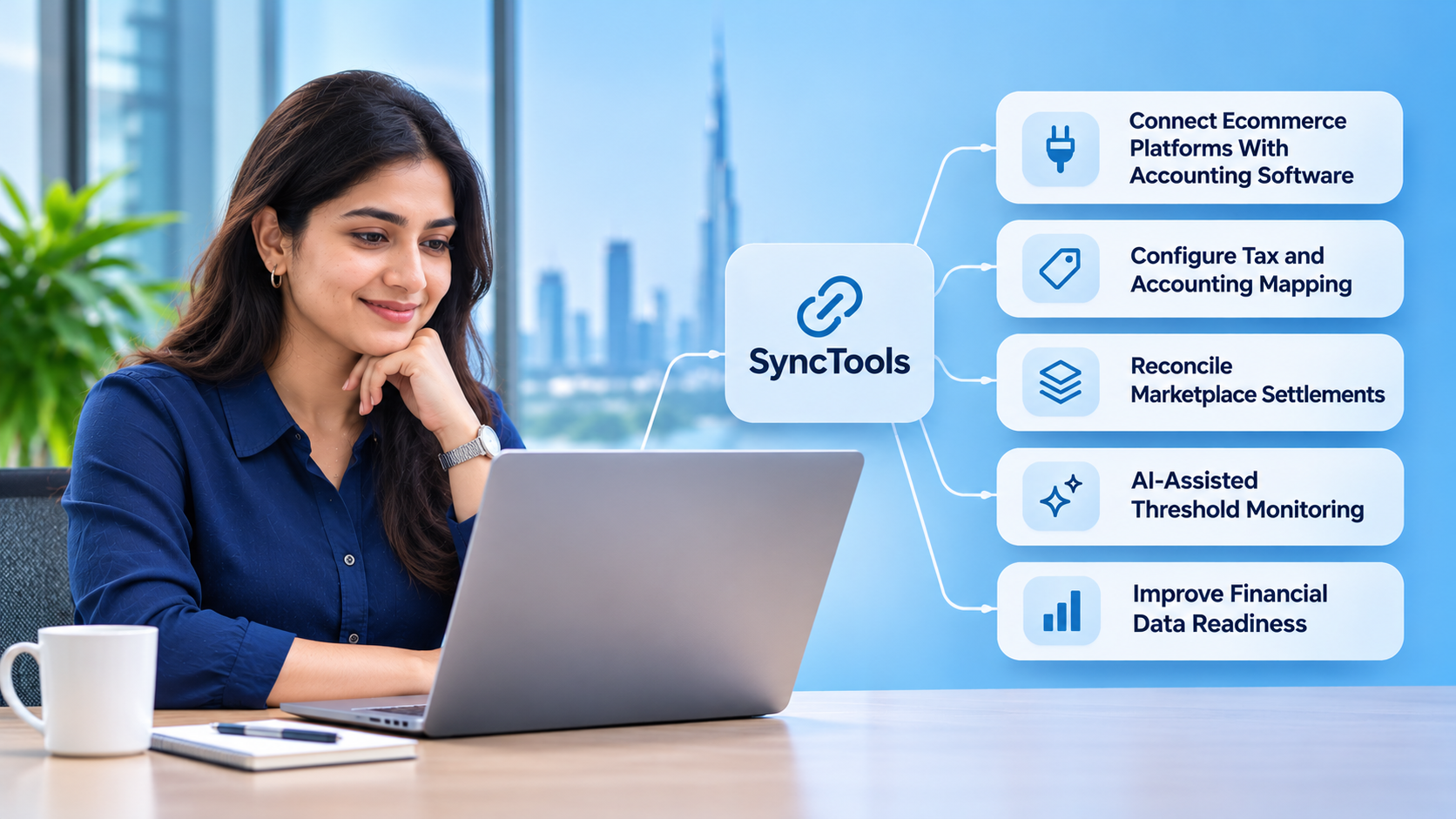
SyncTools connects ecommerce platforms with accounting software to help businesses organize transaction data, map accounting entries, and reconcile financial activity.
For UAE ecommerce merchants, this supports an important part of VAT reporting and e-invoicing preparation: maintaining reliable underlying accounting records.
1. Connect Ecommerce Platforms With Accounting Software
SyncTools supports integrations with platforms such as Shopify, Amazon, and WooCommerce, as well as accounting applications including QuickBooks, Xero, and Zoho Books.
Instead of relying on manual exports, businesses can connect supported sales channels to their accounting systems.
This helps finance teams maintain visibility into sales, refunds, taxes, fees, and settlements.
2. Configure Tax and Accounting Mapping
Different ecommerce transactions may require different accounting treatment.
For example, a UAE merchant may process domestic sales, exports, refunds, and marketplace transactions.
SyncTools supports configurable tax mapping for relevant integrations, allowing businesses to align transaction information with the appropriate accounting tax codes.
However, the correct UAE VAT treatment depends on the transaction and applicable legislation.
3. Reconcile Marketplace Settlements
Marketplace deposits frequently differ from recorded sales because of commissions, payment fees, refunds, and other adjustments.
SyncTools connects underlying transaction information with accounting records.
This improves the information available for financial reconciliation and VAT-related review.
4. Support AI-Assisted Threshold Monitoring
SyncTools' published integration pages describe an AI Threshold Advisor designed to monitor sales against tax registration thresholds and provide alerts supported by regulatory sources.
For UAE merchants, this capability helps monitor potential VAT registration exposure.
Businesses should confirm UAE-specific coverage and configuration before relying on automated alerts.
AI-generated threshold assessments should support, rather than replace, professional tax review.
5. Improve Financial Data Readiness
Businesses preparing for e-invoicing need consistent information across their commerce, invoicing, and accounting environments.
SyncTools can support the accounting-data layer through transaction synchronization, mapping, and reconciliation.
Important: Do not treat SyncTools as a UAE-accredited e-invoicing service provider or a substitute for the prescribed e-invoicing infrastructure unless you separately verify such accreditation or functionality.
Industry-Specific UAE VAT and E-Invoicing Considerations
Different ecommerce business models create different accounting and transaction-classification challenges.
| Industry | Common accounting challenge | Relevant SyncTools capability |
|---|---|---|
| Fashion and apparel | High refund volumes, discounts, and marketplace fees | Refund accounting and payout reconciliation |
| Beauty and cosmetics | Multichannel sales and product-level reporting | Product mapping and sales synchronization |
| Electronics | High-value orders, returns, and inventory costs | COGS and transaction mapping |
| Wholesale ecommerce | B2B invoices and customer-specific transactions | Accounting data synchronization |
| Home and furniture | Shipping charges, returns, and settlement adjustments | Sales, shipping, and refund mapping |
| Cross-border ecommerce | Currency differences and varying tax treatment | Multicurrency accounting and configurable tax mapping |
Fashion and Apparel
Fashion retailers often face high return rates and promotional discounts.
Their accounting systems must distinguish original sales, refunds, discounts, and payment settlements.
This is especially important when calculating qualifying turnover and reconciling VAT records.
Wholesale and B2B Ecommerce
Wholesale ecommerce businesses should pay particular attention to the UAE e-invoicing framework.
Unlike exclusively B2C retailers, businesses issuing qualifying B2B invoices may fall within the mandatory implementation scope.
They should review invoice data requirements, customer information, and connectivity to an Accredited Service Provider.
Cross-Border Ecommerce
International sellers entering the UAE must consider additional questions.
For example, a non-resident business making taxable supplies in the UAE may need to register for VAT even if its supplies are below AED 375,000, unless another party accounts for the VAT.
Cross-border businesses should therefore avoid assuming that the domestic registration threshold applies to every selling arrangement.
Can AI Help Ecommerce Businesses Monitor UAE VAT Thresholds?
AI-assisted monitoring can help finance teams identify potential threshold exposure earlier.
However, its effectiveness depends on the accuracy and classification of the underlying transactions.
Consider an e-commerce business operating multiple sales channels.
Its finance team may need to determine whether qualifying taxable turnover is approaching AED 375,000.
An effective monitoring workflow would involve:
- Collecting relevant sales information across connected channels.
- Identifying transactions potentially included in the VAT threshold calculation.
- Reviewing refunds, discounts, and other adjustments.
- Calculating qualifying turnover over the relevant period.
- Flagging potential threshold breaches for finance-team review.
- Supporting the registration decision with appropriate documentation.
An AI advisor can help monitor and identify unusual patterns.
Nevertheless, businesses must verify how imports, exports, exempt supplies, and other transactions are treated before making registration decisions.
AI should help identify when a tax question needs attention, not independently determine the legal answer.
UAE Ecommerce VAT and E-Invoicing Readiness Checklist
Businesses preparing for the upcoming requirements should review both their tax obligations and their accounting infrastructure.
| Readiness question | Why it matters |
|---|---|
| Have we calculated qualifying taxable turnover? | Determines potential VAT registration obligations |
| Are we monitoring the correct rolling period? | Helps identify registration requirements |
| Do we understand our B2B and B2C transaction mix? | Supports e-invoicing scope assessment |
| Have we identified our applicable implementation phase? | Establishes relevant deadlines |
| Are our e-commerce sales reconciled with accounting records? | Improves financial data reliability |
| Are VAT codes and transaction mappings reviewed? | Supports accurate tax accounting |
| Can we identify refunds, fees, and adjustments separately? | Helps prevent reporting discrepancies |
| Have we evaluated an Accredited Service Provider? | Required for applicable e-invoicing implementation |
| Have we reviewed our invoicing system's technical capabilities? | Supports structured invoice requirements |
| Are finance and technical teams coordinating implementation? | Reduces integration and reporting risks |
Final Thoughts: Two Thresholds, Different Obligations, One Need for Accurate Accounting
The AED 375,000 VAT registration threshold and AED 50 million e-invoicing implementation threshold address different regulatory requirements.
UAE e-commerce businesses must understand both.
VAT registration depends on whether the business qualifies for taxable activity and the applicable registration rules.
Electronic invoicing depends on transaction scope, annual revenue for implementation phasing, and compliance with the prescribed technical framework.
As the UAE moves toward mandatory electronic invoicing in 2027, businesses should review their tax obligations alongside the quality of their ecommerce accounting data.
SyncTools connects ecommerce sales channels to accounting software, supporting transaction mapping, reconciliation, and more reliable financial records.
Prepare Your Ecommerce Accounting for UAE Tax Requirements
Selling through Shopify, Amazon, WooCommerce, or multiple ecommerce channels?
Explore how SyncTools connects your sales data with QuickBooks, Xero, and Zoho Books.
Disclaimer: This article provides general information based on UAE regulatory guidance available as of October 2026. It does not constitute tax or legal advice. Businesses should consult qualified UAE tax professionals and the relevant government authorities regarding their specific obligations.
Frequently Asked Questions
Is AED 375,000 the UAE e-invoicing threshold?
No. AED 375,000 is the mandatory VAT registration threshold for qualifying UAE-resident businesses.
The AED 50 million figure determines the first mandatory implementation phase for businesses within the UAE e-invoicing system's scope.
Are businesses below AED 50 million exempt from UAE e-invoicing?
No. In-scope businesses below AED 50 million generally have a later implementation deadline of July 1, 2027.
Businesses should also assess transaction-level exclusions, including the current treatment of B2C transactions.
Do Shopify sellers in the UAE need electronic invoicing?
It depends on the nature of their transactions.
Businesses engaged exclusively in B2C transactions are currently outside the mandatory system. Shopify merchants with qualifying B2B transactions should evaluate their obligations.
Can SyncTools help with UAE VAT accounting?
SyncTools supports e-commerce transaction synchronization, configurable tax mapping, and reconciliation across supported integrations.
These capabilities can help maintain accounting records for VAT reviews and reporting.
Is SyncTools an Accredited Service Provider for UAE e-invoicing?
SyncTools' accounting integration capabilities should be distinguished from the role of an Accredited Service Provider.
Businesses that need UAE e-invoicing implementation must choose an appropriately accredited provider and establish the required technical processes.
Can international ecommerce sellers be required to register for UAE VAT?
Yes. Non-resident businesses making taxable supplies in the UAE may have registration obligations regardless of the AED 375,000 threshold, depending on whether another party is responsible for accounting for the VAT.
Ready to automate your accounting?
Connect Shopify, WooCommerce, or Linnworks to QuickBooks, Xero & more. Setup in minutes.