What Is Deferred Revenue? Meaning, Accounting, Examples & Why It's a Liability
Getting paid does not always mean you have earned the revenue.
A customer may pay today for a product that will ship next month, a subscription covering the next 12 months, or a service that will be delivered over time. The business has the cash, but it still owes something to the customer.
That is where deferred revenue comes into accounting.
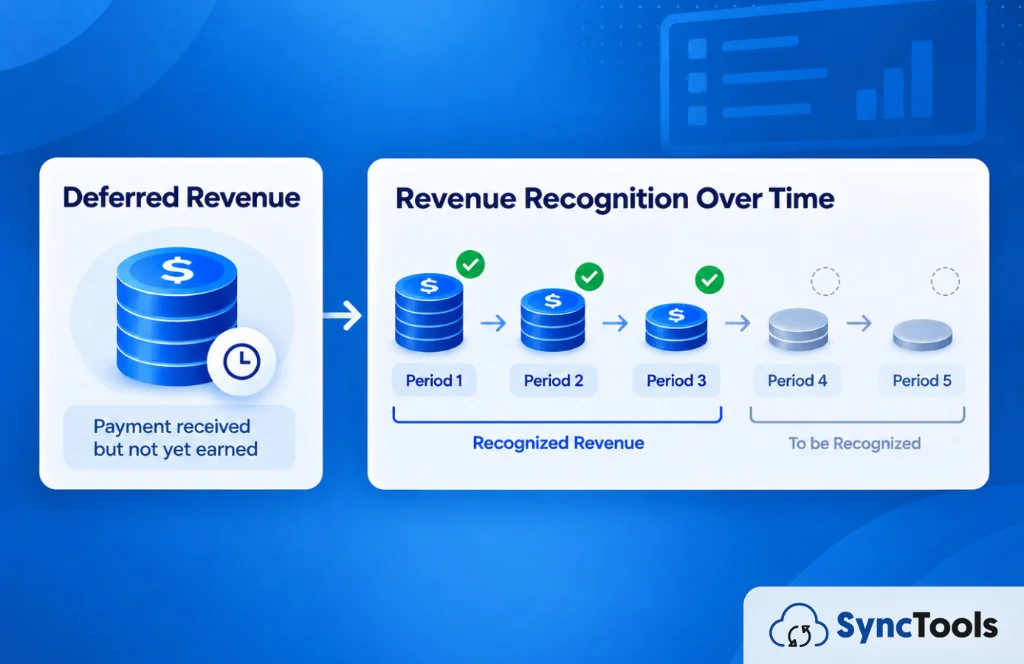
Deferred revenue represents money received from a customer before the related goods or services have been fully provided. Instead of recognizing the entire payment as revenue immediately, the business records an obligation and recognizes revenue when that obligation is fulfilled.
For eCommerce businesses, this can become particularly relevant with pre-orders, subscriptions, backorders, memberships, and other situations where payment and fulfillment happen at different times.
This guide explains what is deferred revenue, why it appears as a liability, how deferred revenue accounting works, and what it can look like in an eCommerce business.
What Is Deferred Revenue?
Deferred revenue is money received before a business has delivered the related goods or services. It is recorded as a liability until the revenue is earned.
Because the business has not yet completed its obligation, the amount generally cannot be treated as earned revenue immediately.
Instead, it is recorded as a liability until the promised product or service is provided.
Consider a simple example.
A customer pays an online retailer $500 in September for furniture that will not ship until October.
The retailer has received $500 in cash. However, if the criteria for revenue recognition have not yet been satisfied, the $500 is recorded as deferred revenue rather than sales revenue.
Once the relevant performance obligation is satisfied, the business can move the appropriate amount from deferred revenue into revenue.
Under IFRS 15, when a customer pays before the business transfers the promised goods or services, the business records a contract liability. Revenue is then recognized as the related performance obligation is satisfied.
Deferred Revenue Meaning in Simple Terms
The easiest way to understand the deferred revenue meaning is:
The customer has paid, but the business still owes the customer something.
Think of deferred revenue as revenue that is waiting to be earned.
The cash may already be sitting in the company's bank account, but accounting looks at more than when the money arrives. It also considers whether the business has actually delivered what the customer paid for.
How Does Deferred Revenue Work?
Deferred revenue usually involves two different events:
1. The customer pays the business
Cash is received, but the product or service is still outstanding.
2. The business fulfills its obligation
Once the required goods or services are delivered, the appropriate amount can be recognized as revenue.
For example, imagine an eCommerce brand accepts a $300 pre-order.
When the customer pays:
| Account | Debit | Credit |
|---|---|---|
| Cash / Clearing Account | $300 | |
| Deferred Revenue | $300 |
At this stage, cash increases, but revenue has not yet been recognized.
Later, when the product is fulfilled and the relevant revenue-recognition requirements are met:
| Account | Debit | Credit |
|---|---|---|
| Deferred Revenue | $300 | |
| Sales Revenue | $300 |
The liability decreases, and revenue is recognized.
The exact accounting treatment depends on the transaction, contract terms, applicable accounting standards, and the business's accounting policies.
Is Deferred Revenue a Liability?
Yes. Deferred revenue is generally recorded as a liability because the business has received payment but still owes goods or services to the customer.
Receiving the money creates an obligation.
Until that obligation is fulfilled, the business may have to:
- Deliver the promised product
- Provide the contracted service
- Continue providing access to a subscription
- Fulfill a prepaid order
- Potentially refund the customer under applicable terms
That outstanding obligation is why deferred revenue normally appears on the liability side of the balance sheet.
Why Is Deferred Revenue a Liability?
A common question is: Why is deferred revenue a liability if the company already has the money?
Because revenue recognition and cash receipt are not always the same event.
Suppose a customer pays $1,200 upfront for a 12-month subscription.
The business receives all $1,200 immediately. But assuming the service is provided evenly throughout the year, it may need to recognize the revenue over the service period rather than treating the entire $1,200 as revenue on day one.
The remaining unearned portion represents an obligation to continue providing the service.
This is why the business may initially record the payment as a liability and gradually reduce that liability as its obligations are fulfilled.
IFRS 15 describes a contract liability as an obligation to transfer goods or services to a customer where payment has already been received or is due.
Ready to Simplify Deferred Revenue Management?
Track deferred revenue, recognize revenue accurately, and stay on top of your financial obligations with smarter accounting workflows.
Is Deferred Revenue a Current Liability?
Deferred revenue can be a current liability, but it is not automatically current in every situation.
The classification generally depends on when the business expects to satisfy the underlying obligation.
If the product or service is expected to be delivered within the business's normal operating cycle or the applicable period for current-liability classification, the deferred amount will generally be presented as current.
For example:
A retailer receives payment today for a product shipping next month.
That deferred revenue would normally fall into the current portion of liabilities.
However, suppose a company receives an advance payment covering services extending over several years. Depending on the facts, accounting framework, and reporting requirements, part of the obligation may need to be classified separately from the current portion.
So when someone asks "is deferred revenue a current liability?", the more accurate answer is:
Often, yes, but the classification depends on when the underlying obligation is expected to be fulfilled.
Is Deferred Revenue an Asset?
No. Deferred revenue itself is not an asset.
The confusion often comes from the fact that the business receives cash.
Cash is an asset.
Deferred revenue is the corresponding liability created because the business still owes the customer a product or service.
For example, if a company receives $5,000 in advance:
Assets
Cash: +$5,000
Liabilities
Deferred Revenue: +$5,000
The cash increases the company's assets, while deferred revenue represents the obligation associated with that payment.
So for the question "is deferred revenue an asset?", it is important to separate the cash received from the accounting obligation created by the advance payment.
Deferred Revenue Accounting Explained
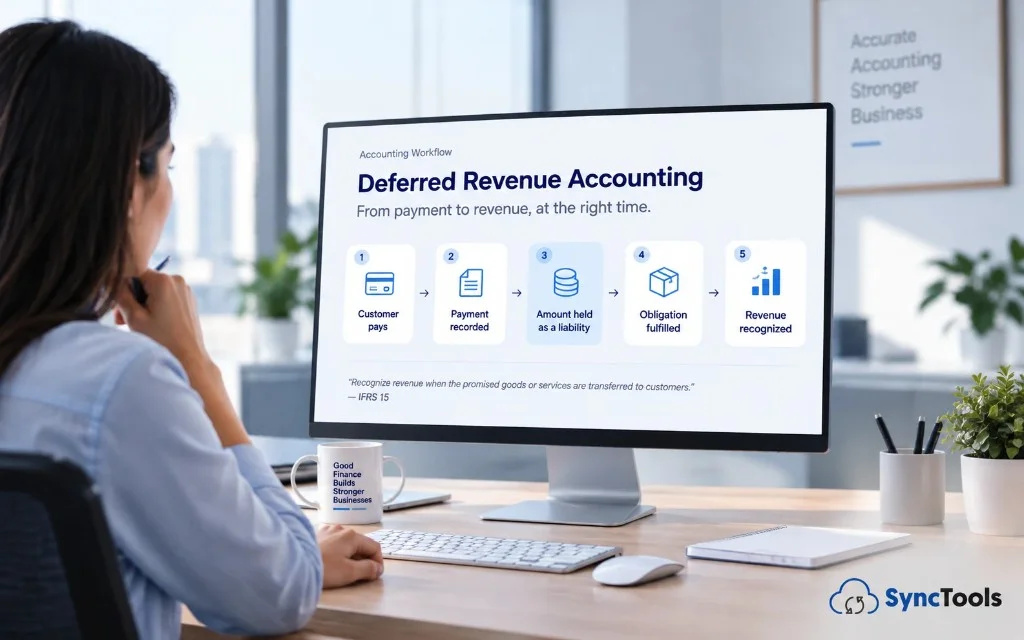
Deferred revenue accounting is based on the idea that revenue should be recognized when the appropriate revenue-recognition conditions are satisfied, rather than simply when payment reaches the bank.
Under IFRS 15, businesses recognize revenue to reflect the transfer of promised goods or services to customers. The framework includes identifying the contract and performance obligations, determining and allocating the transaction price, and recognizing revenue when those obligations are satisfied.
Although the details can become complex, a basic deferred revenue workflow looks like this:
For finance teams, the challenge becomes keeping these stages properly reflected in the accounting system.
This can become harder when a business has hundreds or thousands of orders moving through different fulfillment stages at the same time.
Deferred Revenue Example: Annual Subscription
Suppose a business sells an annual subscription for $1,200 and the customer pays the entire amount upfront.
Rather than immediately recognizing $1,200 of revenue, the accounting treatment may recognize revenue over the period in which the service is provided.
For a service provided evenly across 12 months, that could mean recognizing:
$1,200 ÷ 12 = $100 per month
Initially:
- Cash received: $1,200
- Deferred revenue: $1,200
After the first month:
- Revenue recognized: $100
- Remaining deferred revenue: $1,100
After six months:
- Revenue recognized to date: $600
- Remaining deferred revenue: $600
The liability continues decreasing as the company provides the service.
Common Examples of Deferred Revenue
Deferred revenue is not limited to software subscriptions. Businesses across different industries can encounter it.
Pre-orders
A customer may pay for a product weeks or months before it becomes available.
Until the appropriate fulfillment or revenue recognition condition is met, the payment may need to remain deferred.
Subscription Products
An eCommerce company may collect payment upfront for monthly subscription boxes or recurring products.
Revenue recognition should reflect when the underlying goods or services are provided.
Memberships
Businesses selling annual memberships often receive the full membership fee before completing all of the associated services.
Gift Cards
A business receives cash when the gift card is purchased but generally has an outstanding obligation until the card is redeemed or other applicable recognition criteria are met.
Backorders and Delayed Fulfillment
An online seller might accept payment even though an item will not ship immediately.
Depending on the circumstances and accounting policy, this can create deferred revenue until the relevant obligation has been fulfilled.
Deferred Income vs Deferred Revenue
Deferred income and deferred revenue are often used to describe the same basic concept: payment received before the related revenue has been earned.
You may also see terms such as:
- Unearned revenue
- Unearned income
- Contract liability
- Revenue received in advance
The terminology used can vary according to the accounting framework, accounting software, organization, or context.
The underlying idea remains similar: the business has received consideration but still has an obligation to the customer.
Deferred Revenue vs Accrued Revenue
Deferred revenue and accrued revenue can sound similar, but they represent almost opposite situations.
| Deferred Revenue | Accrued Revenue | |
|---|---|---|
| Payment received? | Yes, generally before revenue recognition | Not yet |
| Goods/services delivered? | Not fully | Generally already provided |
| Typical balance sheet classification | Liability | Asset |
| Main issue | Cash arrived before revenue was earned | Revenue was earned before cash arrived |
With deferred revenue, cash comes first.
With accrued revenue, earning the revenue comes first.
Understanding this distinction helps keep revenue, receivables, cash, and liabilities properly separated.
How Deferred Revenue Affects Financial Statements
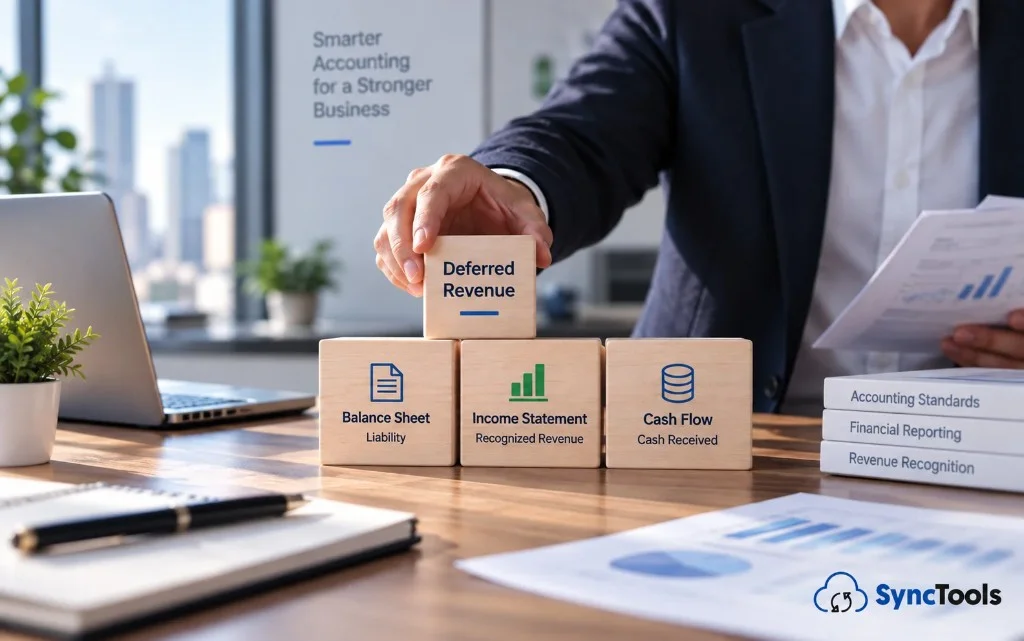
Deferred revenue can affect several parts of a company's financial reporting.
Balance Sheet
The unearned amount appears as a liability rather than revenue.
As the business satisfies its obligations, the liability decreases.
Income Statement
Deferred revenue does not become reported revenue simply because cash has been collected.
The appropriate portion reaches the income statement when the applicable revenue-recognition criteria are satisfied.
Cash Flow
The company may receive cash before recognizing the related revenue.
This means cash inflow and reported revenue can occur in different accounting periods.
That distinction is important when analyzing business performance. A strong month for customer collections does not always mean the same amount should appear as revenue for that month.
Why Deferred Revenue Matters for eCommerce Businesses
For an eCommerce business processing a few orders, tracking payment and fulfillment manually may seem manageable.
The situation changes at scale.
Consider a store handling:
- Pre-orders for upcoming products
- Subscription orders
- Partially fulfilled orders
- Products on backorder
- Multiple fulfillment dates
- Refunds and cancellations
- Thousands of Shopify transactions
- Accounting records in QuickBooks
The payment date and fulfillment date may not always match.
If every paid Shopify order is automatically treated as earned sales revenue without considering fulfillment and applicable revenue-recognition rules, accounting records may recognize revenue earlier than intended.
The finance team then has to identify which orders remain unfulfilled, calculate what should stay deferred, move amounts between accounts, and repeat the process when fulfillment occurs.
This is where transaction volume turns a straightforward accounting concept into an operational accounting problem.
How SyncTools Manages Deferred Revenue for Shopify and QuickBooks
SyncTools includes deferred revenue management for Shopify + QuickBooks Online, allowing businesses to account for qualifying payments based on Shopify fulfillment status.
A business first creates an appropriate Deferred Revenue account in QuickBooks and enables the deferred revenue configuration within SyncTools.
The business can then configure how fulfillment should affect recognition.
For example, SyncTools supports rules that can recognize revenue when:
- All items in an order have been fulfilled or shipped, or
- Individual items are fulfilled or shipped, allowing recognition based on fulfilled items.
Businesses can also configure the feature for all applicable Shopify orders or subscription orders, depending on their accounting requirements.
For an unfulfilled qualifying order, SyncTools can record the amount against the configured deferred revenue account.
When the applicable fulfillment condition is reached, SyncTools can generate the corresponding accounting entry that reduces deferred revenue and records the amount to the relevant sales account.
This connects Shopify fulfillment activity with the accounting workflow in QuickBooks without requiring finance teams to manually identify and reclassify every eligible transaction.
Learn how to configure it:
Shopify + QuickBooks Deferred Revenue Setup with SyncTools
Common Deferred Revenue Accounting Mistakes
Even though the concept is straightforward, several practical issues can affect deferred revenue accounting.
Recognizing Revenue as Soon as Payment Arrives
A bank deposit does not necessarily determine when revenue should be recognized.
The underlying transaction and performance obligations need to be considered.
Mixing Deferred Revenue With Accounts Receivable
Accounts receivable generally represents money customers owe the business.
Deferred revenue represents money the business has received while still owing something to the customer.
They serve very different accounting purposes.
Forgetting Partially Fulfilled Orders
One order can contain several products with different fulfillment dates.
Businesses need an accounting policy that determines how these situations should be handled.
Leaving Fulfilled Orders in Deferred Revenue
Revenue should not remain deferred indefinitely after the relevant obligation has been satisfied.
Regular reconciliation helps identify amounts that should have been recognized.
Applying One Rule to Every Transaction
Subscriptions, pre-orders, standard product sales, memberships, and long-term service arrangements may not have identical revenue-recognition requirements.
Your accounting treatment should reflect the nature of the transaction and the accounting framework applicable to your business.
Final Thoughts
Understanding what is deferred revenue starts with one simple distinction: receiving cash and earning revenue are not always the same thing.
When customers pay before the business has fulfilled its obligation, the amount may initially be recorded as deferred revenue, deferred income, or a contract liability.
That explains both why deferred revenue is a liability and why it should not be confused with an asset.
For eCommerce companies, the concept becomes increasingly important as pre-orders, subscriptions, backorders, and split fulfillments grow.
Having the right accounting rules, transaction mappings, fulfillment data, and accounting integration can help finance teams keep revenue recognition aligned with what is actually happening in the business.
SyncTools can connect Shopify fulfillment activity with QuickBooks deferred revenue accounting, helping businesses move qualifying transactions from deferred revenue to sales based on configured fulfillment rules.
Frequently Asked Questions About Deferred Revenue
What is deferred revenue?
Deferred revenue is payment received from a customer before the business has fulfilled the related goods or services. Until the applicable revenue-recognition conditions are satisfied, the amount is generally recorded as a liability rather than revenue.
Is deferred revenue a liability?
Yes. Deferred revenue is generally a liability because the company has received payment while still having an obligation to provide goods or services to the customer.
Why is deferred revenue a liability?
It is a liability because the business still owes the customer something. Once that obligation is satisfied, the relevant amount can be moved from deferred revenue into recognized revenue.
Is deferred revenue a current liability?
Deferred revenue is commonly recorded as a current liability when the related obligation is expected to be fulfilled within the applicable current period or operating cycle. Amounts associated with longer-term obligations may require different classification.
Is deferred revenue an asset?
No. Deferred revenue is a liability. The cash received from the customer is an asset, while deferred revenue represents the corresponding obligation to provide goods or services.
What is deferred income?
Deferred income is another term commonly used for income received before it has been earned. In many accounting contexts, deferred income and deferred revenue refer to the same general concept.
Where does deferred revenue appear on the balance sheet?
Deferred revenue normally appears in the liabilities section of the balance sheet. Depending on when the obligation will be satisfied, amounts may be classified according to applicable current and non-current presentation requirements.
When does deferred revenue become revenue?
Deferred revenue becomes recognized revenue when the business satisfies the applicable performance obligation and meets the relevant revenue-recognition criteria.
What is an example of deferred revenue in eCommerce?
A common example is a customer paying today for a pre-order that will ship later. Until the appropriate recognition condition is met, the payment may remain in a deferred revenue account rather than immediately being treated as sales revenue.
Can SyncTools manage deferred revenue for Shopify orders?
Yes. SyncTools provides deferred revenue configuration for Shopify + QuickBooks Online. Businesses can configure revenue handling based on Shopify order fulfillment, including rules for complete or partial fulfillment.
Ready to automate your accounting?
Connect Shopify, WooCommerce, or Linnworks to QuickBooks, Xero & more. Setup in minutes.